
IAE Academy

GATE 2022 EE GA Q.4: solution and answer

GATE 2022 · EEGA Q.4 · 1 mark · MCQ

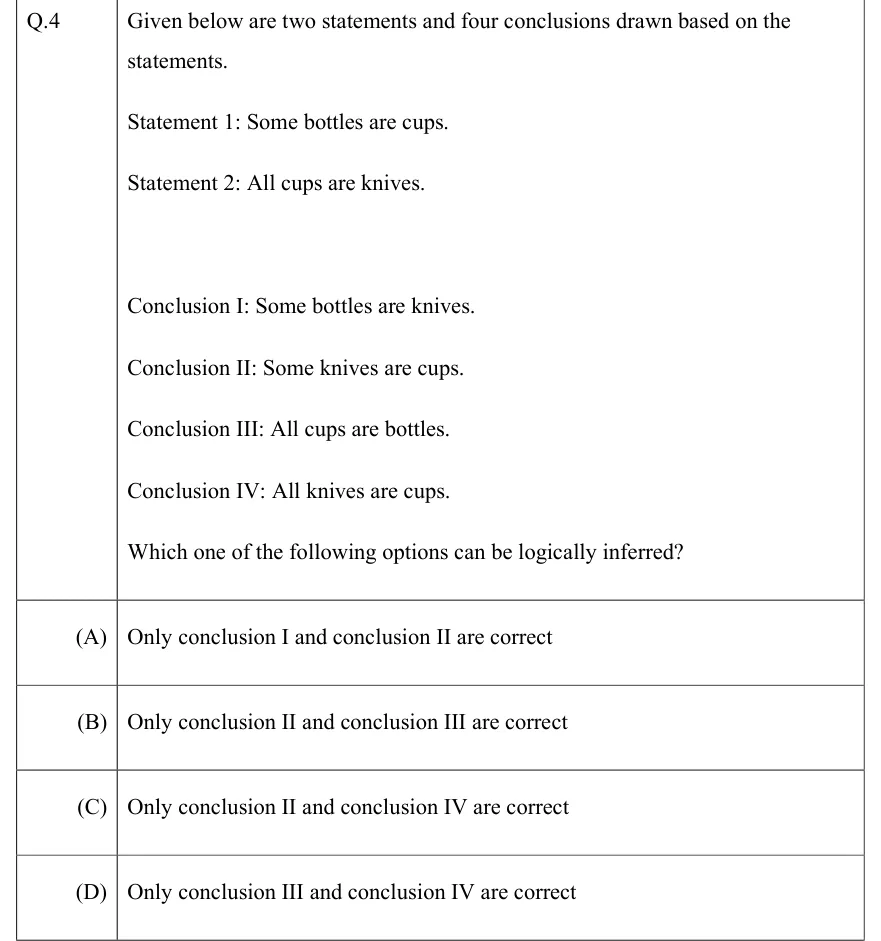
Given below are two statements and four conclusions drawn based on the statements.

Statement 1: Some bottles are cups.

Statement 2: All cups are knives.

Conclusion I: Some bottles are knives.

Conclusion II: Some knives are cups.

Conclusion III: All cups are bottles.

Conclusion IV: All knives are cups.

Which one of the following options can be logically inferred?

  1. (A)

    Only conclusion I and conclusion II are correct

  2. (B)

    Only conclusion II and conclusion III are correct

  3. (C)

    Only conclusion II and conclusion IV are correct

  4. (D)

    Only conclusion III and conclusion IV are correct
See the question in the paper

Answer and solution

ANSWER

Only conclusion I and conclusion II follow, so the answer is (A).

Official answer: ASource: Official answer key, GATE 2022 EE (IIT Kharagpur)

  1. Set up the sets. Statement 1 ('Some bottles are cups', a particular affirmative) says the Bottles and Cups circles overlap: at least one object is both a bottle and a cup. Statement 2 ('All cups are knives', a universal affirmative) puts the whole Cups circle inside the Knives circle.

  2. Conclusion I: take a bottle that is also a cup (Statement 1 guarantees one exists). It is a cup, and every cup is a knife (Statement 2), so it is a knife. That object is a bottle and a knife, so 'Some bottles are knives' must be true. The chain rule is 'Some B are C' + 'All C are K' gives 'Some B are K'. I follows.

  3. Conclusion II: Statement 1 guarantees at least one cup exists, and by Statement 2 that cup is a knife. That object is a knife and a cup, so 'Some knives are cups' must be true. This is the conversion of 'All C are K' into 'Some K are C'. II follows.

  4. Conclusion III: Statement 1 tells us only that some cups are bottles. Draw the Cups circle partly outside Bottles but still wholly inside Knives. Both statements still hold, yet some cup is not a bottle, so 'All cups are bottles' is not forced. III does not follow.

  5. Conclusion IV: 'All C are K' cannot be converted into 'All K are C'. The Knives circle may be larger and contain objects that are not cups, so 'All knives are cups' is not forced. IV does not follow.

  6. A single concrete check confirms both refutations. Let the bottles be , the cups and the knives . Statement 1 holds ( is a bottle and a cup) and Statement 2 holds (both cups are knives). But is a cup that is not a bottle, so III is false, and is a knife that is not a cup, so IV is false.

  7. Only conclusions I and II follow, which is option (A).

KEY IDEA

'Some B are C' + 'All C are K' gives 'Some B are K'. 'All C are K' converts only to 'Some K are C' (here cups exist because Statement 1 names one), never to 'All K are C'. A conclusion follows only if it is true in every diagram consistent with both statements, so one diagram that meets both statements but breaks the conclusion is enough to reject it.

WATCH OUT FOR

Reading a statement as reversible. Students take 'All cups are knives' to mean 'All knives are cups' (IV), or take 'Some bottles are cups' to mean 'All cups are bottles' (III). A universal affirmative converts only to a particular ('Some knives are cups'), and a particular gives only a particular.

From the GATE 2022 EE paper. Every question of this paper · Download the full paper · All 41 Reasoning questions, with notes

More Reasoning questions