
IAE Academy

GATE 2022 EE GA Q.9: solution and answer

GATE 2022 · EEGA Q.9 · 2 marks · MCQ

The letters P, Q, R, S, T and U are to be placed one per vertex on a regular convex hexagon, but not necessarily in the same order.

Consider the following statements:

  • The line segment joining R and S is longer than the line segment joining P and Q.
  • The line segment joining R and S is perpendicular to the line segment joining P and Q.
  • The line segment joining R and U is parallel to the line segment joining T and Q.

Based on the above statements, which one of the following options is CORRECT?

  1. (A)

    The line segment joining R and T is parallel to the line segment joining Q and S

  2. (B)

    The line segment joining T and Q is parallel to the line joining P and U

  3. (C)

    The line segment joining R and P is perpendicular to the line segment joining U and Q

  4. (D)

    The line segment joining Q and S is perpendicular to the line segment joining R and P
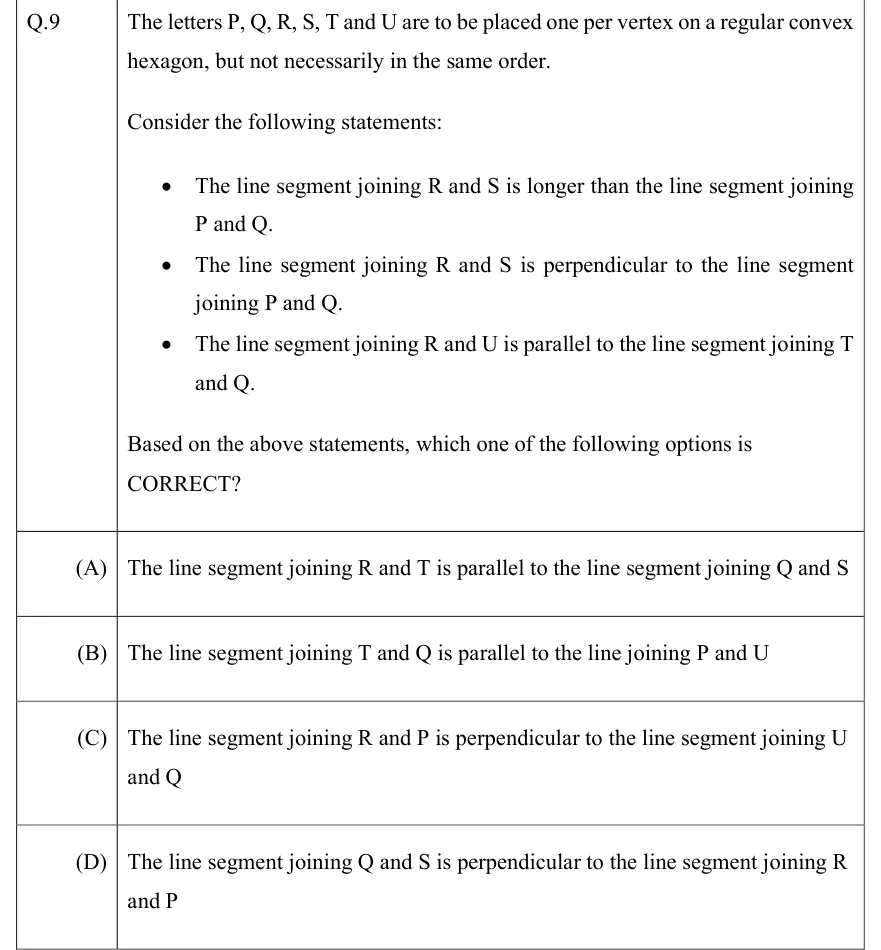
See the question in the paper

Answer and solution

ANSWER

(A) The line segment joining R and T is parallel to the line segment joining Q and S.

Official answer: ASource: Official answer key, GATE 2022 EE (IIT Kharagpur)

  1. Number the hexagon's vertices in order around it. A segment joining two vertices has one of three lengths: a side (adjacent vertices, length ), a short diagonal (one vertex skipped, ) or a long diagonal (opposite vertices, ).

  2. Direction rule for a regular hexagon: the segment joining vertices and has a direction fixed by . Two segments with the same value are parallel. Two segments whose values differ by are perpendicular.

  3. Statement 1 says RS is longer than PQ, so the pair (PQ, RS) is (side, short diagonal), (side, long diagonal) or (short diagonal, long diagonal).

  4. Side with long diagonal: a side has an odd sum, e.g. . A long diagonal has sum , which is also odd. Two odd sums cannot differ by (mod 6), so a side is never perpendicular to a long diagonal. Ruled out.

  5. Side with short diagonal: by symmetry take the side (sum ). It is perpendicular only to the chords with sum , namely and . Both share a vertex with the side, but R, S, P and Q are four different vertices. Ruled out.

  6. So PQ is a short diagonal and RS a long diagonal. By symmetry take (sum ). The perpendicular chords have sum , i.e. , , ; the only long diagonal among them is . So and .

  7. Statement 3 (RU TQ, so equal sums mod 6): checking the eight choices of , , leaves only two arrangements: (both sums ), or (sums and , both ). Going around the hexagon, these orders are P, S, Q, U, R, T and Q, S, P, T, R, U. Each is the mirror image of the other.

  8. Take the first arrangement (). (A) RT (sum ) and QS (sum ): parallel, because these are opposite sides. True.

  9. Check the others: (B) TQ (sum ) and PU (sum ) are two different long diagonals, which cross at the centre, so they are not parallel. (C) RP sum and UQ sum : they differ by , not , so not perpendicular. (D) QS sum and RP sum : they differ by , so not perpendicular. The mirror arrangement gives the same results. Only (A) holds.

KEY IDEA

In a regular hexagon with vertices numbered 1 to 6, the chord joining vertices i and j has a direction fixed by (i+j) mod 6: equal values mean parallel, values 3 apart mean perpendicular. The only way a longer segment can be perpendicular to a shorter one on four distinct vertices is a long diagonal perpendicular to a short diagonal. That fixes R and S up to order, and the parallel condition then pins the whole labelling down to one arrangement and its mirror image.

WATCH OUT FOR

Drawing one arrangement that satisfies the statements and reading the answer off it, without checking that it is forced. Here that works only because the two surviving labellings are mirror images. Students also often let RS be a side perpendicular to a short diagonal PQ, forgetting that such a pair always shares a vertex, which the four distinct letters rule out.

From the GATE 2022 EE paper. Every question of this paper · Download the full paper · All 41 Reasoning questions, with notes

More Reasoning questions