
IAE Academy

GATE 2024 EC GA Q.2: solution and answer

GATE 2024 · ECGA Q.2 · 1 mark · MCQ

P, Q, R, S, and T have launched a new startup. Two of them are siblings. The office of the startup has just three rooms. All of them agree that the siblings should not share the same room.

If S and Q are single children, and the room allocations shown below are acceptable to all,

[Figure: two room allocations]

then, which one of the given options is the siblings?
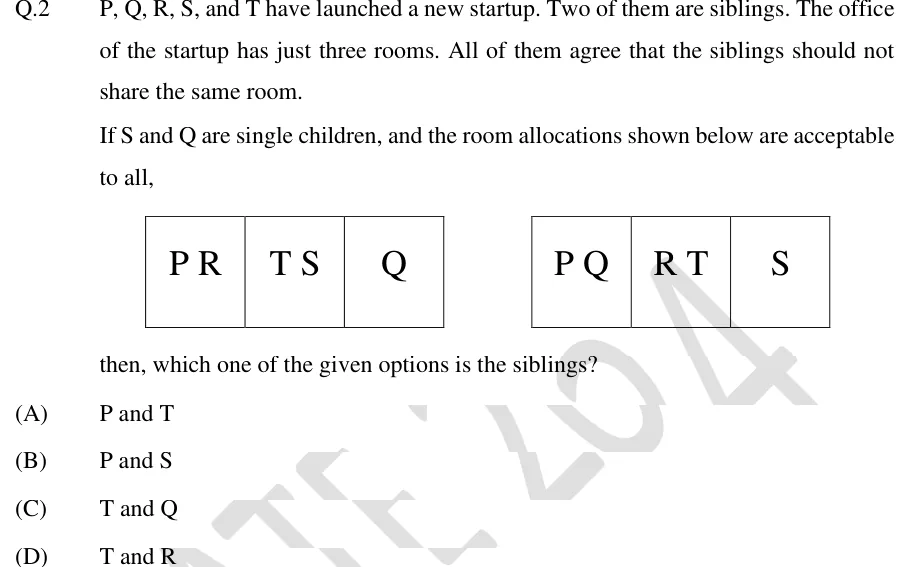
GATE 2024 EC GA question 2: Two separate diagrams side by side, each a row of three adjacent rectangular boxes (rooms).Tap to open full size
Figure from the GATE 2024 EC paper. It is part of the question.
Figure description

Two separate diagrams side by side, each a row of three adjacent rectangular boxes (rooms). Left diagram: first box contains "P R", second box contains "T S", third box contains "Q". Right diagram: first box contains "P Q", second box contains "R T", third box contains "S".

  1. (A)

    P and T

  2. (B)

    P and S

  3. (C)

    T and Q

  4. (D)

    T and R

Answer and solution

ANSWER

(A) P and T are the siblings.

Official answer: ASource: Official answer key, GATE 2024 EC (IISc Bengaluru)

  1. S and Q are single children, so neither of them has a sibling. The sibling pair must therefore come from the other three people: P, R and T. This rules out options (B) P and S and (C) T and Q straight away.

  2. From P, R and T only three pairs can be formed: P and R, R and T, and P and T.

  3. The rule is that the siblings never share a room. So if two people share a room in an allocation that everyone accepts, those two cannot be the siblings.

  4. First allocation (P R | T S | Q): P and R share a room, so P and R are not the siblings.

  5. Second allocation (P Q | R T | S): R and T share a room, so R and T are not the siblings. This rules out option (D) T and R.

  6. Only P and T are left. Check: P and T are in different rooms in both allocations, so both allocations are still acceptable. The siblings are P and T, option (A).

KEY IDEA

Use elimination. Single children cannot be in the sibling pair, and any two people who share a room in an accepted allocation cannot be the siblings. Remove every pair ruled out this way, and the one pair left is the answer.

WATCH OUT FOR

Reading the rule the wrong way round and picking a pair that shares a room (such as T and R, who share a room in the second allocation). Sharing a room rules a pair out; it does not make them siblings. Another slip is to forget that S and Q are single children and consider options (B) or (C).

From the GATE 2024 EC paper. Every question of this paper · Download the full paper · All 41 Reasoning questions, with notes

More Reasoning questions