
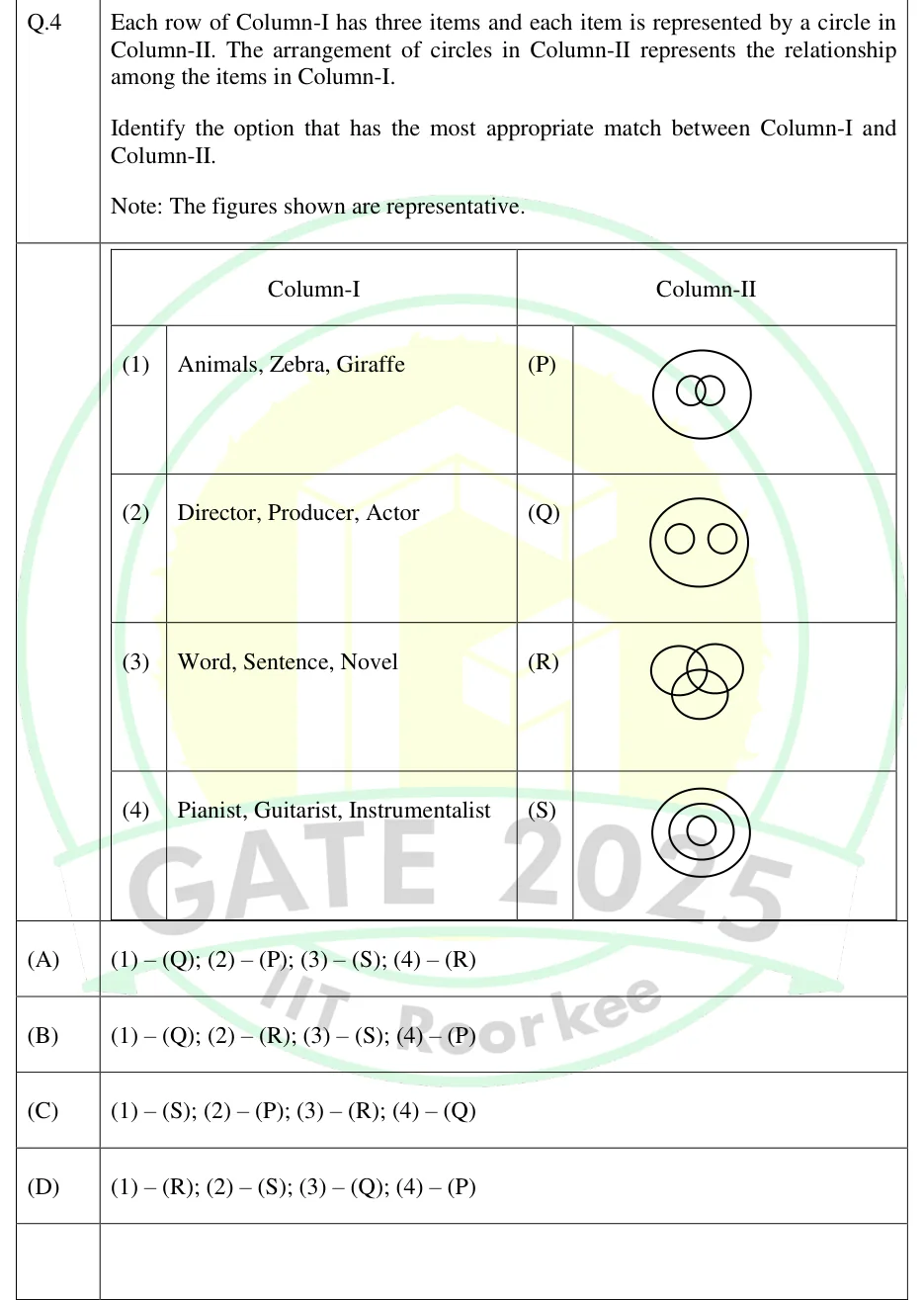
Each row of Column-I has three items and each item is represented by a circle in Column-II. The arrangement of circles in Column-II represents the relationship among the items in Column-I.
Identify the option that has the most appropriate match between Column-I and Column-II.
Note: The figures shown are representative.
| Column-I | Column-II |
|---|---|
| (1) Animals, Zebra, Giraffe | (P) Figure |
| (2) Director, Producer, Actor | (Q) Figure |
| (3) Word, Sentence, Novel | (R) Figure |
| (4) Pianist, Guitarist, Instrumentalist | (S) Figure |
 Tap to open full size
Figure description
Column-II has four circle diagrams, one per row. (P): one large circle with two small circles inside it, near its centre; the two small circles overlap each other. (Q): one large circle with two small circles inside it, side by side; the two small circles do not touch or overlap. (R): three circles of equal size arranged in a triangle (two on top, one below and between them), each overlapping the other two, with no circle enclosing another. (S): three concentric circles, small inside medium inside large, so each circle lies completely inside the next.
- (A)
(1) – (Q); (2) – (P); (3) – (S); (4) – (R)
- (B)
(1) – (Q); (2) – (R); (3) – (S); (4) – (P)
- (C)
(1) – (S); (2) – (P); (3) – (R); (4) – (Q)
- (D)
(1) – (R); (2) – (S); (3) – (Q); (4) – (P)