
IAE Academy

GATE 2022 EE GA Q.6: solution and answer

GATE 2022 · EEGA Q.6 · 2 marks · MCQ

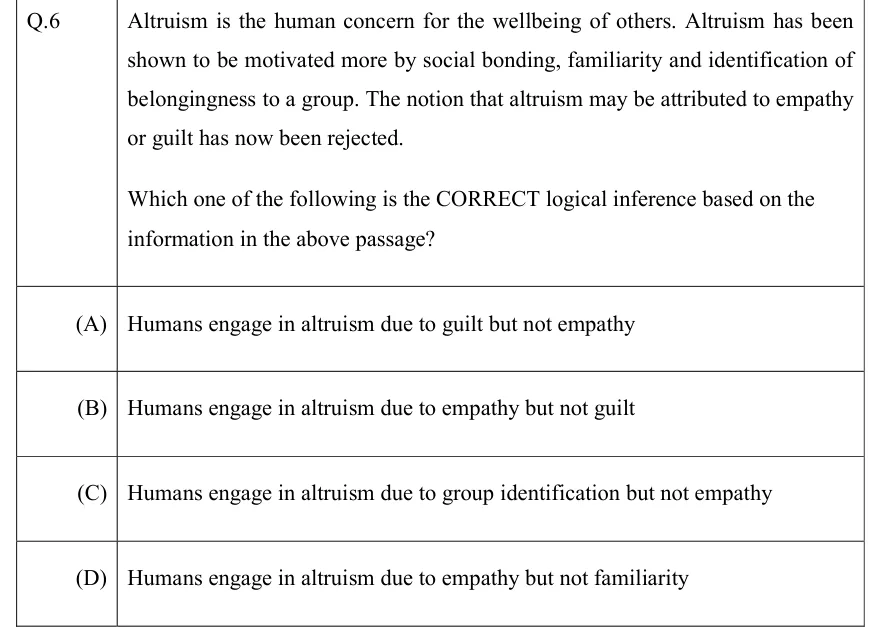
Altruism is the human concern for the wellbeing of others. Altruism has been shown to be motivated more by social bonding, familiarity and identification of belongingness to a group. The notion that altruism may be attributed to empathy or guilt has now been rejected.

Which one of the following is the CORRECT logical inference based on the information in the above passage?

  1. (A)

    Humans engage in altruism due to guilt but not empathy

  2. (B)

    Humans engage in altruism due to empathy but not guilt

  3. (C)

    Humans engage in altruism due to group identification but not empathy

  4. (D)

    Humans engage in altruism due to empathy but not familiarity
See the question in the paper

Answer and solution

ANSWER

The answer is (C): humans engage in altruism because of group identification, not empathy. The passage names group identification as a motivator and says empathy has been rejected as an explanation.

Official answer: CSource: Official answer key, GATE 2022 EE (IIT Kharagpur)

  1. List what the passage says motivates altruism: "social bonding, familiarity and identification of belongingness to a group".

  2. List what the passage says does not explain altruism: empathy and guilt. It says the idea that altruism "may be attributed to empathy or guilt has now been rejected".

  3. Inference rule: an option is a valid inference only if every part of it agrees with the passage. Any cause it accepts must be one the passage supports, and any cause it rules out must be one the passage rejects.

  4. (A) says altruism comes from guilt. The passage rejects guilt. Eliminate.

  5. (B) says altruism comes from empathy. The passage rejects empathy. Eliminate.

  6. (D) says altruism comes from empathy and not from familiarity. That is the reverse of the passage, which rejects empathy and names familiarity as a motivator. Eliminate.

  7. (C) says altruism comes from group identification, which the passage supports ("identification of belongingness to a group"), and not from empathy, which the passage rejects. Both halves agree with the passage, so (C) is the correct inference.

KEY IDEA

Split the passage into two lists: causes it accepts (social bonding, familiarity, group identification) and causes it rejects (empathy, guilt). An option is a valid inference only if every cause it accepts is on the first list and every cause it rules out is on the second.

WATCH OUT FOR

Picking (A) or (B) because each rejects one of empathy and guilt, and missing that each also accepts the other rejected cause. Another trap is checking only the first half of an option. (D)'s \"but not familiarity\" contradicts the passage as directly as its \"due to empathy\" does.

From the GATE 2022 EE paper. Every question of this paper · Download the full paper · All 18 Reading questions, with notes

More Reading questions