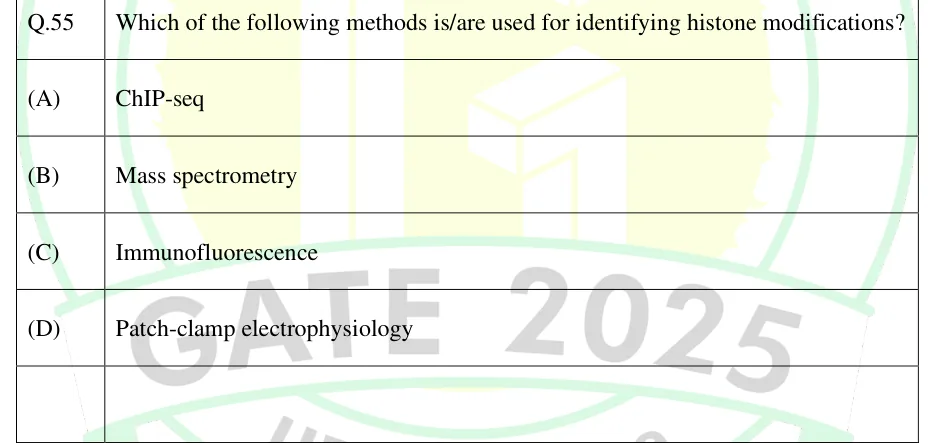
Which of the following methods is/are used for identifying histone modifications?
- (A)
ChIP-seq
- (B)
Mass spectrometry
- (C)
Immunofluorescence
- (D)
Patch-clamp electrophysiology

Which of the following methods is/are used for identifying histone modifications?
ChIP-seq
Mass spectrometry
Immunofluorescence
Patch-clamp electrophysiology
ANSWER
The correct answer is (A), (B) and (C) — ChIP-seq, Mass spectrometry, and Immunofluorescence are all used to identify histone modifications; Patch-clamp electrophysiology is not.
Official answer: A, B, CSource: Official answer key, GATE 2025 BT (IIT Roorkee)
This is an MSQ (one or more correct); evaluate each option on whether the named technique can detect/identify a chemical (post-translational) modification on a histone protein.
(A) ChIP-seq: a modification-specific antibody (e.g., anti-H3K27ac, anti-H3K4me3) immunoprecipitates chromatin bearing that mark, and sequencing the pulled-down DNA maps where the modification occurs genome-wide. This directly identifies histone modifications and their genomic location — CORRECT.
(B) Mass spectrometry: histone PTMs (acetylation, methylation, phosphorylation, etc.) each produce a characteristic, measurable mass shift on the modified residue. MS analysis of digested histone peptides identifies which residues carry which modification with high precision, and is the standard unbiased discovery method for histone PTMs — CORRECT.
(C) Immunofluorescence: modification-specific antibodies (e.g., anti-H3K9me3) conjugated to fluorophores visualize the presence and subcellular/chromatin localization of a histone modification directly in fixed cells — CORRECT.
(D) Patch-clamp electrophysiology measures ionic currents through membrane ion channels; it provides no biochemical or immunological readout for a covalent modification on a nuclear histone protein — INCORRECT.
Therefore the techniques that identify histone modifications are A, B and C.
KEY IDEA
Histone post-translational modifications (acetylation, methylation, phosphorylation, etc.) can be identified by antibody-based methods (ChIP-seq for genome-wide location, immunofluorescence for cellular localization) and by direct physical/chemical detection (mass spectrometry, which measures the mass shift the modification causes). Patch-clamp electrophysiology measures ion-channel currents across membranes and has no readout for a covalent chromatin modification.
WATCH OUT FOR
Confusing "identifying/detecting a modification" with "measuring gene expression" — some students wrongly include RT-PCR/qPCR-type reasoning or wrongly exclude ChIP-seq thinking it only maps genomic location, not the modification itself, when the antibody step is precisely what identifies the modification.
From the GATE 2025 BT paper. Every question of this paper · Download the full paper · All 9 Assays & electrophoresis questions, with notes