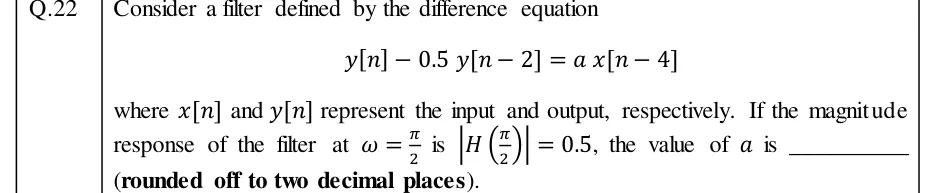
Consider a filter defined by the difference equation
where and represent the input and output, respectively. If the magnitude response of the filter at is , the value of is ________ (rounded off to two decimal places).

Consider a filter defined by the difference equation
where and represent the input and output, respectively. If the magnitude response of the filter at is , the value of is ________ (rounded off to two decimal places).
ANSWER
.
Official answer: 0.70 to 0.80Source: Official answer key, GATE 2024 IN (IISc Bengaluru)
Take the DTFT of both sides, using the time-shift property :
Frequency response: (The equivalent has poles at , inside the unit circle, so the causal filter is stable and its frequency response exists.)
At : and .
So
Magnitude condition:
The magnitude fixes only ; the value asked for is the positive gain, . (A gain of would give the same magnitude, since it only adds a phase of .)
KEY IDEA
Delays in the difference equation become factors in the frequency response. At , and , so the input delay has magnitude 1 and drops out, and the denominator becomes .
WATCH OUT FOR
Taking as at (it is ). That gives a denominator of and the wrong answer . Another mistake is thinking the delay changes the magnitude. It only adds phase, because at every frequency.
From the GATE 2024 IN paper. Every question of this paper · Download the full paper · All 2 FIR & IIR filters questions, with notes