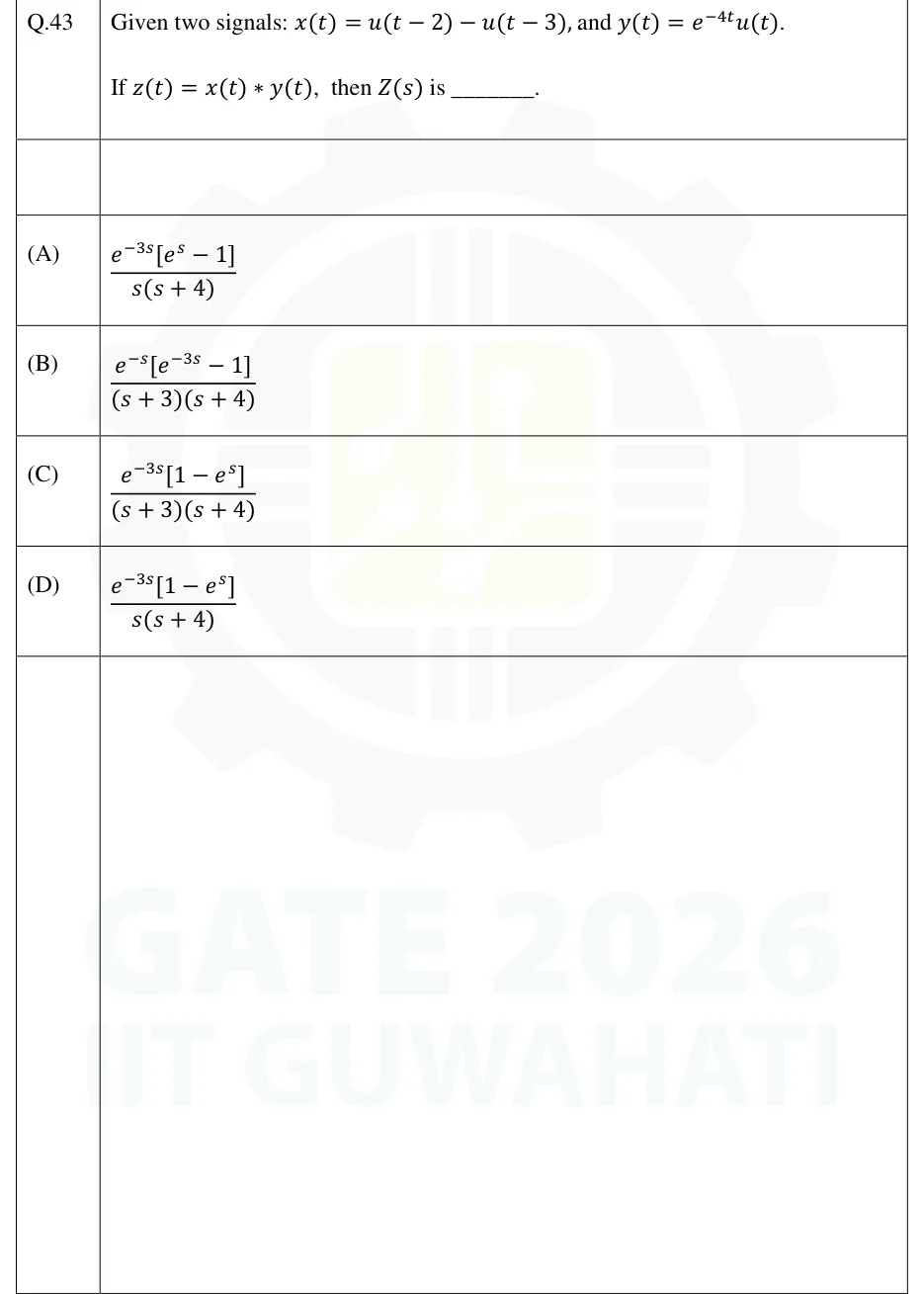
Given two signals: , and .
If , then is ________.
- (A)
- (B)
- (C)
- (D)

Given two signals: , and .
If , then is ________.
ANSWER
, which is option (A).
Official answer: ASource: Official answer key, GATE 2026 IN (IIT Guwahati)
Convolution property: convolution in time becomes multiplication in , so .
Time-shift property with : , so
Standard pair: , so .
Multiply:
Take out as a common factor: , so
Checking the other options: the denominator must be , because the rectangular pulse brings the factor . That rules out (B) and (C). (D) is exactly , since . The answer is (A).
KEY IDEA
Convolution in time becomes multiplication in . The pulse transforms to by the time-shift property, and transforms to . Taking out as a common factor puts the product in the printed form. Quick check: and , so and its area must be positive. The pulse has area and has area , so . Option (A) tends to as and (D) tends to .
WATCH OUT FOR
Getting the sign wrong when taking out the common factor. equals , not , and the wrong sign leads to (D). A second mistake is to shift the factor and get something like in the denominator, as in (B) and (C). Only the step functions pick up . The exponential is not shifted, so its transform stays .
From the GATE 2026 IN paper. Every question of this paper · Download the full paper · All 8 Laplace questions, with notes