
IAE Academy

GATE 2023 EC Q.50: solution and answer

GATE 2023 · ECQ.50 · 2 marks · MCQ

Let and be two band-limited signals having bandwidth rad/s each. In the figure below, the Nyquist sampling frequency, in rad/s, required to sample , is
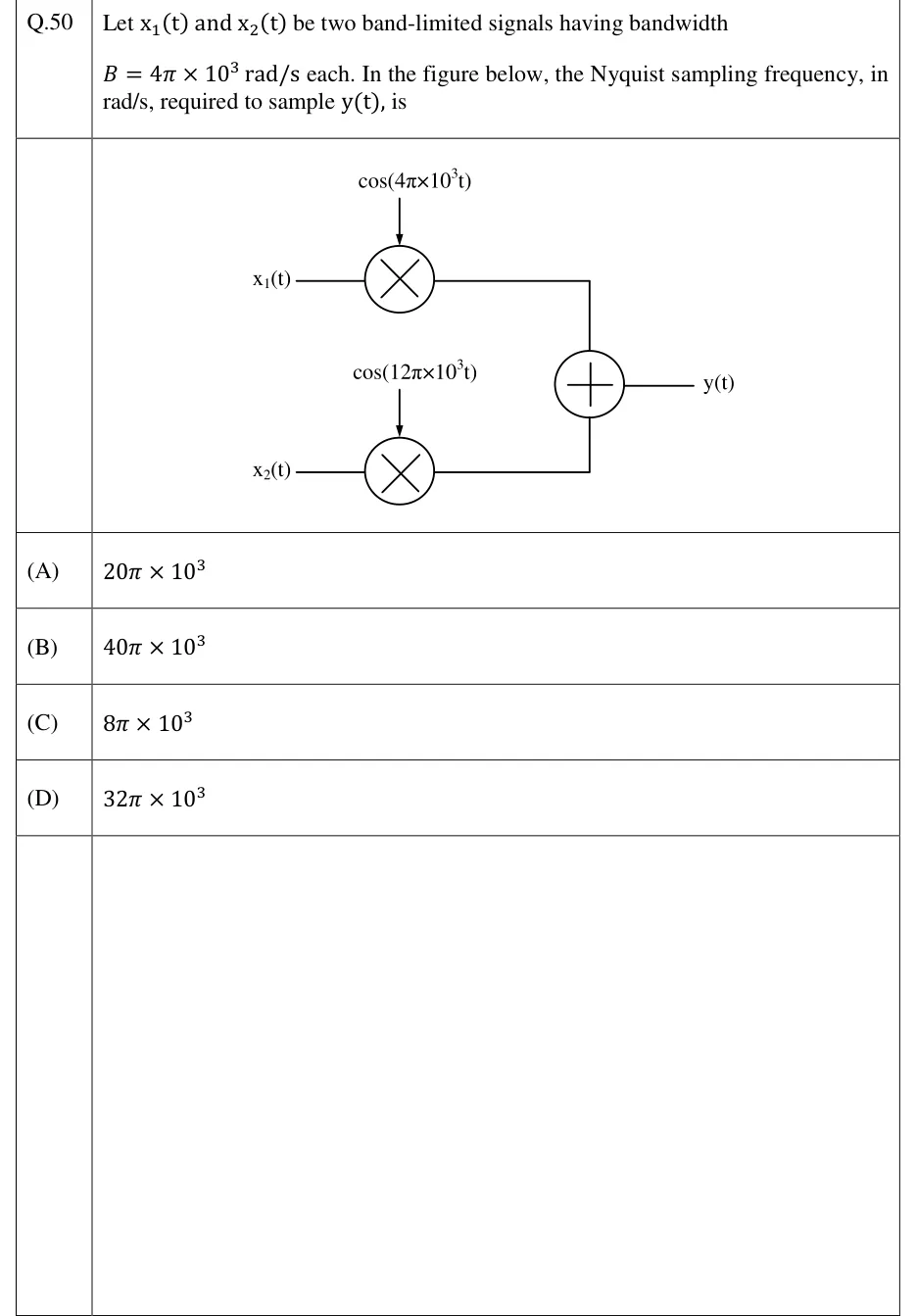
GATE 2023 EC question 50: Block diagram with two branches.Tap to open full size
Figure from the GATE 2023 EC paper. It is part of the question.
Figure description

Block diagram with two branches. Top branch: x_1(t) enters a multiplier (circle with X), whose other input, coming from above, is cos (4 π × 10^3 t). Bottom branch: x_2(t) enters a second multiplier, whose other input, coming from above, is cos (12 π × 10^3 t). The two multiplier outputs go into a summing junction (circle with +; neither input has a minus sign). The summer's output is y(t). So y(t) = x_1(t) cos (4 π × 10^3 t) + x_2(t) cos (12 π × 10^3 t).

  1. (A)

  2. (B)

  3. (C)

  4. (D)

Answer and solution

ANSWER

The Nyquist sampling frequency for is rad/s, which is option (D).

Official answer: DSource: Official answer key, GATE 2023 EC (IIT Kanpur)

  1. From the figure, . Each is low-pass with bandwidth , so for rad/s.

  2. Modulation property: . Multiplying by the cosine moves a copy of the spectrum to , and each copy still extends either side of its centre.

  3. Top branch, rad/s: the copies occupy rad/s.

  4. Bottom branch, rad/s: the copies occupy , that is rad/s.

  5. The adder adds the two spectra (the Fourier transform is linear). Together they fill rad/s with no gap, so is a low-pass signal whose highest frequency is rad/s.

  6. Nyquist sampling frequency for a low-pass signal:

  7. This is option (D).

KEY IDEA

Multiplying by shifts a baseband spectrum of bandwidth so it sits at . The highest frequency in is therefore the largest carrier plus : rad/s. The top branch fills the band from 0 up to , so there is no empty band that band-pass sampling could use, and the Nyquist rate is simply .

WATCH OUT FOR

Answering (option C), which ignores the fact that modulation moves the spectrum up to the carrier frequency. Another mistake is taking the DSB width as the one-sided extent above the carrier. That gives a highest frequency of , and doubling it gives (option B). A third is to apply band-pass sampling to the bottom branch alone. The sum also contains the top branch, which occupies to rad/s.

From the GATE 2023 EC paper. Every question of this paper · Download the full paper · All 8 Sampling questions, with notes

More Sampling questions