Sampling turns a continuous-time signal into a sequence of numbers; the sampling theorem says when those numbers still carry the whole signal, and reconstruction says how an ideal lowpass filter rebuilds it from them. The standard calculations — the Nyquist rate of a sum, product or square of signals, the apparent frequency of an aliased tone, the allowed cutoff of the reconstruction filter, the output when a sampled signal is filtered, the minimum rate for a bandpass signal — all follow from one picture: sampling repeats the spectrum at every multiple of fs, scaled by 1/Ts.
8 previous-year questions · 7 solved · 6 practice questions
Ideal sampling and the spectrum of the sampled signal
Conventions on this page. The Fourier transform is written in f (Hz), symmetric form: X(f)=∫−∞∞x(t)e−j2πftdt and x(t)=∫−∞∞X(f)ej2πftdf. In ω (rad/s) the forward transform is ∫x(t)e−jωtdt and the inverse carries 1/2π; the ω form of each result is given where you will meet it. sinc(x)=πxsin(πx) (normalised: sinc(0)=1, zeros at every nonzero integer). rect(x)=1 for ∣x∣<21 and 0 for ∣x∣>21;tri(x)=1−∣x∣ for ∣x∣≤1 and 0 otherwise. Ts is the sampling interval, fs=1/Ts the sampling rate in samples/s, ωs=2πfs. Digital frequency Ω is in rad/sample.
Ideal sampling multiplies x(t) by a unit impulse train of period Ts. Multiplication in time is convolution in frequency, and the transform of an impulse train is another impulse train — spacing fs, strength fs. Convolving X(f) with it places a copy of X(f) at every integer multiple of fs, each multiplied by fs=1/Ts.
So the sampled spectrum is periodic in f with period fs. Sampling in time makes the spectrum periodic, just as a periodic time signal has a line spectrum.
IMPULSE TRAIN AND ITS TRANSFORM
n=−∞∑∞δ(t−nTs)↔fsk=−∞∑∞δ(f−kfs)
In ω: the transform is ωs∑kδ(ω−kωs), with ωs=2π/Ts.
Replicas of X(f) at every multiple of fs, each scaled by 1/Ts. In ω:Xs(ω)=Ts1∑kX(ω−kωs) — the scale factor is still 1/Ts, not ωs.
EXAM TIP
The 1/Ts scaling is why the ideal reconstruction filter is specified with passband gain Ts: the two cancel and x(t) comes back at its original amplitude. If a question's filter has gain 1 instead, the output is fsx(t).
Put f=0 in the spectrum formula above. The first equality holds generally; the second needs X(kfs)=0 for every k=0, which a signal band-limited to fm<fs guarantees — the rate does not have to reach the Nyquist rate for this. It turns an infinite sum of sinc-type samples into a single transform value.
WORKED EXAMPLE
Evaluate n=−∞∑∞sinc2(3n).
▸ Solution
Read the terms as samples of x(t)=sinc2(t/3) taken at t=n, so Ts=1 s and fs=1 Hz.
sinc2(at)↔∣a∣1tri(af) with a=1/3 gives X(f)=3tri(3f): band-limited to fm=1/3 Hz, with X(0)=3.
fm=1/3<fs=1, so X(k)=0 for every k=0 and the sum is X(0)/Ts=3.
Direct check: sin2(πn/3)=3/4 unless 3 divides n (then it is 0), so the sum is 1+2⋅π29⋅43∑n≥1,3∤nn21=1+2π227⋅274π2=1+2=3, using ∑3∤n1/n2=6π2⋅98.
Answer: 3
The sampling theorem and the Nyquist rate
Let x(t) be band-limited: X(f)=0 for ∣f∣>fm. The replica centred at kfs occupies [kfs−fm,kfs+fm]. Neighbouring replicas do not overlap when fs−fm≥fm, that is fs≥2fm, and then a lowpass filter can cut out the baseband copy intact.
The empty band fs−2fm between the top of the baseband copy and the bottom of the first replica is the guard band. A real filter needs it to roll off from passband to stopband.
SAMPLING THEOREM
fs≥2fm(Ts≤2fm1)
For a signal band-limited to fm Hz. If X(f) has impulses exactly at ±fm (the highest component is a sinusoid), the inequality must be strict: fs>2fm.
NYQUIST RATE AND NYQUIST INTERVAL
fN=2fm,TN=fN1=2fm1
Nyquist rate = twice the HIGHEST frequency present (equal to twice the bandwidth only for a lowpass signal). Nyquist interval = the largest allowed sampling interval. In rad/s: ωN=2ωm.
rect(f/2B)=1 for ∣f∣<B;tri(f/2B)=1−∣f∣/(2B) for ∣f∣≤2B. So sin(2πBt)/(πt) reaches B Hz and its square reaches 2B Hz. In ω:sin(Wt)/(πt) is band-limited to W rad/s =W/2π Hz, so its Nyquist rate is W/π samples/s.
Most Nyquist-rate questions give a signal built from simpler ones. Find the highest frequency of the combination with the rules below, then double it. Let x be band-limited to B,x1 to B1 and x2 to B2 (all lowpass). The entries are the band edges in general; a special cancellation can only make them smaller.
Signal
Highest frequency
Nyquist rate
x1(t)+x2(t)
max(B1,B2)
2max(B1,B2)
x1(t)x2(t)
B1+B2
2(B1+B2)
x2(t)
2B
4B
xn(t)
nB
2nB
x1(t)∗x2(t) (convolution)
min(B1,B2)
2min(B1,B2)
x(at)
∣a∣B
2∣a∣B
x(t−t0),dtdx,∫xdt
B
2B
x(t)cos(2πf0t) (a bandpass signal when f0>B)
f0+B
2(f0+B)
x(t) after an ideal LPF of cutoff fc<B
fc
2fc
EXAM TIP
Multiplication in time adds band limits (the spectra convolve); convolution in time keeps the smaller one (the spectra multiply). Squaring doubles the band limit: cos2(2πf0t)=21+21cos(4πf0t) contains 2f0.
EXAM TIP
Convert to Hz before anything else. cos(1000πt) is a 500 Hz tone, not 1000 Hz. A missing factor of 2π is the commonest slip in these questions.
EXAM TIP
A periodic signal with finitely many harmonics has Nyquist rate 2× its highest harmonic, not its fundamental. A time-limited signal (a rectangular or triangular pulse) is never band-limited: its Nyquist rate is infinite, and some aliasing is unavoidable unless it is filtered first.
WORKED EXAMPLE
Let x1(t)=πtsin(200πt) and x2(t)=[πtsin(300πt)]2. Find the Nyquist rate of (a) x1(t)+x2(t), (b) x1(t)x2(t), (c) x1(t)cos(2000πt).
▸ Solution
sin(200πt)/(πt)=sin(2π⋅100t)/(πt) is a rectangle in frequency reaching B1=100 Hz.
sin(300πt)/(πt) reaches 150 Hz. Squaring convolves its spectrum with itself, so x2 reaches B2=2×150=300 Hz.
(a) Sum: highest frequency max(100,300)=300 Hz, so the Nyquist rate is 600 Hz.
(b) Product: highest frequency 100+300=400 Hz, so the Nyquist rate is 800 Hz.
(c) cos(2000πt) is a 1000 Hz carrier. The product occupies 900 to 1100 Hz; highest frequency 1100 Hz, Nyquist rate 2200 Hz. (It is a bandpass signal of bandwidth 200 Hz, so bandpass sampling could go as low as 2(1100)/⌊1100/200⌋=440 Hz — see the bandpass section.)
Answer: (a) 600 Hz, (b) 800 Hz, (c) 2200 Hz
Aliasing and the apparent frequency
If fs<2fm, the replica centred at fs overlaps the baseband copy. A component at f0 has images at ∣f0−kfs∣ for every integer k, and one of them lands in [0,fs/2]. After sampling, that image is indistinguishable from a genuine tone at that frequency — the two produce identical samples. This is aliasing.
fs/2 is the folding frequency: the part of the spectrum above it is reflected back into [0,fs/2], like a sheet folded at fs/2, then at fs, and so on.
APPARENT (ALIASED) FREQUENCY
fa=∣f0−kfs∣,k=integer nearest to fsf0,0≤fa≤2fs
The frequency an ideal reconstruction filter of cutoff fs/2 outputs for a tone at f0 sampled at fs. If f0<fs/2,k=0 and fa=f0 — no aliasing.
Finding the output tone, with its phase, when the samples pass through an ideal lowpass filter of cutoff fs/2 and passband gain Ts (so amplitudes carry over unchanged):
Write the tone in Hz: Acos(2πf0t+θ).
Reduce modulo fs:f′=f0−mfs with m chosen so that 0≤f′<fs.
If f′<fs/2: the output is Acos(2πf′t+θ) — same phase. (If f′=0 this is the DC value Acosθ.)
If fs/2<f′<fs: the tone folds. The output frequency is fa=fs−f′ and the phase changes sign: Acos(2πfat−θ). A sine also flips sign: Asin(2πf′t+θ) becomes −Asin(2πfat−θ).
If f′=fs/2 exactly: the samples are A(−1)ncosθ and the phase is lost (next formula).
Tones that land on the same frequency add as phasors. If the filter's passband gain is 1 instead of Ts, multiply the result by fs.
SINUSOID SAMPLED AT EXACTLY TWICE ITS FREQUENCY
fs=2f0:x(nTs)=Acos(πn+θ)=A(−1)ncosθ
The samples depend only on Acosθ: a sine (θ=−π/2) gives all-zero samples, and different (A,θ) pairs give identical samples. A sinusoid therefore needs fs>2f0 strictly. In the spectrum, the impulses at ±f0 fall on each other's replicas at ±fs/2.
WORKED EXAMPLE
x(t)=3sin(1400πt)+2sin(2600πt) is sampled by an ideal impulse train at fs=1 kHz, and the samples are passed through an ideal lowpass filter with cutoff 500 Hz and passband gain Ts. Find the output y(t).
▸ Solution
In Hz the tones are 700 Hz and 1300 Hz. Both exceed fs/2=500 Hz, so both alias.
700 Hz: f′=700>500, so it folds to fa=1000−700=300 Hz and the sine changes sign: 3sin(1400πt)→−3sin(600πt).
1300 Hz: f′=1300−1000=300<500, so no fold: 2sin(2600πt)→2sin(600πt).
Check on the samples (t=n/1000):3sin(1.4πn)=3sin(1.4πn−2πn)=−3sin(0.6πn) and 2sin(2.6πn)=2sin(0.6πn).
Both land on 300 Hz and add: −3+2=−1. The gain Ts cancels the 1/Ts from sampling.
Answer:y(t)=−sin(600πt) — a 300 Hz tone of amplitude 1; the two inputs partly cancel.
EXAM TIP
Never add the amplitudes of tones that alias onto the same frequency without checking which of them folded: a folded tone has its phase reversed, so they can reinforce or cancel.
EXAM TIP
In rad/s the same rule reads ωa=∣ω0−kωs∣ with ωs=2π/Ts. Pick one unit and stay in it.
Reconstruction with an ideal lowpass filter
When fs>2fm, an ideal lowpass filter with passband gain Ts keeps the baseband copy and rejects every replica. Its cutoff only has to lie in the empty band between the top of the baseband copy (fm) and the bottom of the first replica (fs−fm).
In time, the filter's impulse response is a sinc, so the output is a sum of sinc pulses, one centred on each sampling instant and weighted by that sample — the sinc interpolation formula. With fc=fs/2 each sinc is zero at all the other sampling instants, so the rebuilt signal passes exactly through the samples.
RECONSTRUCTION FILTER AND ALLOWED CUTOFF
Hr(f)=Tsrect(2fcf),fm<fc<fs−fm
Passband gain Ts restores the amplitude. The range exists only when fs>2fm; at fs=2fm it shrinks to the single value fc=fs/2. The endpoints are also acceptable when X(f) has no impulses at ±fm.
With fc=fs/2:hr(0)=1 and hr(nTs)=0 for every n=0.
SINC INTERPOLATION FORMULA
x(t)=n=−∞∑∞x(nTs)sinc(Tst−nTs)
Exact for x(t) band-limited to fm<fs/2, using fc=fs/2. For any other allowed cutoff: x(t)=2fcTs∑nx(nTs)sinc(2fc(t−nTs)).
ENERGY FROM THE SAMPLES
∫−∞∞∣x(t)∣2dt=Tsn=−∞∑∞∣x(nTs)∣2
For an energy signal band-limited to fm with fs≥2fm. It follows from the sinc interpolation formula: the pulses sinc((t−nTs)/Ts) are mutually orthogonal and each has energy Ts.
Below the Nyquist rate no cutoff works. The overlapping parts of adjacent replicas are already added together inside Xs(f), and no filter can separate a sum. The ideal LPF with cutoff fs/2 then outputs the original components below fs/2 plus the aliases found in the previous section.
EXAM TIP
Check a given cutoff against both ends of the gap. A cutoff above fs−fm lets in the bottom of the first replica even though fs>2fm; for a tone at f0 sampled at fs, the first replica tone sits at fs−f0, and the filter must stop it.
Practical sampling: natural, flat-top, aperture effect and anti-aliasing
Real samplers use pulses of finite width τ, not impulses. In natural sampling a switch passes x(t) for τ seconds in every Ts, so the pulse tops follow the signal. In flat-top sampling (sample-and-hold) the value at the sampling instant is held constant for τ, so the pulse tops are flat.
The difference shows up in the spectrum: natural sampling weights each replica by a constant, while flat-top sampling multiplies the whole spectrum, baseband copy included, by sinc(fτ).
NATURAL SAMPLING
Xns(f)=Tsτk=−∞∑∞sinc(Tskτ)X(f−kfs)
x(t) times a unit-height rectangular pulse train (width τ, period Ts, pulses centred on nTs).ck=(τ/Ts)sinc(kτ/Ts) are the pulse train's Fourier-series coefficients — one constant per replica. The baseband copy is (τ/Ts)X(f), undistorted; an ideal LPF with gain Ts/τ recovers x(t).
FLAT-TOP (SAMPLE-AND-HOLD) SAMPLING
Xft(f)=Tsτsinc(fτ)e−jπfτk=−∞∑∞X(f−kfs)
Impulse samples convolved with the hold pulse rect((t−τ/2)/τ) (width τ, starting at each sampling instant), whose transform is τsinc(fτ)e−jπfτ. The factor varies with f, so the baseband copy itself is distorted — the aperture effect — and delayed by τ/2.
Attenuation relative to DC, worst at the top of the band f=fm. The equaliser, placed with the reconstruction filter, undoes the magnitude distortion; the delay τ/2 is simply left in. The effect is small when τ≪Ts: with τ/Ts=0.1 the loss even at fs/2 is under 0.04 dB.
Flat-top with τ=Ts: each sample is held until the next, giving a staircase. It droops across the band (needs a 1/sinc equaliser) and passes attenuated images (needs a smoothing lowpass filter).
Property
Ideal (impulse)
Natural
Flat-top
Pulse top
impulse of strength x(nTs)
follows x(t) for τ
held at x(nTs) for τ
Weight on replica k
1/Ts
(τ/Ts)sinc(kτ/Ts), a constant
(τ/Ts)sinc(fτ)e−jπfτ, varies with f
Baseband copy
exact, scaled by 1/Ts
exact, scaled by τ/Ts
distorted by sinc(fτ), delayed by τ/2
Recovery
ideal LPF, gain Ts
ideal LPF, gain Ts/τ
ideal LPF, gain Ts/τ, plus 1/sinc(fτ) equaliser
Anti-aliasing filter. An analog lowpass filter placed before the sampler, removing signal and noise above the wanted band so that nothing can fold into it. It cannot work after the sampler: once a component has folded it sits at a legitimate in-band frequency.
Its transition band may run from fm up to fs−fm. A component at f between fs/2 and fs−fm folds to fs−f, which lies between fm and fs/2 — outside the wanted band [0,fm], so a later filter that keeps only [0,fm] removes it. A component in [fs−fm,fs+fm] (and likewise near 2fs,3fs, …) folds into [0,fm], so the filter must stop everything from fs−fm upward. This is why practical systems sample faster than 2fm: the guard band is room for real filters to roll off.
WORKED EXAMPLE
A signal band-limited to 4 kHz is sampled at 10 kHz. Find the aperture-effect attenuation at 4 kHz, relative to DC, in dB, for (a) flat-top pulses of width τ=25μs and (b) a zero-order hold (τ=Ts).
▸ Solution
Ts=1/(10 kHz)=100μs. The attenuation factor at f=4 kHz is ∣sinc(fτ)∣.
(a) fτ=4000×25×10−6=0.1, so sinc(0.1)=0.1πsin(0.1π)=0.31420.3090=0.9836, and 20log100.9836=−0.14 dB.
(b) fτ=4000×100×10−6=0.4, so sinc(0.4)=0.4πsin(0.4π)=1.25660.9511=0.7568, and 20log100.7568=−2.42 dB.
Narrow pulses make the aperture effect negligible. The full-interval hold needs an equaliser gain of 1/0.7568≈1.32 at 4 kHz.
Answer: (a) about −0.14 dB; (b) about −2.42 dB
Bandpass sampling
A bandpass signal occupies only fL≤∣f∣≤fH, with bandwidth B=fH−fL. Sampling at 2fH always works, but much lower rates can too: the shifted copies of the positive and negative bands only have to avoid the original band — they may sit in the empty space between −fL and fL or above fH. The minimum depends on how many whole bandwidths fit under fH.
MINIMUM BANDPASS SAMPLING RATE
fs,min=⌊fH/B⌋2fH,B=fH−fL
⌊⋅⌋ is the greatest-integer function. If fH is an integer multiple of B,fs,min=2B. In general 2B≤fs,min<4B.
ALL ALIAS-FREE UNIFORM SAMPLING RATES
k2fH≤fs≤k−12fL,k=1,2,…,⌊BfH⌋
For k=1 the upper limit is ∞: ordinary sampling at fs≥2fH. Rates in the gaps between these windows alias, so a rate above the minimum is not automatically safe.
WORKED EXAMPLE
A bandpass signal occupies 18 kHz to 25 kHz. Find the minimum sampling rate that avoids aliasing, and decide whether fs=20 kHz is acceptable.
20 kHz lies in the gap between 18 and 25 kHz, so it aliases. Check: the negative band [−25,−18] kHz shifted by 2fs=40 kHz lands on [15,22] kHz, overlapping the original [18,25] kHz.
Answer:fs,min≈16.67 kHz; 20 kHz is not acceptable (it causes aliasing).
EXAM TIP
The Nyquist rate is 2fmax by definition. The bandpass formula answers a different question — the lowest rate at which a bandpass signal can be sampled without aliasing. For m(t)cos(2πfct) with m band-limited to fm, the Nyquist rate is 2(fc+fm), while the bandpass minimum uses fH=fc+fm and B=2fm. Read which one is asked.
From continuous to discrete frequency, and sampling followed by filtering
The samples x[n]=x(nTs) form a discrete-time signal. Its DTFT is the sampled spectrum with the frequency axis relabelled: a continuous-time frequency f (Hz) or ω (rad/s) appears at the digital frequency Ω=ωTs=2πf/fs rad/sample. The folding frequency fs/2 maps to Ω=π, and the fs-periodicity of Xs(f) becomes the 2π-periodicity of the DTFT.
CT TO DT FREQUENCY MAPPING
Ω=ωTs=fs2πfrad/sample,f=2πΩfs
One-to-one only on the baseband, ∣Ω∣≤π↔∣f∣≤fs/2. cos(2πf0t) sampled gives cos(Ω0n) with Ω0=2πf0/fs; reduce Ω0 modulo 2π into (−π,π] to read off the alias.
PERIODICITY OF A SAMPLED SINUSOID
x[n]=Acos(2πfsf0n+θ)is periodic only iffsf0=qp(integers, lowest terms, q>0);then N=q
A continuous-time sinusoid is always periodic; its samples need not be — cos(n), from f0/fs=1/2π, never repeats. Examples: 1 kHz sampled at 3 kHz gives p/q=1/3,N=3; 700 Hz sampled at 1 kHz gives 7/10,N=10. A sum of such sequences with periods N1 and N2 repeats every lcm(N1,N2) samples.
Xc(ω) is the continuous-time transform in ω (rad/s). This is Xs(ω) evaluated at ω=Ω/Ts.
DISCRETE-TIME PROCESSING OF A CT SIGNAL
Heff(ω)={H(ejωTs),0,∣ω∣<ωs/2∣ω∣>ωs/2
Sampler at fs, then an LTI discrete-time system H(ejΩ), then ideal reconstruction (cutoff fs/2, gain Ts). Valid when x(t) is band-limited below fs/2. A DT cutoff Ωc acts as a CT cutoff fc=Ωcfs/(2π): at fs=8 kHz, Ωc=π/4 gives fc=1 kHz.
Sampling followed by a bandpass filter. The impulse-sampled signal contains every replica, so a bandpass filter after the sampler can select a replica instead of the baseband copy — sampling used as frequency translation. The output can sit at a frequency the input never contained. That is not aliasing; aliasing is a replica landing inside the band the reconstruction filter keeps. Work line by line.
Procedure: sample, then filter.
Write x(t) as spectral lines: Acos(2πf0t+θ) has 2Aejθ at +f0 and 2Ae−jθ at −f0.
Impulse sampling copies every line to kfs±f0 for all integers k, with strength multiplied by fs. (For natural sampling, multiply by that replica's weight ck instead.)
Keep the lines inside the filter's passband — a real filter passes the + and − bands together — and multiply by its gain.
Pair each line at +f with its mirror at −f to form a real cosine. A line at kfs+f0 keeps phase θ; a line at kfs−f0 (with k≥1) came from the −f0 line and carries −θ.
Add everything that lands on the same frequency as phasors.
WORKED EXAMPLE
x(t)=2cos(2000πt+π/6) is sampled by an ideal impulse train at fs=3 kHz. The sampled signal passes through an ideal bandpass filter with gain Ts for 3.5 kHz≤∣f∣≤5.5 kHz and zero elsewhere. Find the output y(t).
▸ Solution
x(t) is a 1 kHz tone: lines ejπ/6 at +1 kHz and e−jπ/6 at −1 kHz.
The sampled spectrum has lines at 3k±1 kHz — at 1, 2, 4, 5, 7, 8, … kHz and their negatives — each multiplied by fs.
The passband keeps 4 kHz (=3+1, from the +1 kHz line, phase +π/6) and 5 kHz (=6−1, from the −1 kHz line, phase −π/6). The gain Ts cancels the factor fs.
Pairing with the mirror lines at −4 and −5 kHz gives 2cos(8000πt+π/6) and 2cos(10000πt−π/6).
Answer:y(t)=2cos(8000πt+π/6)+2cos(10000πt−π/6)
EXAM TIP
A DT sinusoid cos(Ω0n) is unchanged when Ω0 changes by 2π, and cos((2π−Ω0)n)=cos(Ω0n). These two identities are aliasing and folding seen from the discrete-time side; use them to check any apparent-frequency answer.
PREVIOUS-YEAR QUESTIONS
8 questions from the EC, EE and IN papers
Try each question first, then open the answer. One shows the official answer only. We placed each question under a topic ourselves; the exam paper does not label topics.
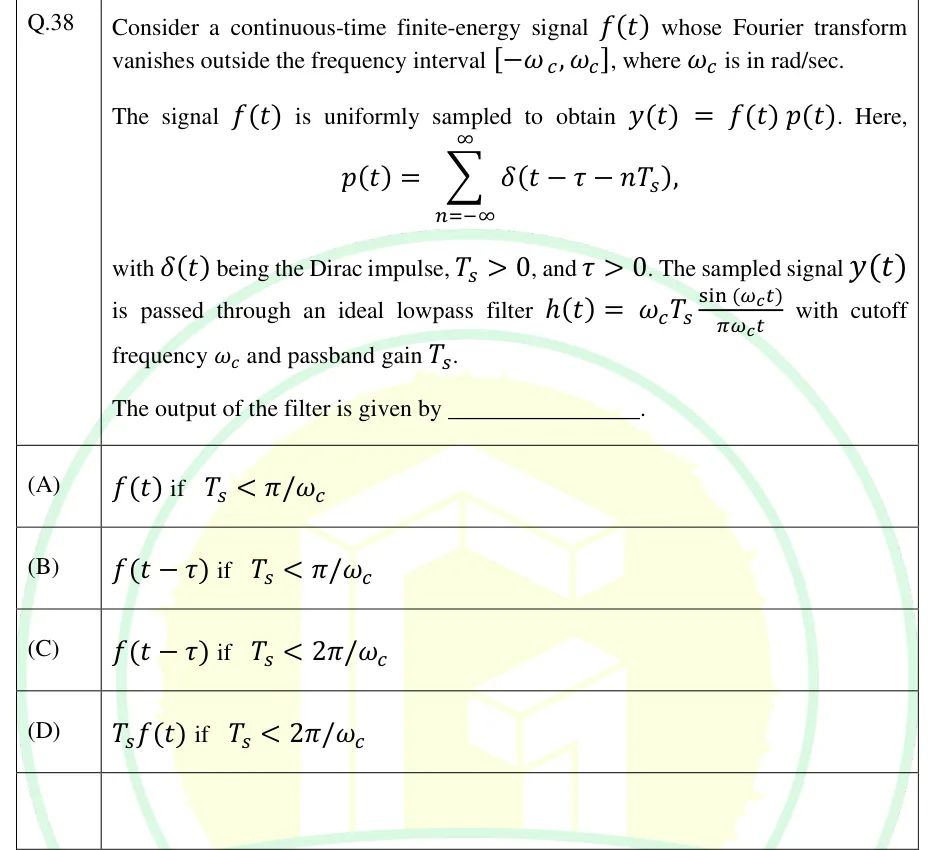
Consider a continuous-time finite-energy signal f(t) whose Fourier transform vanishes outside the frequency interval [−ωc,ωc], where ωc is in rad/sec.
The signal f(t) is uniformly sampled to obtain y(t)=f(t)p(t). Here, p(t)=n=−∞∑∞δ(t−τ−nTs), with δ(t) being the Dirac impulse, Ts>0, and τ>0. The sampled signal y(t) is passed through an ideal lowpass filter h(t)=ωcTsπωctsin(ωct) with cutoff frequency ωc and passband gain Ts.
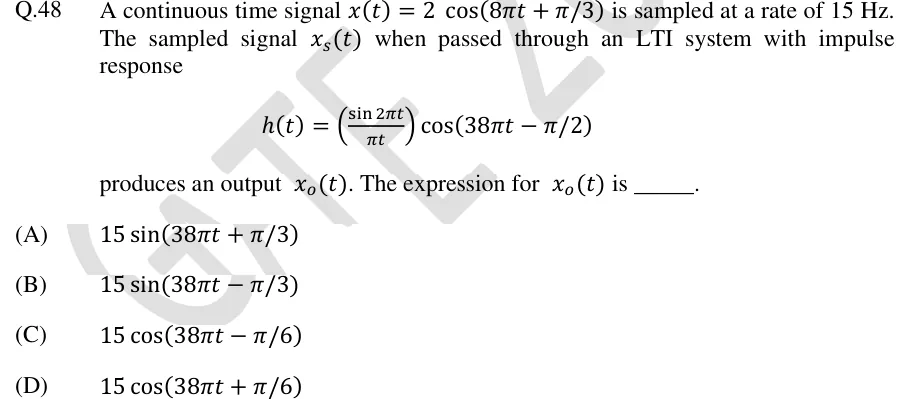
A continuous time signal x(t)=2cos(8πt+π/3) is sampled at a rate of 15 Hz. The sampled signal xs(t) when passed through an LTI system with impulse response
h(t)=(πtsin2πt)cos(38πt−π/2)
produces an output xo(t). The expression for xo(t) is ______.
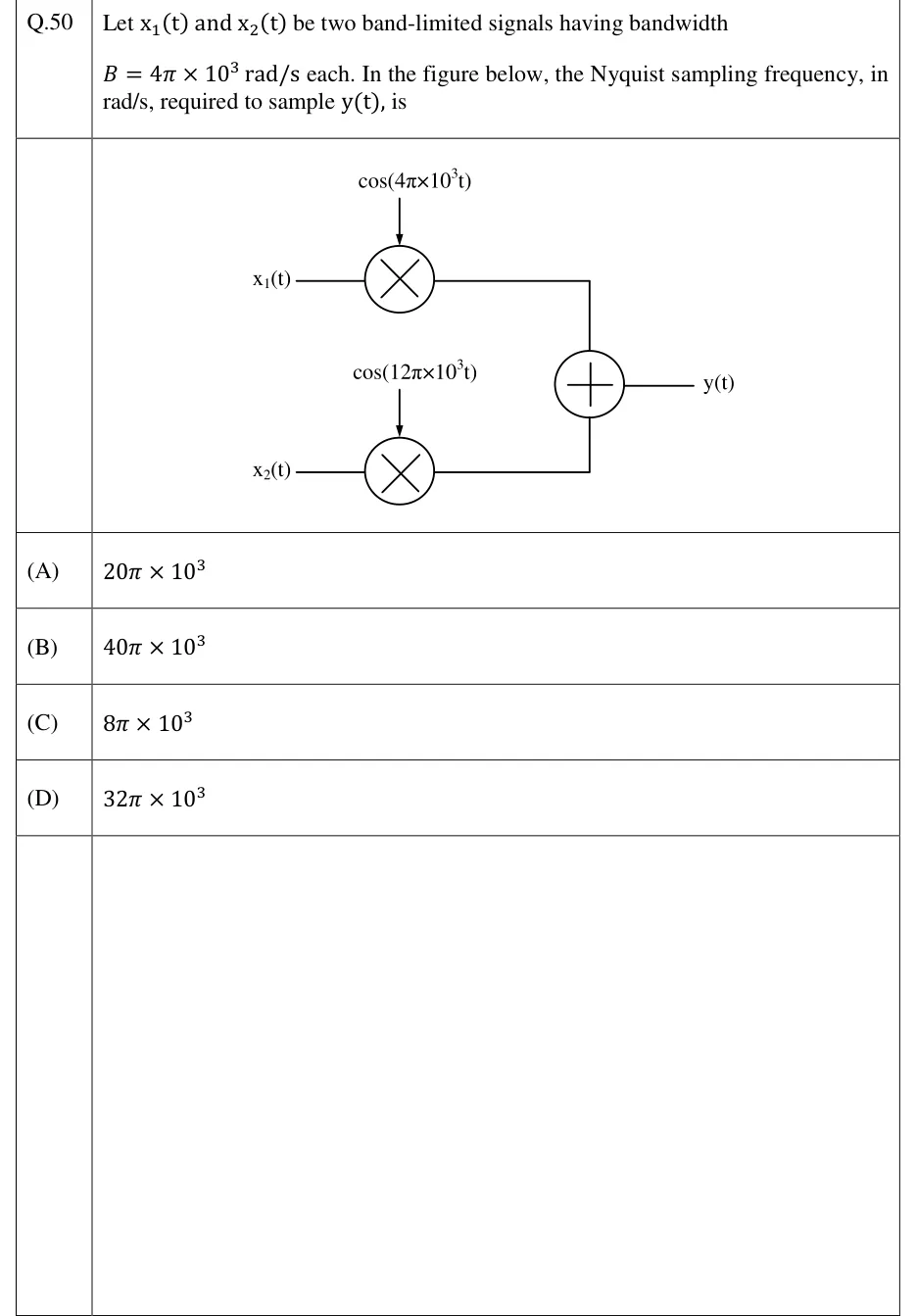
Let x1(t) and x2(t) be two band-limited signals having bandwidth B=4π×103 rad/s each. In the figure below, the Nyquist sampling frequency, in rad/s, required to sample y(t), is
Tap to open full sizeFigure from the GATE 2023 EC paper. It is part of the question.Figure description
Block diagram with two branches. Top branch: x_1(t) enters a multiplier (circle with X), whose other input, coming from above, is cos (4 π × 10^3 t). Bottom branch: x_2(t) enters a second multiplier, whose other input, coming from above, is cos (12 π × 10^3 t). The two multiplier outputs go into a summing junction (circle with +; neither input has a minus sign). The summer's output is y(t). So y(t) = x_1(t) cos (4 π × 10^3 t) + x_2(t) cos (12 π × 10^3 t).
A sinusoid of 10 kHz is sampled at 15 k samples/s. The resulting signal is passed through an ideal low pass filter (LPF) with cut-off frequency of 25 kHz. The maximum frequency component at the output of the LPF (in kHz) is ____
▸Official answer
Official answer: 25Source: Official answer key, GATE 2020 IN (IIT Delhi)
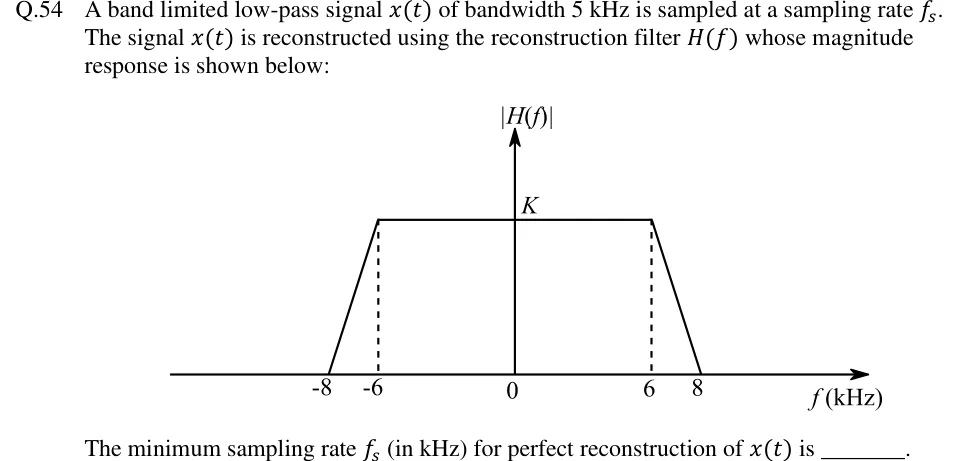
A band limited low-pass signal x(t) of bandwidth 5 kHz is sampled at a sampling rate fs. The signal x(t) is reconstructed using the reconstruction filter H(f) whose magnitude response is shown below:
[Figure]
The minimum sampling rate fs (in kHz) for perfect reconstruction of x(t) is ______.
Tap to open full sizeFigure from the GATE 2018 EC paper. It is part of the question.Figure description
Plot of |H(f)| (vertical axis) against f (kHz) (horizontal axis). The magnitude response is a symmetric trapezoid centred at f = 0: it is flat at height K for -6 ≤ f ≤ 6 kHz (dashed vertical lines drop from the corners at f = -6 and f = 6), falls linearly from K to 0 between f = 6 and f = 8 kHz on the right and between f = -6 and f = -8 kHz on the left, and is zero for |f| ≥ 8 kHz. Axis labels marked: -8, -6, 0, 6, 8 on the frequency axis; K on the vertical axis.
Let x(t)=πtsin(100πt)+cos(240πt) and y(t)=x2(t). The Nyquist rate of y(t) (twice its highest frequency) is
(A)
240 Hz
(B)
340 Hz
(C)
480 Hz
(D)
960 Hz
▸ Answer and solution
Answer: (C)
sin(100πt)/(πt)=sin(2π⋅50t)/(πt) is band-limited to 50 Hz.
cos(240πt) is a 120 Hz tone, so x(t) reaches 120 Hz.
Squaring doubles the band limit: y(t) reaches 240 Hz (the term 21cos(480πt) from cos2(240πt) is present; the cross term reaches only 120+50=170 Hz and the squared sinc only 100 Hz).
Nyquist rate =2×240=480 Hz.
PRACTICE 22 marks · MSQ
A real bandpass signal has its spectrum confined to 30 kHz≤∣f∣≤38 kHz. It is sampled uniformly by an ideal impulse train. Which of the following sampling rates avoid aliasing, so that the signal can be recovered exactly by an ideal bandpass filter?
(A)
19.5 kHz
(B)
22 kHz
(C)
28 kHz
(D)
70 kHz
▸ Answer and solution
Answer: (A), (C)
B=38−30=8 kHz and ⌊fH/B⌋=⌊4.75⌋=4.
Alias-free windows 2fH/k≤fs≤2fL/(k−1), in kHz: k=4:19≤fs≤20;k=3:25.33≤fs≤30;k=2:38≤fs≤60;k=1:fs≥76.
19.5 kHz lies in the k=4 window and 28 kHz in the k=3 window, so both are valid.
22 kHz (between 20 and 25.33) and 70 kHz (between 60 and 76) lie in gaps. Check 70 kHz: the band [−38,−30] kHz shifted by +70 kHz lands on [32,40] kHz, overlapping [30,38] kHz.
PRACTICE 31 mark · NAT
The value of n=−∞∑∞πnsin(πn/4), with the n=0 term taken as its limiting value 1/4, is ________.
▸ Answer and solution
Answer:1
The terms are the samples at t=n (Ts=1 s, fs=1 Hz) of x(t)=πtsin(πt/4)=πtsin(2π⋅81t).
By the sinc-form pair with B=1/8 Hz, X(f)=rect(4f): band-limited to 1/8 Hz, with X(0)=1.
fm=1/8<fs=1 Hz, so X(k)=0 for every k=0 and the sum equals X(0)/Ts=1.
Check: ∑n≥1sin(nα)/n=(π−α)/2 for 0<α<2π; with α=π/4 the full sum is 41+π2⋅83π=41+43=1.
PRACTICE 42 marks · NAT
The signal x(t)=4cos(2000πt) is multiplied by a periodic rectangular pulse train of unit height, pulse width τ=50μs and period Ts=200μs, with the pulses centred at t=nTs (natural sampling). The product passes through an ideal bandpass filter of unit gain for 3.5 kHz≤∣f∣≤4.5 kHz and zero elsewhere. The amplitude of the output sinusoid is ________ (round off to two decimal places).
▸ Answer and solution
Answer:0.9 (accepted range ±0.01)
fs=1/Ts=5 kHz and the duty cycle is d=τ/Ts=0.25. The pulse train's Fourier-series coefficients are ck=dsinc(kd), with sinc(x)=sin(πx)/(πx).
x(t) has lines of strength 2 at ±1 kHz. The product has lines at 5k±1 kHz: 1, 4, 6, 9, … kHz and their negatives.
Only the 4 kHz pair is in the passband: +4=5−1 (from k=1) and −4=−5+1 (from k=−1), each of strength 2c1 since c−1=c1.
The output is 2×(2c1)cos(8000πt)=4c1cos(8000πt), amplitude 4×0.2251=0.90 (exactly 22/π).
PRACTICE 51 mark · NAT
The signal x(t)=5cos(5200πt+π/4) is sampled by an ideal impulse train at 1000 samples/s, and the samples are passed through an ideal lowpass filter with cutoff 500 Hz and passband gain Ts. The output is a single sinusoid. Its frequency, in Hz, is ________.
▸ Answer and solution
Answer:400
5200π=2π×2600, so f0=2600 Hz.
Reduce modulo fs:f′=2600−2(1000)=600 Hz.
600>fs/2=500, so the tone folds to fa=1000−600=400 Hz, with its phase reversed: the output is 5cos(800πt−π/4).
PRACTICE 61 mark · MSQ
Which of the following statements are TRUE?
(A)
In natural sampling with a rectangular pulse train, the replica centred at kfs is X(f−kfs) multiplied by a constant that depends on k but not on f.
(B)
In flat-top sampling with pulse width τ, the baseband part of the sampled spectrum is X(f) multiplied by a factor whose magnitude is proportional to ∣sinc(fτ)∣.
(C)
Sampling x(t)=cos(2πf0t) at exactly fs=2f0, with samples at t=nTs, gives all-zero samples.
(D)
An anti-aliasing filter placed after the sampler removes aliasing that has already occurred.
▸ Answer and solution
Answer: (A), (B)
A — true: natural sampling multiplies x(t) by a pulse train with Fourier-series coefficients ck=(τ/Ts)sinc(kτ/Ts), giving ∑kckX(f−kfs); each ck depends on k only.
B — true: flat-top sampling convolves the impulse samples with a hold pulse whose transform is τsinc(fτ)e−jπfτ, which multiplies the baseband copy (aperture effect).
C — false: cos(2πf0⋅n/(2f0))=cos(πn)=(−1)n. It is a sine that gives all-zero samples.
D — false: a folded component occupies an in-band frequency and cannot be filtered out afterwards; the anti-aliasing filter must come before the sampler.