IAE Academy

GATE EC · EE · IN

z-transform and discrete-time systems

The z-transform turns a sequence into a function of a complex variable , so that convolution becomes multiplication and a difference equation becomes an algebraic equation. These notes cover recovering a sequence from and its region of convergence (ROC), reading causality and stability off the pole positions, solving difference equations with initial conditions, getting the frequency response on the unit circle and, for IN, finding the pulse transfer function of a sampled-data loop.

12 previous-year questions · 12 solved · 6 practice questions

1. Definition, conventions and the region of convergence

The z-transform does for sequences what the Laplace transform does for continuous-time signals. Convolution becomes multiplication, a linear constant-coefficient difference equation becomes an algebraic equation, and the poles of a system function decide causality and stability. Conventions in these notes: the transform is bilateral unless it is marked unilateral (). Discrete-time frequency is the normalised digital frequency in rad/sample, and the DTFT is .

BILATERAL Z-TRANSFORM

Defined only for in the ROC, the set of where the sum converges absolutely. Always quote together with its ROC.

UNILATERAL Z-TRANSFORM

Ignores for ; it equals the bilateral transform of . When it exists, its ROC is the exterior of a circle, (including ), so it is usually not written. For a causal sequence the two transforms are identical.

LINK TO THE DTFT

Valid only when the ROC contains the unit circle . is periodic in with period .

Writing turns the sum into . So the z-transform is the DTFT of weighted by , and whether it converges absolutely depends only on . That is why every ROC is a ring centred on the origin. The ROC is part of the answer: the same algebraic with a different ROC is a different sequence.

Properties of the ROC

For a rational the poles are what bound the ROC.

  1. The ROC is a ring centred on the origin; may be and may be .

  2. The ROC contains no poles. For a rational its boundaries pass through poles (or it extends to or ).

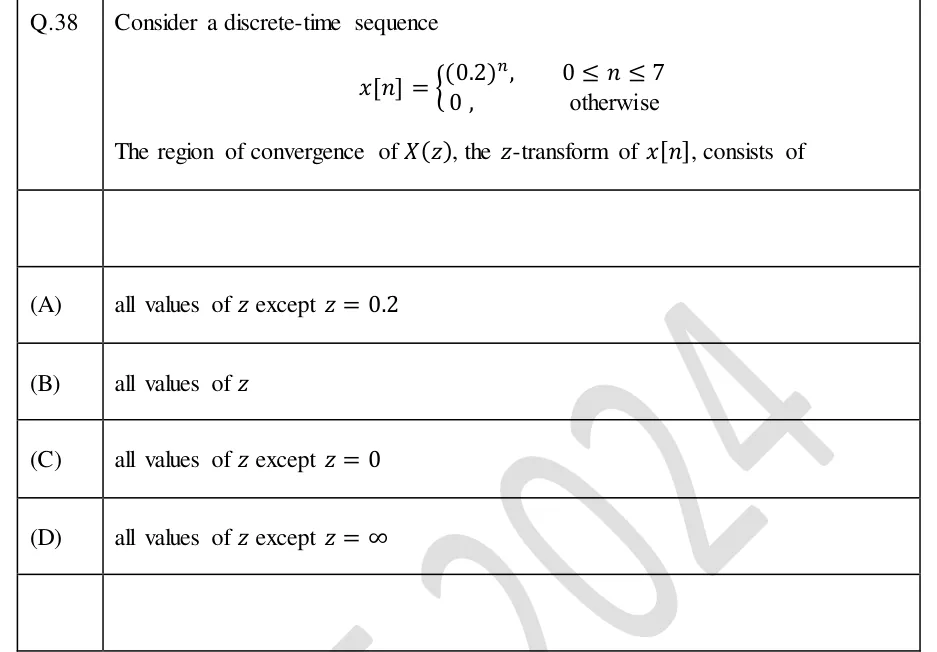
  3. Finite-length : the ROC is the whole z-plane, except if for some , and except if for some .

  4. Right-sided (zero for ): the ROC is outside the outermost pole, . It includes exactly when the sequence is causal ().

  5. Left-sided (zero for ): the ROC is inside the innermost non-zero pole, . It includes exactly when .

  6. Two-sided : the ROC is an annulus between two consecutive pole radii, or it is empty (no z-transform exists) when the rings of the right-sided and left-sided parts do not overlap.

  7. The ROC is one connected region. If the poles lie on distinct non-zero radii, a rational has possible ROCs, and each gives a different .

Type of sequence and its ROC

Sequence

Example

ROC

Finite length, causal

all except

Finite length, two-sided

Right-sided, causal

, including

Left-sided, anticausal

Two-sided

Two-sided, no transform

and do not overlap: none

READ THE ROC BEFORE YOU INVERT

is the transform of when and of when . When a question gives only , the ROC is fixed by whatever else it states: causal (the region outside the outermost pole), stable (the region containing ), or absolutely summable (same as stable).

2. Standard pairs, properties and the value theorems

RIGHT-SIDED EXPONENTIAL

With : , . With (limit): for all .

LEFT-SIDED EXPONENTIAL

Same algebraic transform as ; only the ROC differs. Note the minus sign and the (it starts at ).

RAMP-WEIGHTED EXPONENTIAL

Follows from differentiation in . Useful variants: and , both right-sided.

DAMPED COSINE AND SINE

Here and are real. ROC ; poles at . Put for the undamped and , whose poles lie on the unit circle (ROC ).

Standard pairs

ROC

all

,

all except

,

all finite (excludes )

,

causal periodic , period ; is the transform of one period

TIME SHIFT (BILATERAL)

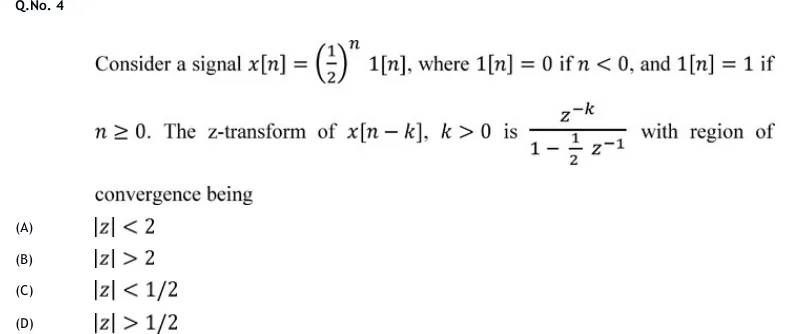
ROC unchanged except possibly for or . A delay of samples multiplies by . For the unilateral version with initial conditions see Section 5.

TIME REVERSAL

The ROC inverts: becomes . A pole at moves to .

SCALING IN Z (MULTIPLICATION BY AN EXPONENTIAL)

ROC scales to ; every pole and zero moves from to . With (modulation) the pole-zero plot rotates by .

DIFFERENTIATION IN Z

Same ROC. Apply it twice for .

CONVOLUTION

ROC contains (it can be larger if a pole cancels against a zero).

ACCUMULATION

ROC contains . The inverse operation, the first difference , gives .

CONJUGATION

Same ROC. For a real sequence , so complex poles and zeros come in conjugate pairs.

Properties at a glance

Property

Sequence

Transform

ROC

Linearity

contains

Time shift

, except possibly or

Time reversal

Scaling in

Differentiation in

Convolution

contains

Accumulation

contains

First difference

contains

Conjugation

Time expansion

for a multiple of , else

INITIAL VALUE THEOREM

For a causal ( for ), or for any with the unilateral transform. The next sample is . A rational whose numerator degree in exceeds the denominator degree cannot be the transform of a causal sequence, and the theorem does not apply. For an anticausal ( for ) the mirror result is .

FINAL VALUE THEOREM

For a causal (or the unilateral transform of any ), and only when the limit exists: every pole of must lie strictly inside the unit circle. itself may have one simple pole at .

THE FINAL VALUE THEOREM TRAP

Applied blindly to , the theorem gives , yet grows without bound. Likewise has poles at on the unit circle and no final value. Check the poles of first.

SUMS WITHOUT INVERTING

If the ROC contains the unit circle: , and . These come straight from the definition and save an inversion.

3. Inverse z-transform

There are three methods. Partial fractions is the standard route for a rational : split it into table pairs and let the ROC decide, term by term, whether each pole gives a right-sided or a left-sided sequence. Long division gives the samples one at a time, which is enough when a question asks for only , , . Residues evaluate the inversion integral directly.

Partial fractions, step by step

  1. Form and make sure it is a proper rational function of (divide first if it is not). If has no zero at the origin, has a pole at ; its term becomes after multiplying back by .

  2. Factor the denominator and expand: .

  3. Multiply back by : . Every term is now a table pair.

  4. Use the ROC term by term. A pole with (inside the ring's inner edge) gives the right-sided . A pole with (outside the outer edge) gives the left-sided .

  5. For a double pole at , include both and in the expansion of . After multiplying by , use if the pole is inside the ROC's inner edge, or if it is outside the outer edge.

PARTIAL-FRACTION COEFFICIENT (SIMPLE POLE)

Equivalent form in : with . That form needs the numerator degree in to be less than the denominator degree; otherwise divide out the polynomial part first (it gives impulses).

INVERSION INTEGRAL AND RESIDUES

is a counter-clockwise circle centred on the origin and lying in the ROC. For a causal it encloses every pole. For small , check whether adds a pole at (for example at when has no zero at the origin) and include its residue.

RESIDUE AT A POLE OF ORDER M

For a simple pole () this is just evaluated at .

Long division. For a right-sided (causal) sequence, write numerator and denominator in descending powers of (equivalently ascending powers of ) and divide. The coefficient of in the quotient is . For a left-sided sequence, write both in ascending powers of , so that the quotient runs in positive powers of . Division rarely gives a closed form, but it is the quickest check on a partial-fraction answer.

WORKED EXAMPLE · EXAMPLE 1: ONE X(Z), THREE SEQUENCES

. Find for every possible ROC, and say which one is causal and which one is stable.

Solution
  1. The poles are at and , so there are three possible ROCs: , and .

  2. , with and .

  3. So .

  4. : both terms are right-sided, so . This one is causal. It is not stable, because the ROC excludes .

  5. : the pole at is inside the ring (right-sided) and the pole at is outside it (left-sided), so . This one is stable (the ring contains ) but two-sided, so not causal.

  6. : both terms are left-sided, so . This one is anticausal and not stable.

  7. Check the causal case by long division: The formula gives , and .

Answer: : , causal, unstable. : , stable, not causal. : , anticausal, unstable.

EXPAND X(Z)/Z, NOT X(Z)

Expanding and multiplying back by makes every term , which is directly in the table. Expanding itself gives terms , whose inverse is the delayed . Forgetting that delay is a common slip.

4. Discrete-time LTI systems: system function, causality, stability, frequency response

For an LTI system , so . The system function is the ratio with the system initially at rest. Its poles, zeros and ROC fix causality, stability and the frequency response.

SYSTEM FUNCTION OF A DIFFERENCE EQUATION

Take the transform term by term with and zero initial conditions. Sign convention: every output term is on the left. If the equation is written , the feedback coefficient changes sign when moved across: .

Causality and stability from H(z)

Property

Condition on

Condition on and its ROC

Causal

for

ROC is the exterior of a circle and includes . For a rational : ROC outside the outermost pole, and numerator degree in not greater than the denominator degree.

BIBO stable

ROC contains the unit circle .

Causal and stable

both of the above

For a rational : the causal ROC with , i.e. every pole strictly inside the unit circle, and numerator degree in not greater than the denominator degree.

FREQUENCY RESPONSE

Exists when the ROC contains the unit circle (a stable system). is the point (DC) and is (the highest digital frequency). has period .

STEADY-STATE RESPONSE TO A SINUSOID

For a stable LTI system with real . It is exact for an input present for all ; for an input switched on at it is the response once the transients have died out. A constant input gives the output .

Reading the pole-zero plot. Write . Then , the product of distances from the point on the unit circle to the zeros, divided by the product of distances to the poles. A zero on the unit circle at angle gives an exact null at . A pole close to the unit circle gives a sharp peak near its angle. Poles and zeros at the origin change only the phase (they are pure delays or advances).

Pole position and the mode it adds to a causal h[n] (real coefficients)

Pole of

Term in ,

Behaviour

at

impulses

lasts a finite number of samples

real ,

decays without oscillating

real ,

decays, alternating in sign every sample

complex pair ,

decaying oscillation at rad/sample

simple pole on

at ; at ; for a pair

neither decays nor grows; not BIBO stable

repeated pole on , order

terms up to times the simple-pole mode

grows without bound

, or for a pair

grows without bound

FIR and IIR systems

FIR

IIR

Difference equation

non-recursive: (causal FIR)

recursive: past outputs are fed back ( for some )

a polynomial in ; for a causal FIR every pole is at

a ratio of polynomials with at least one pole away from the origin after common factors cancel

finite length

infinite length

Stability

always BIBO stable

causal IIR: stable if and only if every pole is inside the unit circle

Exact linear phase

possible, with symmetric or antisymmetric

not achievable by a causal, stable IIR filter

RECURSIVE IS NOT THE SAME AS IIR

A recursive equation can still have a finite-length when its poles are cancelled by zeros. has : the pole at cancels, and is an -point running sum, an FIR system.

FIRST-ORDER ALLPASS SECTION

Pole at , zero at (its mirror image in the unit circle). Causal and stable for . Any pole-zero pair placed as mirror images in the unit circle has a flat magnitude response.

A causal, stable system is minimum phase when all its zeros are also inside the unit circle. The zeros of become the poles of the inverse system , so a causal and stable inverse needs every zero of inside the unit circle. It also needs the numerator and denominator of to have equal degree in (in the form, ). The pure delay has no finite zeros, but its inverse is an advance, which is not causal. When both conditions hold, the inverse is causal and stable.

RIGHT-SIDED IS NOT THE SAME AS CAUSAL

with is right-sided, but is non-zero at . A rational with more finite zeros than finite poles cannot be causal.

STABLE DOES NOT NEED CAUSAL

The ROC in Example 1 contains the unit circle, so that system is stable although it is two-sided. Poles at the origin (from pure delays) never affect stability.

A POLE ON THE UNIT CIRCLE IS NOT BIBO STABLE

The accumulator has , a simple pole at , and , which is not absolutely summable. The bounded input gives , which grows without bound. A causal system with any pole on the unit circle is not BIBO stable; some texts call the simple-pole case marginally stable.

POLE-ZERO SHORTCUTS

A zero at kills (for example , a lowpass shape). A zero at blocks DC (for example , a highpass shape). A system with real coefficients has its complex poles and zeros in conjugate pairs.

5. Unilateral z-transform and difference equations with initial conditions

The bilateral transform assumes the system is at rest. When a difference equation comes with initial conditions , use the unilateral transform: its shift property brings those values into the algebra automatically.

UNILATERAL DELAY PROPERTY

The cases used most: and .

UNILATERAL ADVANCE PROPERTY

For : . For : .

Solving a difference equation with initial conditions

  1. Take the unilateral transform of both sides, using the delay property with the given For an input applied at , .

  2. Solve the resulting algebraic equation for .

  3. Separate the terms: those produced by the initial conditions form the zero-input response; the term is the zero-state response.

  4. Invert by partial fractions. Every term is right-sided, and the result holds for .

  5. Check (and ) by substituting directly into the difference equation, and check the final value with the final value theorem if the poles allow it.

WORKED EXAMPLE · EXAMPLE 2: FIRST-ORDER SYSTEM WITH AN INITIAL CONDITION

A system obeys . With and , find for , and separate the zero-input and zero-state responses.

Solution
  1. Unilateral transform: .

  2. So , and .

  3. Zero-input part: .

  4. Zero-state part: , with and . So the zero-state response is .

  5. Total: for .

  6. Check: from the equation, and ; the formula gives and . Final value: , valid because the only other pole, , is inside the unit circle.

Answer: for : zero-input response , zero-state response .

ZERO-STATE IS NOT THE SAME AS FORCED

The zero-state response in Example 2 itself contains a natural-mode term , so the zero-input response is not the whole transient. Read carefully whether a question asks for the zero-input, zero-state, natural or forced response.

6. From s to z: sampling, the mapping and the pulse transfer function

Sampling every seconds gives . The Laplace transform of the impulse-sampled signal is , which is exactly with . This is the bridge between continuous-time and discrete-time pole locations. For a signal that jumps at , the sample is taken as ; the standard tables (for example at ) use this convention.

THE S-TO-Z MAPPING

is the sampling period. The digital frequency is rad/sample. A continuous-time pole at appears at in the transform of the sampled signal.

SAMPLED EXPONENTIAL

For real . The pole maps to , inside the unit circle when .

How regions of the s-plane map under z = e^{sT}

s-plane

z-plane

imaginary axis,

unit circle,

left half-plane,

inside the unit circle

right half-plane,

outside the unit circle

negative real axis, ()

the segment of the real axis

vertical line

circle of radius

horizontal line

radial line at angle

(half the sampling frequency)

negative real axis

primary strip

the whole z-plane except

line of constant damping ratio ,

a logarithmic spiral into

THE MAPPING IS MANY-TO-ONE

and land on the same for every integer : that is aliasing, and only the primary strip maps one-to-one. Poles map by ; zeros, in general, do not.

BILINEAR TRANSFORMATION

A different mapping, used to design a digital filter from an analog one. It also sends the axis onto the unit circle and the left half-plane inside it, one-to-one, so there is no aliasing, but the frequency axis is warped as shown. It is not .

Pulse transfer function (IN). In a sampled-data system a sampler (period ) and a zero-order hold (ZOH) drive a continuous plant , and the output is read at the sampling instants. The pulse transfer function is with zero initial conditions, where is the z-transform of . Notation: means the z-transform of the samples of .

ZERO-ORDER HOLD WITH PLANT

Exact at the sampling instants: is times the transform of the sampled step response of the plant.

ZOH WITH A FIRST-ORDER PLANT

For . From . Without the hold, , a different answer.

CASCADED BLOCKS IN A SAMPLED-DATA SYSTEM

When a sampler separates and , their pulse transfer functions multiply. When none does, multiply in first and then transform; in general . Example with and : with a sampler between them, ; without, .

CLOSED LOOP WITH THE SAMPLER ON THE ERROR

is the forward path after the sampler (hold included) and the continuous feedback path. Because and are not separated by a sampler, they are multiplied before transforming. The loop is stable when every root of lies inside the unit circle.

STEADY-STATE ERROR OF A UNITY-FEEDBACK SAMPLED LOOP

Unity feedback, the sampler on the error, the pulse transfer function of the forward path (hold included), and a stable closed loop (otherwise the final value theorem does not apply). From and the final value theorem, with for a step and for the sampled ramp. The constants are often written and , so that for a step and for a ramp. Each pole of at plays the part of an integrator.

STABILITY TEST FOR A SECOND-ORDER CHARACTERISTIC POLYNOMIAL

For real coefficients, all three conditions together are necessary and sufficient for both roots to lie strictly inside the unit circle (the Jury conditions for order 2). For with the first condition becomes . At any order , with a positive leading coefficient, and are necessary. For a full test at higher orders, use the Jury table, or substitute and apply the Routh test to the polynomial in .

PREVIOUS-YEAR QUESTIONS

12 questions from the EC, EE and IN papers

Try each question first, then open the answer. We placed each question under a topic ourselves; the exam paper does not label topics.

See these papers in full: GATE ECE 2026 · GATE ECE 2025 · GATE ECE 2024 · GATE ECE 2020 · GATE ECE 2018 · GATE EE 2026 · GATE EE 2024 · GATE EE 2023 · GATE EE 2020 · GATE IN 2024 · GATE IN 2018

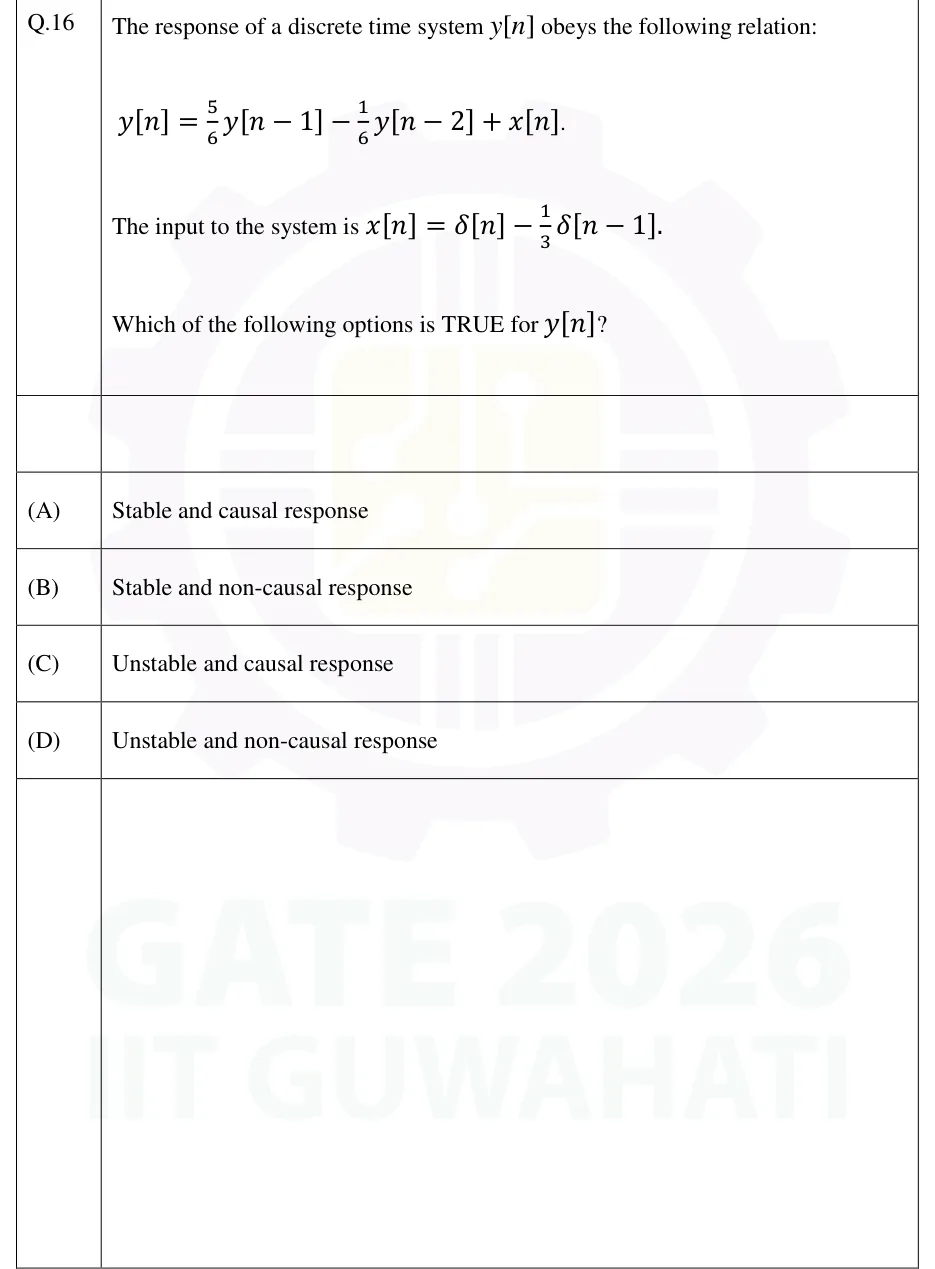
GATE 2026 EC Q.16

GATE 2026 · ECQ.16 · 1 mark · MCQ

The response of a discrete time system obeys the following relation:

The input to the system is .

Which of the following options is TRUE for ?

  1. (A)

    Stable and causal response

  2. (B)

    Stable and non-causal response

  3. (C)

    Unstable and causal response

  4. (D)

    Unstable and non-causal response
Answer and solution
See the question in the paper
GATE 2026 EC Q.16: answer and solution

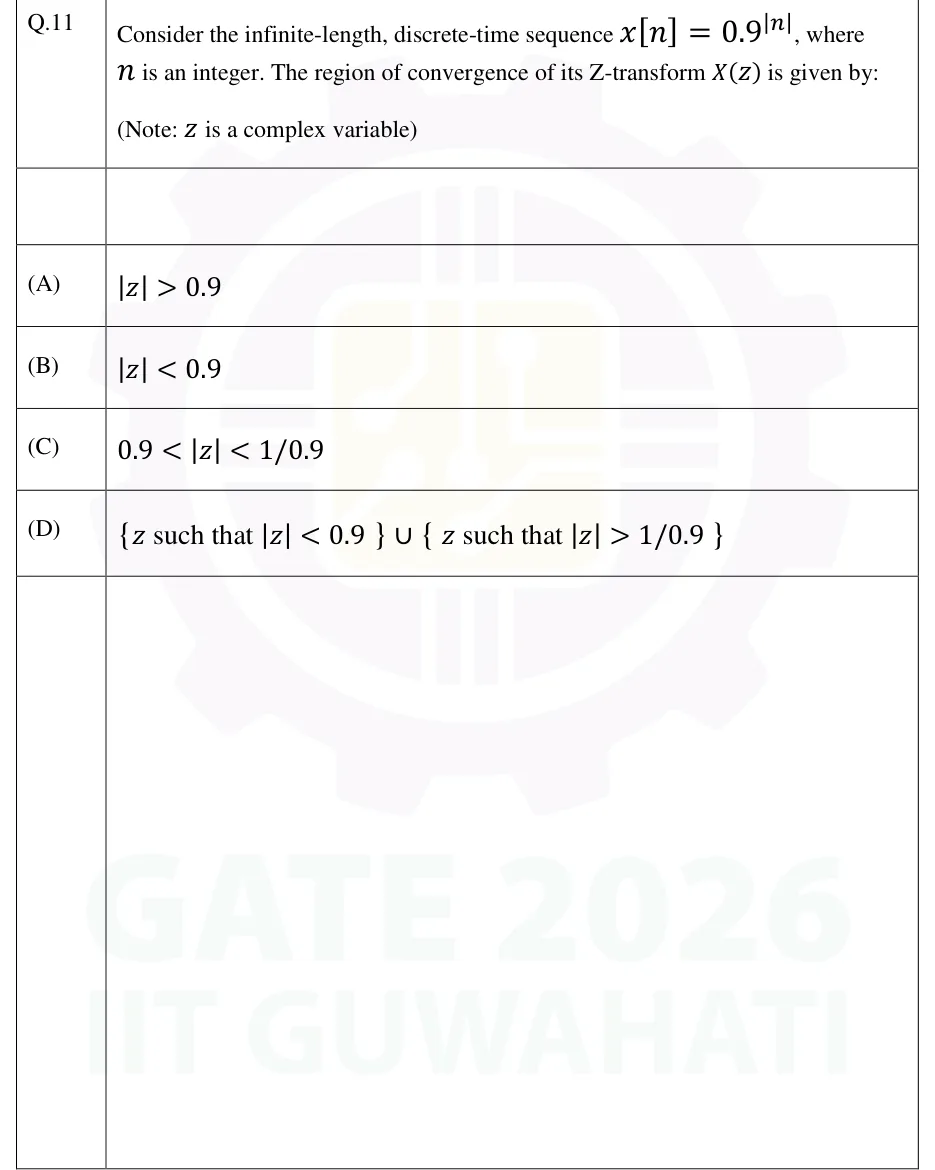
GATE 2026 EE Q.11

GATE 2026 · EEQ.11 · 1 mark · MCQ

Consider the infinite-length, discrete-time sequence , where is an integer. The region of convergence of its Z-transform is given by:

(Note: is a complex variable)

  1. (A)

  2. (B)

  3. (C)

  4. (D)

Answer and solution
See the question in the paper
GATE 2026 EE Q.11: answer and solution

GATE 2025 EC Q.27

GATE 2025 · ECQ.27 · 1 mark · MSQ

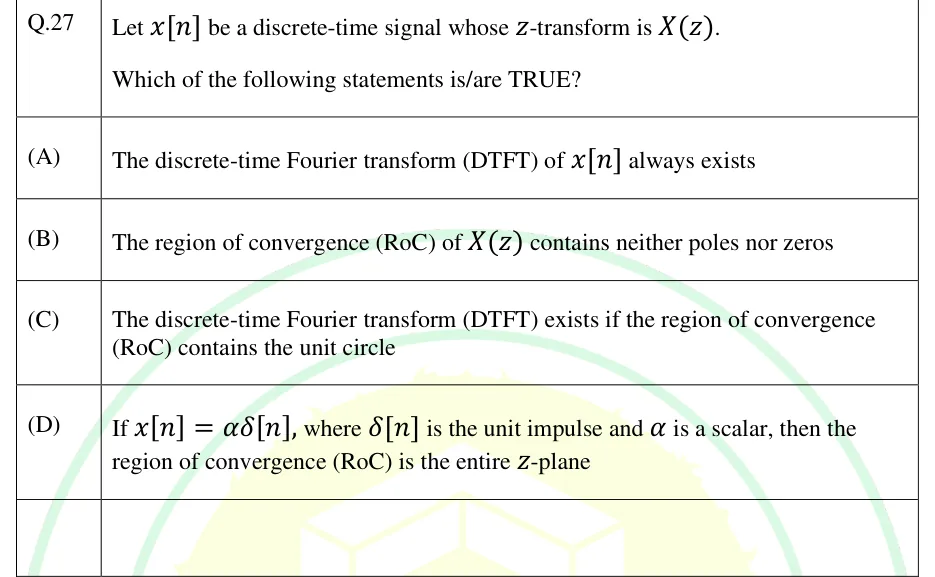
Let be a discrete-time signal whose -transform is .

Which of the following statements is/are TRUE?

  1. (A)

    The discrete-time Fourier transform (DTFT) of always exists

  2. (B)

    The region of convergence (RoC) of contains neither poles nor zeros

  3. (C)

    The discrete-time Fourier transform (DTFT) exists if the region of convergence (RoC) contains the unit circle

  4. (D)

    If , where is the unit impulse and is a scalar, then the region of convergence (RoC) is the entire -plane

Answer and solution
See the question in the paper
GATE 2025 EC Q.27: answer and solution

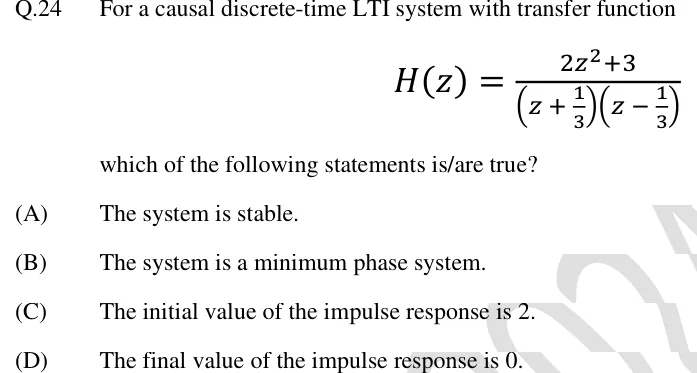
GATE 2024 EC Q.24

GATE 2024 · ECQ.24 · 1 mark · MSQ

For a causal discrete-time LTI system with transfer function

which of the following statements is/are true?

  1. (A)

    The system is stable.

  2. (B)

    The system is a minimum phase system.

  3. (C)

    The initial value of the impulse response is 2.

  4. (D)

    The final value of the impulse response is 0.

Answer and solution
See the question in the paper
GATE 2024 EC Q.24: answer and solution

GATE 2023 EE Q.19

GATE 2023 · EEQ.19 · 1 mark · MCQ

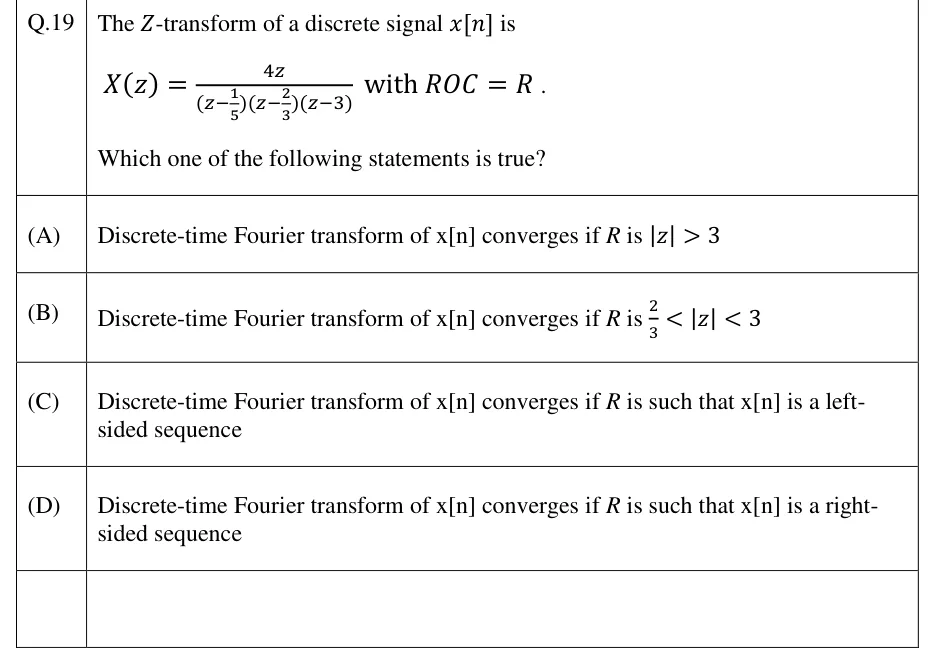
The -transform of a discrete signal is

Which one of the following statements is true?

  1. (A)

    Discrete-time Fourier transform of x[n] converges if is

  2. (B)

    Discrete-time Fourier transform of x[n] converges if is

  3. (C)

    Discrete-time Fourier transform of x[n] converges if is such that x[n] is a left-sided sequence

  4. (D)

    Discrete-time Fourier transform of x[n] converges if is such that x[n] is a right-sided sequence

Answer and solution
See the question in the paper
GATE 2023 EE Q.19: answer and solution

GATE 2020 EC Q.14

GATE 2020 · ECQ.14 · 1 mark · MCQ

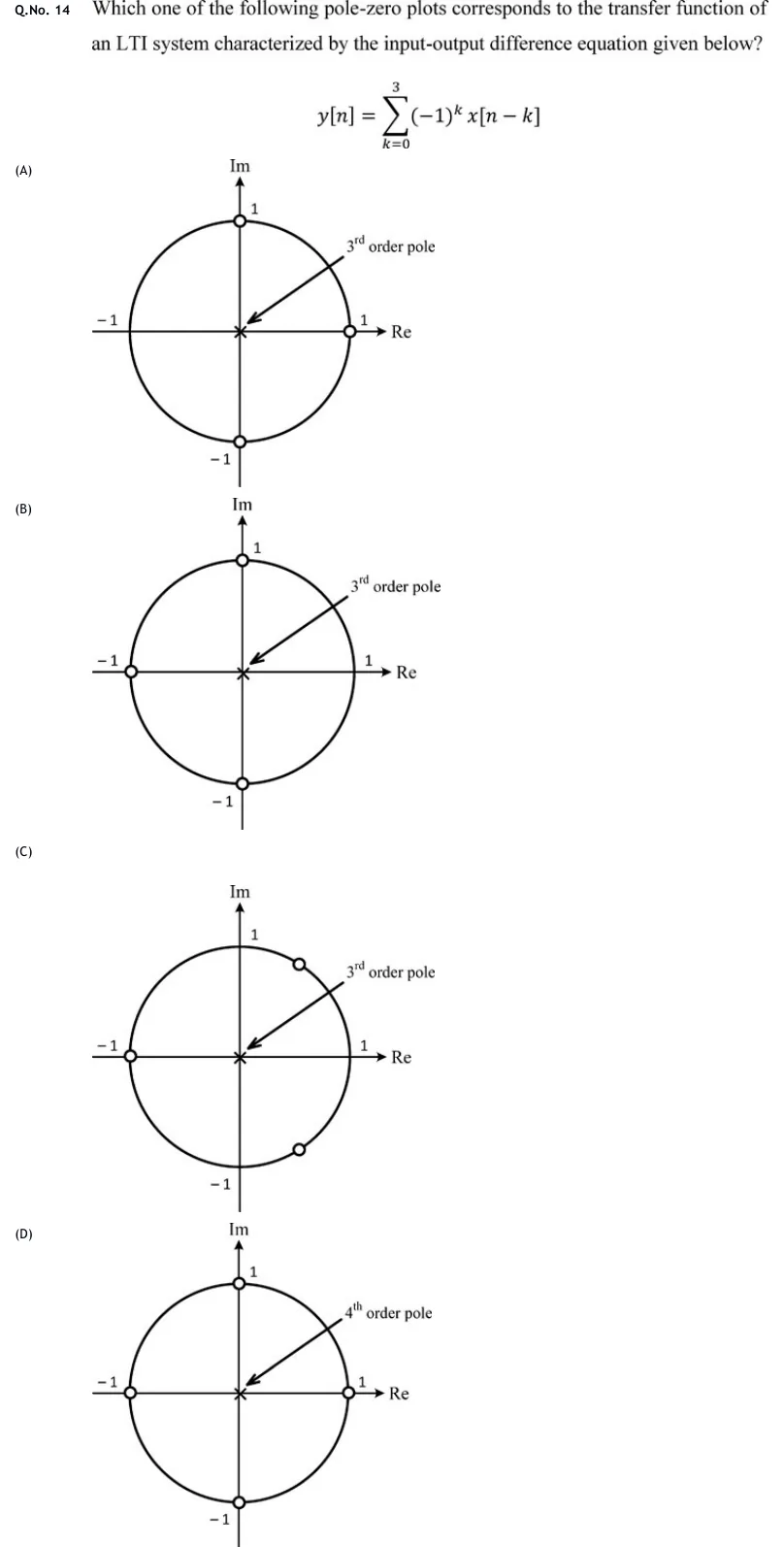
Which one of the following pole-zero plots corresponds to the transfer function of an LTI system characterized by the input-output difference equation given below?

GATE 2020 EC question 14: Each option is a z-plane pole-zero plot: horizontal axis Re, vertical axis Im, with the unit circle drawn and the points…Tap to open full size
Figure from the GATE 2020 EC paper. It is part of the question.
Figure description

Each option is a z-plane pole-zero plot: horizontal axis Re, vertical axis Im, with the unit circle drawn and the points 1, -1 marked on the Re axis and 1, -1 on the Im axis. Zeros are drawn as small open circles on the unit circle. A cross at the origin marks a multiple pole, labelled with an arrow.

  1. (A)

    Figure — zeros (o) at , and on the unit circle; a cross at the origin labelled "3rd order pole".

  2. (B)

    Figure — zeros (o) at , and on the unit circle; a cross at the origin labelled "3rd order pole".

  3. (C)

    Figure — zeros (o) at and at two conjugate points on the unit circle in the right half-plane, at about (i.e. ); a cross at the origin labelled "3rd order pole".

  4. (D)

    Figure — zeros (o) at , , and on the unit circle; a cross at the origin labelled "4th order pole".

Answer and solution
GATE 2020 EC Q.14: answer and solution

GATE 2018 EC Q.13

GATE 2018 · ECQ.13 · 1 mark · MCQ

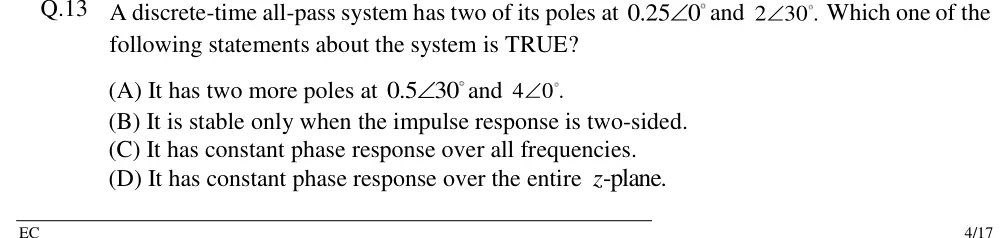
A discrete-time all-pass system has two of its poles at and . Which one of the following statements about the system is TRUE?

  1. (A)

    It has two more poles at and .

  2. (B)

    It is stable only when the impulse response is two-sided.

  3. (C)

    It has constant phase response over all frequencies.

  4. (D)

    It has constant phase response over the entire -plane.

Answer and solution
See the question in the paper
GATE 2018 EC Q.13: answer and solution

PRACTICE

6 questions to test yourself

PRACTICE 11 mark · MCQ

Under the mapping with sampling period s, the region of the s-plane maps onto

  1. (A)

  2. (B)

  3. (C)

  4. (D)

Answer and solution

Answer: (A)

  1. With , depends only on , and depends only on .

  2. gives . As , without reaching it.

  3. Every angle occurs, so the image is the whole punctured disc .

PRACTICE 21 mark · NAT

A causal sequence has the z-transform . The value of is ______.

Answer and solution

Answer: (accepted range )

  1. has its only pole at , inside the unit circle, so the final value theorem applies.

  2. .

  3. Check by partial fractions: , so , which tends to .

PRACTICE 32 marks · MSQ

A causal LTI system has the system function . Which of the following statements is/are correct?

  1. (A)

    The system is BIBO stable.

  2. (B)

    The system is minimum phase (all its poles and zeros lie inside the unit circle).

  3. (C)

    for every .

  4. (D)

    There is an inverse system that is both causal and stable.

Answer and solution

Answer: (A), (C)

  1. Poles: , so . Zeros: , so .

  2. The system is causal, so the ROC is , which contains the unit circle. It is stable: (A) is correct.

  3. The zeros at lie outside the unit circle, so the system is not minimum phase: (B) is wrong.

  4. On the unit circle let , so and . Then and , so for every . Spot check: . (C) is correct.

  5. The inverse has poles at . Its causal version (ROC ) excludes the unit circle and is unstable; its stable version (ROC ) is anticausal. (D) is wrong.

PRACTICE 42 marks · NAT

is the z-transform of an absolutely summable sequence . The value of is ______ (rounded to three decimal places).

Answer and solution

Answer: (accepted range )

  1. Absolutely summable means the ROC contains , so the ROC is .

  2. (coefficients and ).

  3. . The pole at is inside the ring, giving . The pole at is outside it, giving .

  4. At only the left-sided term contributes: .

PRACTICE 52 marks · MCQ

In a sampled-data system, a zero-order hold with sampling period s drives the plant . Taking , the pulse transfer function of the hold and plant together is

  1. (A)

  2. (B)

  3. (C)

  4. (D)

Answer and solution

Answer: (A)

  1. .

  2. . Its time function sampled at is , with transform .

  3. Multiplying by and putting : .

  4. Over the common denominator the numerator is .

  5. Option B is with the hold left out; option C is the hold with only, dropping the integrator; option D swaps the numerator coefficients.

PRACTICE 62 marks · NAT

A unity-feedback sampled-data loop has the sampler on the error signal, sampling period s, and forward-path pulse transfer function (hold and plant together) . For the input , the steady-state error at the sampling instants is ______ (rounded to two decimal places).

Answer and solution

Answer: (accepted range )

  1. The final value theorem needs a stable closed loop, so check that first. Characteristic polynomial: .

  2. Second-order Jury conditions: ; ; . Both roots are inside the unit circle, so the loop is stable.

  3. .

  4. , i.e. . As a check, the continuous plant that this comes from has the same velocity constant, .

OFFICIAL GATE 2027 SYLLABUS WORDING

Copied from the GATE 2027 syllabus; see all 2027 syllabi.

GATE EC

z-transform

GATE EE

Z transform

GATE IN

z-transforms … pulse transfer function

Preparing in Kolkata? IAE Academy's course for GATE ECE, GATE EE or GATE IN.