IAE Academy

GATE 2026 EC Q.16: solution and answer

GATE 2026 · ECQ.16 · 1 mark · MCQ

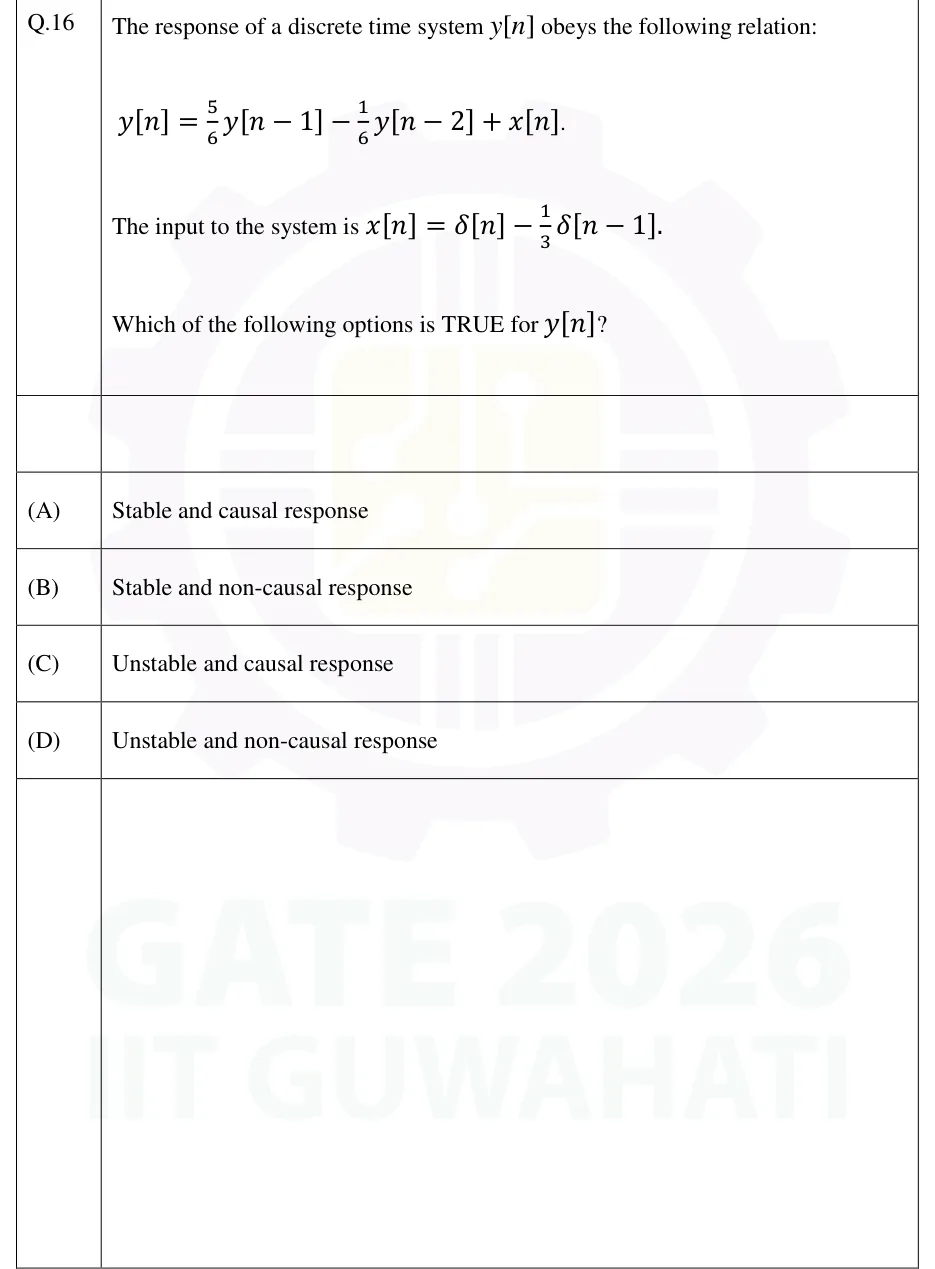
The response of a discrete time system obeys the following relation:

The input to the system is .

Which of the following options is TRUE for ?

  1. (A)

    Stable and causal response

  2. (B)

    Stable and non-causal response

  3. (C)

    Unstable and causal response

  4. (D)

    Unstable and non-causal response

See the question in the paper

Answer and solution

ANSWER

. It is zero for and absolutely summable (sum ), so the response is stable and causal: option (A).

Official answer: ASource: Official answer key, GATE 2026 EC (IIT Guwahati)

  1. Take the z-transform of the difference equation, assuming initial rest (the system is run forward from ):

  2. Factor the denominator. The roots of are and , since and . So

  3. Transform the input using : .

  4. Multiply. The input's zero at cancels the pole at :

  5. A recursive difference equation run forward from rest gives a right-sided output, so the ROC is . Inverting, .

  6. Check by direct recursion: , , . This matches .

  7. for , so the response is causal. Also , and the ROC contains the unit circle , so the response is stable (absolutely summable). The answer is (A).

KEY IDEA

Find . The input's zero at cancels one system pole, which leaves one pole at . A recursion run forward from rest gives a right-sided output, so the ROC is . That ROC contains the unit circle, so is both causal and absolutely summable.

WATCH OUT FOR

Taking the left-sided ROC gives , which grows like as . That points to option (D), "unstable and non-causal". But a difference equation computed forward in time from rest always gives a right-sided response. A second slip is to judge the response by the system's poles alone and miss the pole-zero cancellation. Here both poles ( and ) lie inside the unit circle anyway, so the conclusion is the same, but the cancellation is what makes a single geometric sequence.

From the GATE 2026 EC paper. Every question of this paper · Download the full paper · All 12 z-transform questions, with notes

More z-transform questions