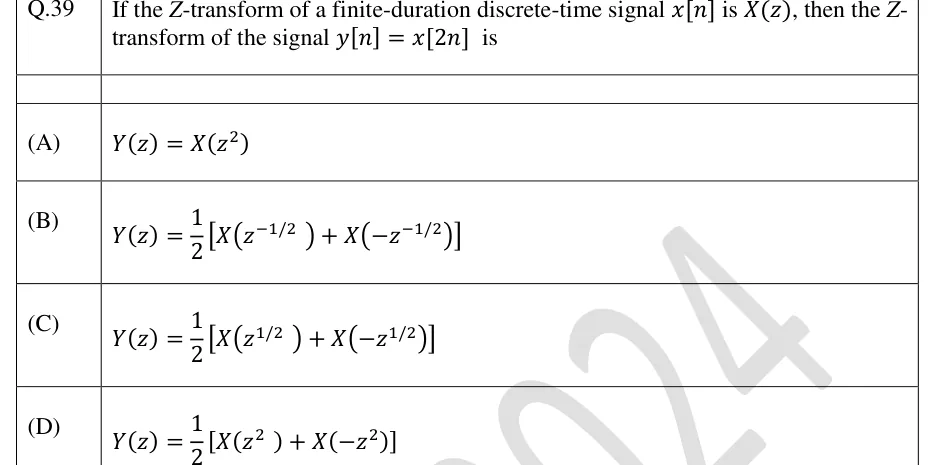
If the -transform of a finite-duration discrete-time signal is , then the -transform of the signal is
- (A)
- (B)
- (C)
- (D)

If the -transform of a finite-duration discrete-time signal is , then the -transform of the signal is
ANSWER
, option (C).
Official answer: CSource: Official answer key, GATE 2024 EE (IISc Bengaluru)
Start from the definition of the -transform:
Substitute . As runs over all integers, runs over the even integers only, and :
Write the sum over all and keep only the even-indexed samples with the selector , which is for even and for odd :
Split the sum into two halves. The first half is .
For the second half, for every integer , so . Hence the second half is .
Adding the two halves gives the downsampling-by-2 property: Which square root of is taken does not matter, because swapping and leaves the sum unchanged. This is option (C).
Quick check with , so . Then , so . Option (C) gives , which matches. Option (B) gives , and options (A) and (D) both give , so none of them matches.
KEY IDEA
Downsampling by 2 () keeps only the even-indexed samples. Pick them out with the selector . With , that selector turns into the average of evaluated at and at .
WATCH OUT FOR
Mixing up downsampling with upsampling. , option (A), is the transform of the expanded signal , not of . Option (B) comes from carrying the minus sign of into the argument and writing . Remember that already contains the negative powers, so the argument is . Option (D) applies the right averaging structure to the wrong operation.
From the GATE 2024 EE paper. Every question of this paper · Download the full paper · All 12 z-transform questions, with notes