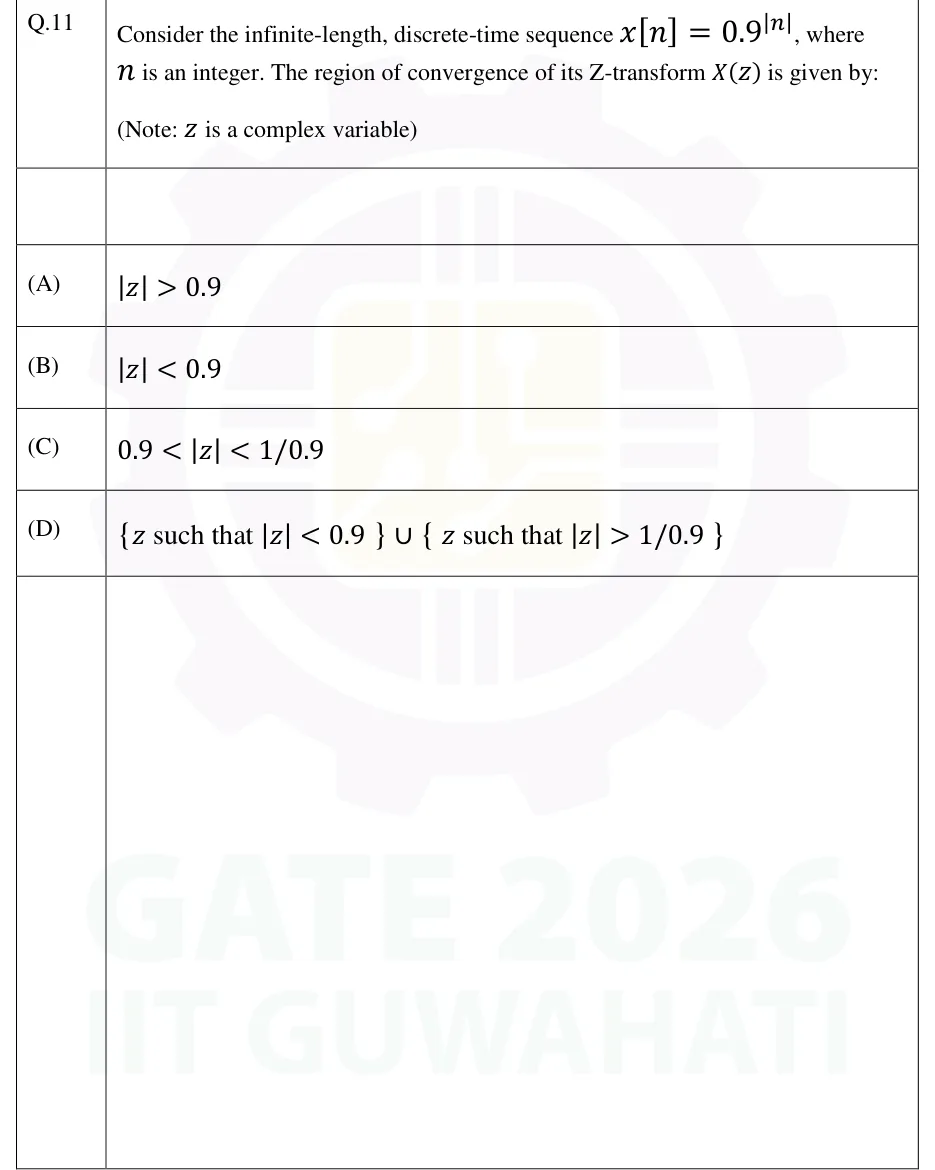
Consider the infinite-length, discrete-time sequence , where is an integer. The region of convergence of its Z-transform is given by:
(Note: is a complex variable)
- (A)
- (B)
- (C)
- (D)

Consider the infinite-length, discrete-time sequence , where is an integer. The region of convergence of its Z-transform is given by:
(Note: is a complex variable)
ANSWER
The ROC is the annulus , which is option (C).
Official answer: CSource: Official answer key, GATE 2026 EE (IIT Guwahati)
Split the two-sided sequence into a right-sided part and a left-sided part: .
Right-sided part (a geometric series): converges if and only if , i.e. .
Left-sided part: substitute to get , which converges if and only if , i.e. .
exists only where both series converge, so the ROC is the intersection of the two regions:
The ring is non-empty because (true for any base with ), so exists. As a check, , with poles at and , and these two poles are exactly the edges of the annulus.
The ROC of any Z-transform is a single connected ring centred on the origin and bounded by poles. It can never be two disjoint regions, which rules out (D). Options (A) and (B) are each the ROC of only one half of the sequence. Answer: (C).
KEY IDEA
is two-sided. Its causal half converges outside its pole () and its anti-causal half converges inside its pole (). The Z-transform of the whole sequence exists only on the intersection of the two regions, which is a ring between the two poles. The ring is non-empty because the base satisfies .
WATCH OUT FOR
Reading as the causal and choosing (A). Another mistake is taking the union of the two half-ROCs instead of their intersection, or inverting the left-sided condition, which leads to (D). An ROC is always one connected ring, never two separate pieces.
From the GATE 2026 EE paper. Every question of this paper · Download the full paper · All 12 z-transform questions, with notes