
IAE Academy

GATE 2025 EC Q.27: solution and answer

GATE 2025 · ECQ.27 · 1 mark · MSQ

Let be a discrete-time signal whose -transform is .

Which of the following statements is/are TRUE?

  1. (A)

    The discrete-time Fourier transform (DTFT) of always exists

  2. (B)

    The region of convergence (RoC) of contains neither poles nor zeros

  3. (C)

    The discrete-time Fourier transform (DTFT) exists if the region of convergence (RoC) contains the unit circle

  4. (D)

    If , where is the unit impulse and is a scalar, then the region of convergence (RoC) is the entire -plane
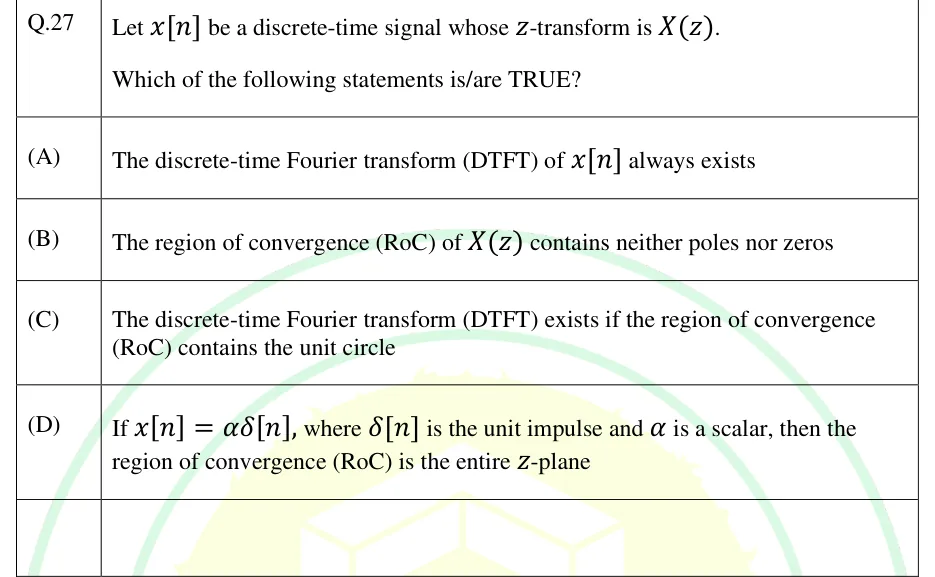
See the question in the paper

Answer and solution

ANSWER

(C) and (D) are true. The DTFT exists when the RoC contains the unit circle, and the RoC of is the entire -plane.

Official answer: C, DSource: Official answer key, GATE 2025 EC (IIT Roorkee)

  1. How the two transforms are linked. The DTFT is the -transform evaluated on the unit circle: The RoC is the set of for which the series converges absolutely, . On that sum is exactly . So the DTFT sum converges absolutely exactly when the unit circle lies in the RoC.

  2. (A) False. Counter-example: has with RoC , so its -transform exists. Its DTFT sum has terms of magnitude , so it diverges at every . Having a -transform does not guarantee a DTFT.

  3. (B) False. The RoC can never contain a pole. Inside the RoC the series converges to a finite value, but at a pole. The RoC can contain zeros, though. Counter-example: gives . It has a pole at , a zero at , and RoC . That RoC contains the zero at , so the statement "neither poles nor zeros" is false.

  4. (C) True. If the RoC contains , then by the definition of the RoC in Step 1, . The signal is absolutely summable, so the DTFT sum converges for every and equals .

  5. (D) True. , a constant. There is no negative power of , which would blow up at , and no positive power of , which would blow up as . is finite everywhere, so the RoC is the entire -plane, including and .

  6. Correct options: (C) and (D).

KEY IDEA

The DTFT is evaluated on . The RoC is defined by absolute convergence, so a unit circle inside the RoC means , and then the DTFT exists. The RoC can never contain a pole, but it can contain zeros. A signal that is nonzero only at has a constant , so its RoC is the whole -plane with no exception at or .

WATCH OUT FOR

Marking (B) true by misremembering the rule. The RoC contains no poles, but zeros can lie inside it. Marking (A) true on the assumption that any signal with a -transform also has a DTFT; a growing signal such as has one and not the other. In (D), excluding or by habit. Those exclusions apply to a shifted impulse with , not to .

From the GATE 2025 EC paper. Every question of this paper · Download the full paper · All 12 z-transform questions, with notes

More z-transform questions