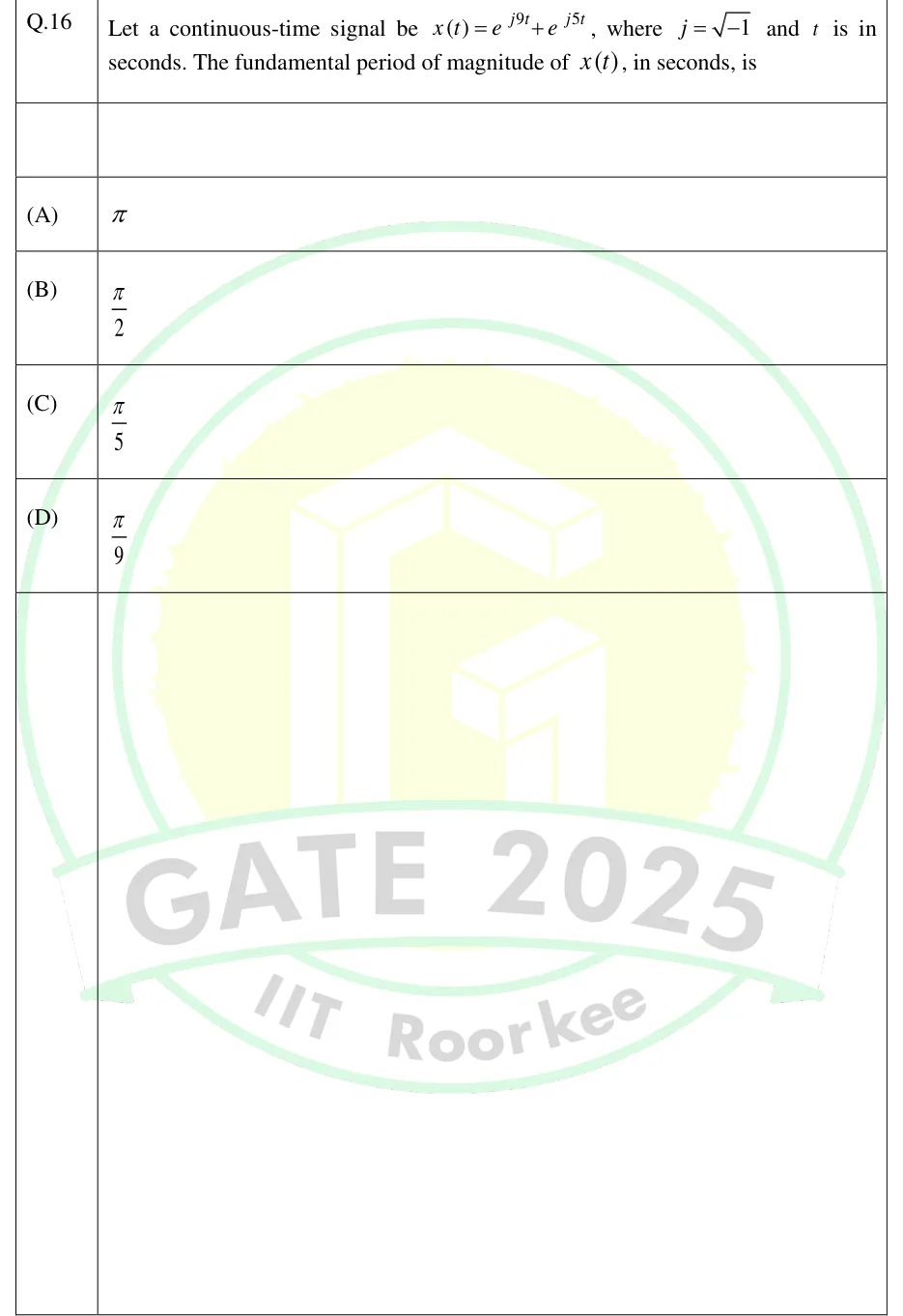
Let a continuous-time signal be , where and is in seconds. The fundamental period of magnitude of , in seconds, is
- (A)
- (B)
- (C)
- (D)

Let a continuous-time signal be , where and is in seconds. The fundamental period of magnitude of , in seconds, is
ANSWER
, whose fundamental period is . Option (B).
Official answer: BSource: Official answer key, GATE 2025 IN (IIT Roorkee)
Factor out the mean frequency (half of ):
The magnitude of a product is the product of the magnitudes, and , so
Check with : This agrees with step 2.
is a period: In words, has period , and taking the absolute value flips the negative half-cycle up, so repeats after half of that.
No shorter period exists: at , so for any period it must also equal 1 at . But only at , so the smallest positive period is . The fundamental period of is , option (B).
KEY IDEA
Factor out the average frequency: . The unit-magnitude phasor has no effect on , so the magnitude is . Taking the absolute value halves the period of the cosine.
WATCH OUT FOR
There are three common slips. One is to give the period of itself: rad/s gives , which is not an option, and students then guess. Another is to stop at the period of , which is (option A), and forget that the absolute value halves it. The third is to read the answer off one exponent and pick or .
From the GATE 2025 IN paper. Every question of this paper · Download the full paper · All 18 Signals basics questions, with notes