
IAE Academy

GATE 2023 EC Q.64: solution and answer

GATE 2023 · ECQ.64 · 2 marks · NAT

In the circuit below, the voltage is ________ V (rounded off to two decimal places).
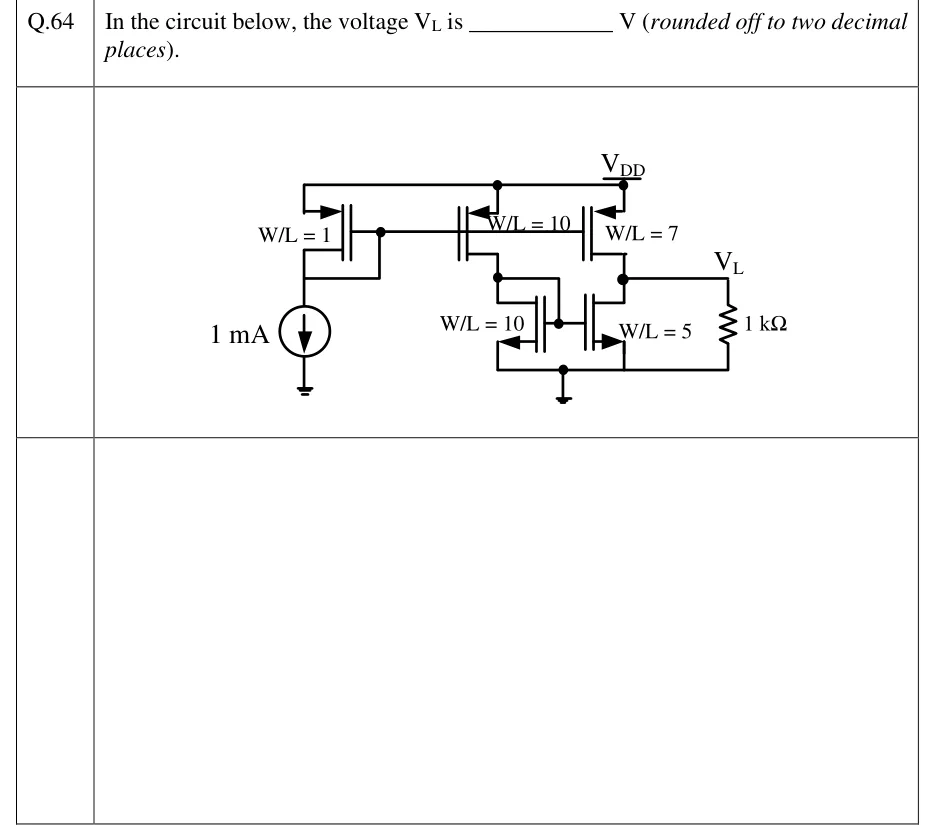
GATE 2023 EC question 64: A CMOS current-mirror circuit, supply V_DD on a top rail and ground at the bottom.Tap to open full size
Figure from the GATE 2023 EC paper. It is part of the question.
Figure description

A CMOS current-mirror circuit, supply V_DD on a top rail and ground at the bottom. Three PMOS transistors have their sources on the V_DD rail and share one gate line. (1) Left PMOS M_1, W/L = 1: diode-connected (gate tied to drain). Its drain goes to a 1 mA current source that pulls current down to ground. (2) Middle PMOS M_2, W/L = 10: gate on the shared gate line, drain at node X. (3) Right PMOS M_3, W/L = 7: gate on the shared gate line, drain at the output node V_L. Two NMOS transistors below have their sources grounded. (4) Left NMOS M_4, W/L = 10: drain at node X. Node X is also wired to the common gate of M_4 and M_5, so M_4 is diode-connected. (5) Right NMOS M_5, W/L = 5: gate on that common gate node, drain at the output node V_L. A 1 kΩ load resistor runs from V_L to ground.

Answer and solution

ANSWER

Official answer: 2.00Source: Official answer key, GATE 2023 EC (IIT Kanpur)

  1. Assumptions. Every transistor is in saturation. Channel-length modulation is neglected (). All PMOS devices share one and , and all NMOS devices share one and . Every source sits on a supply rail, so there is no body effect. With these assumptions, transistors that share a gate-source voltage carry drain currents in proportion to their : . The labels to and node X are not printed on the figure. They are used here only to name the devices.

  2. Reference branch. The diode-connected PMOS () carries all of the source current, . That current fixes the shared by , and . is always saturated because .

  3. PMOS mirror (equal , so ). and .

  4. Second reference. Node X has only one other path, so all 10 mA from flows into the diode-connected NMOS (). This sets the that and share.

  5. NMOS mirror. . draws this current out of the node and sends it to ground.

  6. KCL at the output node. pushes 7 mA into the node and pulls 5 mA out. The only other path is the load, so the difference goes through it to ground: .

  7. Ohm's law. This answer holds only if and stay saturated with their drains at 2 V. and the thresholds are not given, so the question intends ideal mirror operation, and that is assumed here.

KEY IDEA

This is a cascade of current mirrors. When transistors share a gate-source voltage and are in saturation with , their drain currents scale with . The PMOS mirror multiplies the 1 mA reference to 10 mA and 7 mA. The NMOS mirror then scales the 10 mA to 5 mA. KCL at the output node leaves for the 1 kΩ load.

WATCH OUT FOR

There are three common slips. The first is taking the NMOS ratio against the 1 mA source instead of the 10 mA branch, which gives mA by luck or mA by mistake. The second is scaling the current through from 's 7 mA, when is mirrored from 's branch. The third is adding the two currents at the output node (12 mA, so 12 V) when sources current into the node and sinks current out of it.

From the GATE 2023 EC paper. Every question of this paper · Download the full paper · All 20 Amplifiers questions, with notes

More Amplifiers questions