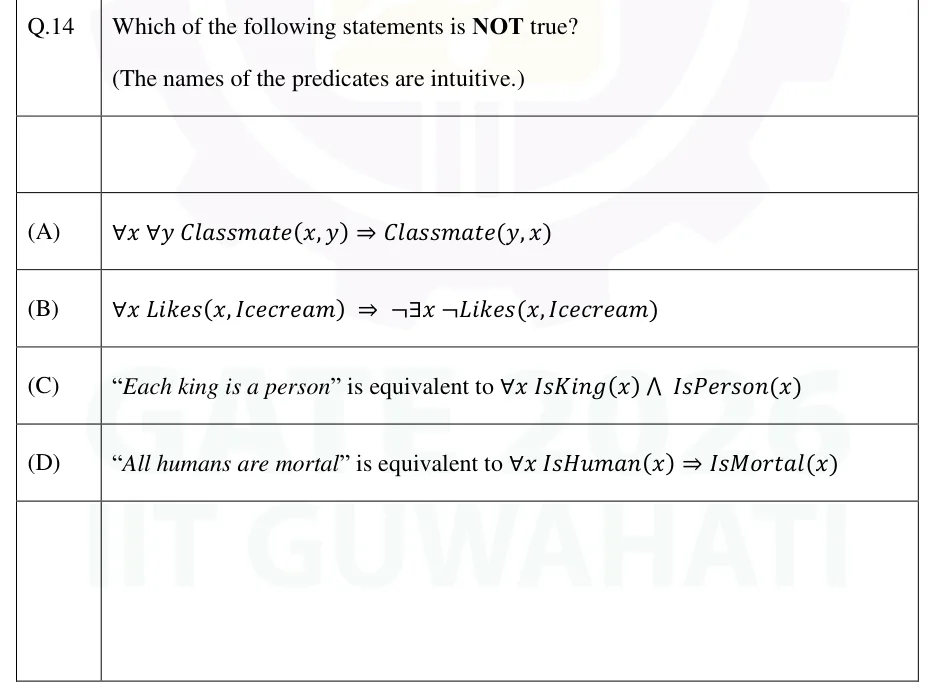
Which of the following statements is NOT true?
(The names of the predicates are intuitive.)
- (A)
- (B)
- (C)
"Each king is a person" is equivalent to
- (D)
"All humans are mortal" is equivalent to

Which of the following statements is NOT true?
(The names of the predicates are intuitive.)
"Each king is a person" is equivalent to
"All humans are mortal" is equivalent to
ANSWER
The statement that is not true is (C): \"Each king is a person\" is not equivalent to .
Official answer: CSource: Official answer key, GATE 2026 DA (IIT Guwahati)
We need the statement that is NOT true, so check each option in turn.
(A) says that being classmates is symmetric. If is a classmate of , then is a classmate of . This is true.
(B) By quantifier duality, . With , the right side is equivalent to . The statement therefore has the form , which is always true.
(D) "All humans are mortal" is the standard universal-implication form . This is true.
(C) "Each king is a person" translates to .
The option instead gives . This says every object in the domain is both a king and a person. It fails in any domain that contains a non-king, for instance a person who is not a king. In such a domain the intended sentence is true and the option's sentence is false, so they are not equivalent. The statement is NOT true.
Hence the answer is (C).
KEY IDEA
A universal quantifier over a restricted class ("each king", "all humans") pairs with an implication , never a conjunction . An existential statement ("some king is a person") pairs with .
WATCH OUT FOR
Writing for "every is a ". That claims every object in the domain is a and a , which is far stronger than the English sentence.
From the GATE 2026 DA paper. Every question of this paper · Download the full paper · All 7 Logic questions, with notes