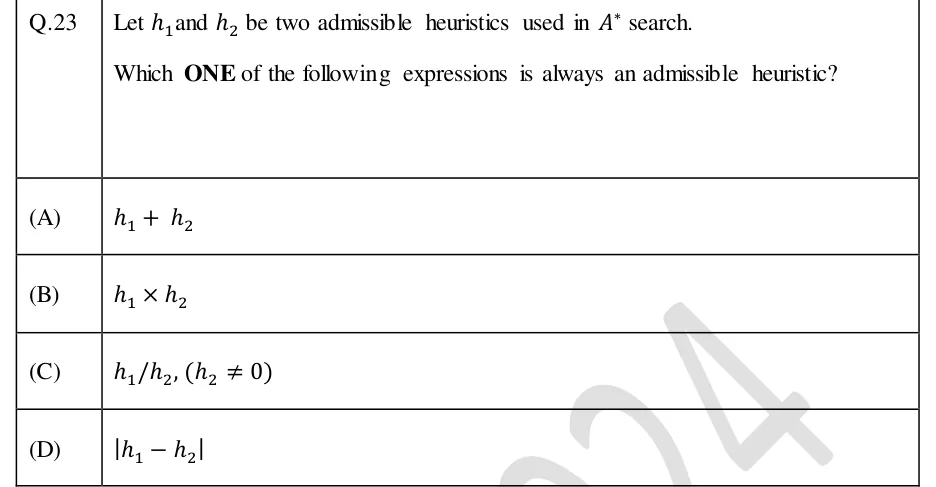
Let and be two admissible heuristics used in search.
Which ONE of the following expressions is always an admissible heuristic?
- (A)
- (B)
- (C)
- (D)

Let and be two admissible heuristics used in search.
Which ONE of the following expressions is always an admissible heuristic?
ANSWER
The answer is (D): is the only expression that is always admissible.
Official answer: DSource: Official answer key, GATE 2024 DA (IISc Bengaluru)
A heuristic is admissible if for every node , where is the true cheapest cost from to a goal. We need the expression that satisfies this bound for every pair of admissible at every node.
(A) : take , which is admissible because never overestimates itself. The sum is at any node with . It overestimates, so it is not always admissible.
(B) : take at a node where . The product is . Not admissible.
(C) : take and , which is admissible since . The ratio is . Not admissible.
(D) : both and lie in . The absolute difference of two non-negative numbers is at most the larger of them, so . It never overestimates, so it is admissible for every pair of admissible heuristics.
Therefore only is always admissible, which is option (D).
KEY IDEA
Admissible means at every node. The absolute difference of two values in stays in , but a sum, product or ratio can exceed .
WATCH OUT FOR
Choosing because combining two good heuristics seems to give a stronger one. Adding two admissible estimates can double-count the remaining cost and overestimate. Only the maximum (or minimum) of admissible heuristics is guaranteed admissible.
From the GATE 2024 DA paper. Every question of this paper · Download the full paper · All 7 Search questions, with notes