IAE Academy

GATE 2022 BT Q.40: solution and answer

GATE 2022 · BTQ.40 · 2 marks · MCQ

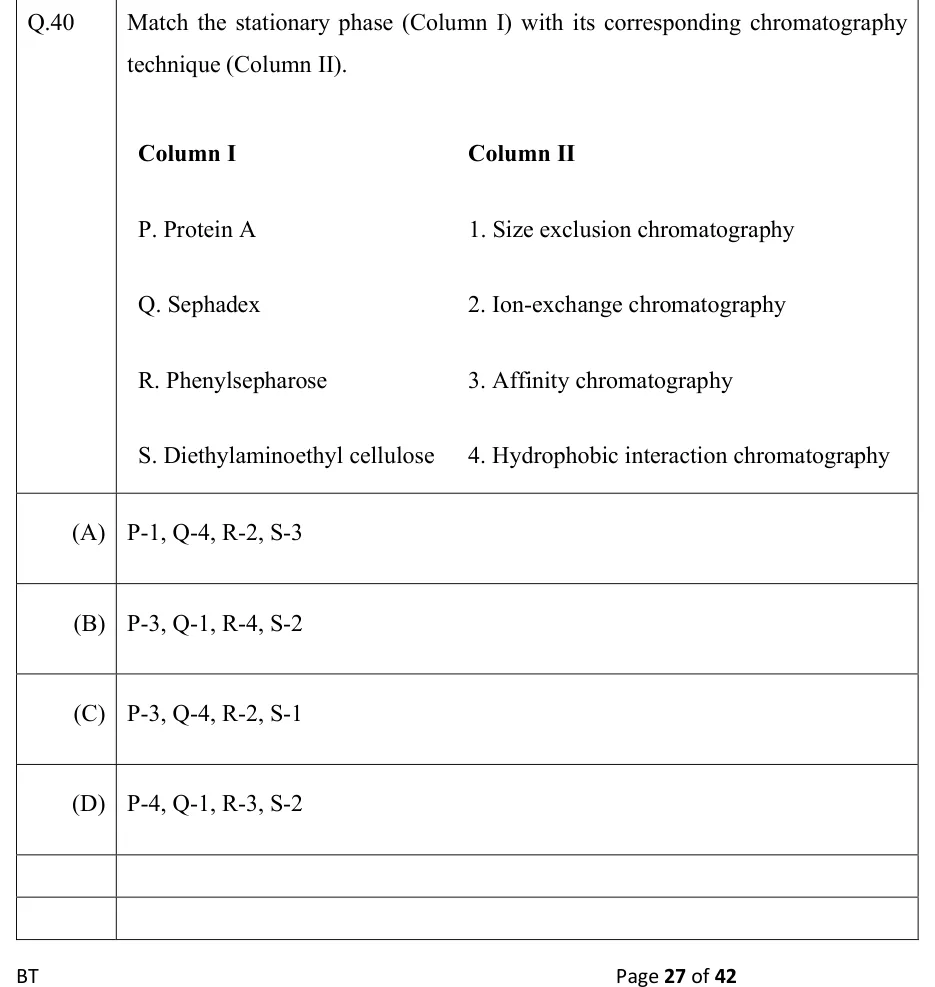
Match the stationary phase (Column I) with its corresponding chromatography technique (Column II).

| Column I | Column II |
|---|---|
| P. Protein A | 1. Size exclusion chromatography |
| Q. Sephadex | 2. Ion-exchange chromatography |
| R. Phenylsepharose | 3. Affinity chromatography |
| S. Diethylaminoethyl cellulose | 4. Hydrophobic interaction chromatography |

  1. (A)

    P-1, Q-4, R-2, S-3

  2. (B)

    P-3, Q-1, R-4, S-2

  3. (C)

    P-3, Q-4, R-2, S-1

  4. (D)

    P-4, Q-1, R-3, S-2

See the question in the paper

Answer and solution

ANSWER

P-3, Q-1, R-4, S-2: Protein A goes with affinity chromatography, Sephadex with size exclusion, Phenylsepharose with hydrophobic interaction and DEAE cellulose with ion exchange. The answer is (B).

Official answer: BSource: Official answer key, GATE 2022 BT (IIT Kharagpur)

  1. P. Protein A is a cell-wall protein of Staphylococcus aureus that binds specifically to the Fc region of immunoglobulin G (IgG). When the stationary phase carries a ligand that binds its target through a specific biological interaction, the technique is affinity chromatography, so P → 3. Protein A columns are the standard capture step for monoclonal antibodies.

  2. Q. Sephadex is a bead of cross-linked dextran with a controlled pore size, made so that it does not bind proteins. Molecules too large to enter the pores leave the column first. Smaller molecules pass through the pores, travel a longer path and come out later. Separating molecules by size in this way is size exclusion (gel filtration) chromatography, so Q → 1.

  3. R. Phenylsepharose is agarose (Sepharose) carrying phenyl groups, which are hydrophobic. Proteins are loaded in high salt, which strips water from their surface so that their hydrophobic patches bind the phenyl groups. They are then eluted with a falling salt gradient. This is hydrophobic interaction chromatography, so R → 4.

  4. S. Diethylaminoethyl (DEAE) cellulose is cellulose carrying the tertiary amine group . At working pH this group is protonated, so it is positively charged and binds negatively charged proteins. DEAE cellulose is a weak anion exchanger, which places it under ion-exchange chromatography, so S → 2.

  5. The matching is P-3, Q-1, R-4, S-2, which is option (B). Quick check: only (B) and (C) have P-3, and (C) puts Sephadex under hydrophobic interaction and DEAE cellulose under size exclusion, both of which are wrong.

KEY IDEA

A stationary phase is named after what it carries. A specific biological ligand (Protein A binding the Fc region of IgG) means affinity. A porous cross-linked gel with no binding groups (Sephadex) means size exclusion. Hydrophobic groups on agarose (phenyl on Sepharose) mean hydrophobic interaction. Charged groups (the protonated DEAE amine, an anion exchanger) mean ion exchange.

WATCH OUT FOR

Seeing "Sepharose" in Phenylsepharose and matching it to size exclusion, because plain Sepharose (agarose) is also used as a gel-filtration medium. The phenyl groups are what count here: they make it a hydrophobic interaction resin. Another slip is calling DEAE a cation exchanger. Its amine is positively charged, so it binds anions.

From the GATE 2022 BT paper. Every question of this paper · Download the full paper · All 9 Downstream questions, with notes

More Downstream questions