GATE 2026 BT Q.19
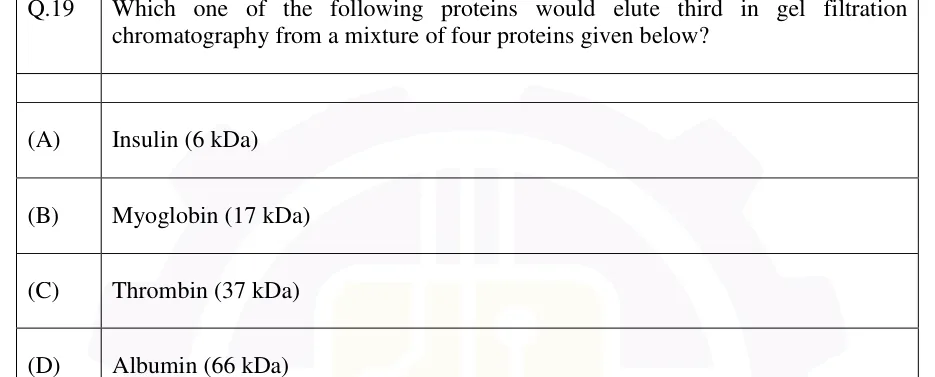
Which one of the following proteins would elute third in gel filtration chromatography from a mixture of four proteins given below?
- (A)
Insulin (6 kDa)
- (B)
Myoglobin (17 kDa)
- (C)
Thrombin (37 kDa)
- (D)
Albumin (66 kDa)

GATE BT
Filtration, centrifugation, chromatography, extraction
Downstream processing is the chain of separation steps that takes a product from the fermentation broth or cell mass to the required purity and final form: solid-liquid separation, cell disruption, concentration, high-resolution purification and drying. Its calculations rest on a small set of relations (Stokes' law and the sigma factor, the sedimentation coefficient, the Ruth cake-filtration equation, membrane flux and polarisation, first-order disruption kinetics, partition and stage balances, adsorption isotherms, plate count and resolution, purification fold and yield), and its descriptive side on knowing which physical or chemical property each technique separates by.
9 previous-year questions · 9 solved · 7 practice questions
Downstream processing (DSP) starts where the bioreactor stops. The product is usually dilute, mixed with cells, debris, medium components and many other proteins, and it may be sensitive to heat, shear, pH or proteases. The design logic follows from this: use cheap, high-capacity, low-resolution steps first while the volume is large, and keep the expensive, high-resolution steps (chromatography) for later, when the volume is small and the product concentrated.
Conventions in these notes: SI units unless stated (m, kg, s, Pa; viscosity in Pa s); is the natural logarithm and the base-10 logarithm; concentrations in g/L, which is numerically equal to kg/m³; rotor speed in rpm and angular speed in rad/s; moisture contents on a dry basis. The same letter is reused in different sections (for example is the specific cake resistance in filtration but the selectivity in chromatography, and is the protein released in cell disruption but the rejection coefficient in membrane work), so each formula defines its own symbols.
Typical order of steps (removal of insolubles, isolation, purification, polishing)
Removal of insolubles - separate cells or debris from the liquid: centrifugation, cake filtration or microfiltration, flocculation and sedimentation. For an intracellular product, harvest the cells, disrupt them, then remove the debris.
Isolation (primary recovery) - remove most of the water and gross impurities, concentrating the product: liquid-liquid extraction (including aqueous two-phase systems), adsorption, precipitation, ultrafiltration.
Purification - separate the product from closely related impurities: chromatography (ion exchange, hydrophobic interaction, affinity, gel filtration), fractional precipitation.
Polishing - bring the product to its final form: crystallisation, sterile filtration, drying (spray drying, lyophilisation), formulation.
SPECIFIC ACTIVITY
In U/mg, where 1 U (enzyme unit) is the amount of enzyme that converts 1 μmol of substrate per minute under the stated assay conditions. It rises as contaminating protein is removed and is the working measure of purity for an enzyme or other active protein.
STEP YIELD AND OVERALL YIELD
Yields use TOTAL activity (or total product mass), never specific activity. The overall yield is the product of the step yields.
PURIFICATION FOLD
Uses SPECIFIC activity; dimensionless, equal to 1 for the crude extract. The fold for one step alone is the ratio of specific activities after and before that step, and step folds multiply.
WORKED EXAMPLE
A crude cell extract contains 2000 mg total protein and 40 000 U of enzyme activity. After ammonium sulphate fractionation it holds 500 mg protein and 32 000 U; after ion-exchange chromatography, 40 mg protein and 24 000 U. Find the specific activity after each step, the overall purification fold and the overall yield.
Specific activities: crude U/mg; after precipitation U/mg; after ion exchange U/mg.
Overall purification fold . Check by steps: precipitation gives , ion exchange gives , and .
Step yields: and . Overall yield , the same as .
Answer: Specific activities 20, 64 and 600 U/mg; purification fold 30; overall yield 60 %.
EXAM TIP
Fold and yield pull in opposite directions: a step can raise the fold while losing product. Because yields multiply, every extra step costs: five steps at 80 % each leave of the product. If a question gives specific activity and asks for yield, first convert back to total activity (specific activity total protein).
Secreted products (extracellular enzymes, most antibiotics, antibodies secreted by mammalian cells) skip this step. Intracellular products, including recombinant proteins made in the cytoplasm of E. coli (often as insoluble inclusion bodies), need the cells opened first. The ease of disruption follows wall strength: animal cells have no wall and lyse easily; Gram-negative bacteria (thin peptidoglycan plus an outer membrane) are generally easier to break than Gram-positive bacteria (thick peptidoglycan); yeasts and fungi (thick walls of glucan, mannan and chitin) and plant cells (cellulose walls) also resist disruption and need vigorous mechanical methods. Resistance also changes with growth conditions and growth phase.
Method | Mechanism | Use and drawbacks |
|---|---|---|
High-pressure homogeniser | Suspension forced through a narrow valve at high pressure; shear, impingement and the sudden pressure drop rupture the cells | Large-scale bacteria and yeast; heats the suspension (cooling between passes), several passes often needed, fine debris; unsuitable for filamentous organisms, which can block the valve |
Bead mill | Rapidly agitated glass or ceramic beads grind and shear the cells | Yeast, fungi, algae and bacteria; heat generation; batch release is first order in time |
Ultrasonication | Cavitation: collapsing bubbles create intense local shear | Laboratory scale; heating and possible damage by free radicals |
Osmotic shock | Cells equilibrated in a hypertonic medium are transferred suddenly to a hypotonic one | Releases periplasmic proteins of Gram-negative bacteria selectively; mild |
Enzymatic lysis (lysozyme) | Hydrolyses the bond between N-acetylmuramic acid and N-acetylglucosamine in peptidoglycan | Acts on Gram-positive bacteria directly; Gram-negative bacteria need EDTA to open the outer membrane first; gentle but costly at scale |
Chemical (detergents, alkali, solvents, chaotropes) | Solubilise membrane lipids or permeabilise the wall | Simple; may denature the product, and the agent must be removed later |
Freeze-thaw | Ice crystals rupture the membranes | Slow, incomplete release; laboratory use |
FIRST-ORDER RELEASE (BATCH BEAD MILL)
= protein released at time , = maximum releasable protein, = first-order rate constant (for example min). Natural log. Equivalently .
HIGH-PRESSURE HOMOGENISER
= number of passes, = operating pressure, = empirical pressure exponent that depends on the organism and its growth conditions, = rate constant (its numerical value depends on the units of and on temperature). Release is first order in the number of passes.
EXAM TIP
With fraction released , . The time (or number of passes) for 90 % release is , and for 99 % it is twice that; for a given neither depends on how much protein is releasable. At a fixed target release on a homogeniser (constant ), is constant, so the passes needed scale as . Harsher disruption is not free: it produces finer debris that is harder to remove and releases nucleic acids that raise viscosity (removed with a nuclease or by precipitating the nucleic acids).
Inclusion bodies are dense aggregates of misfolded recombinant protein. After disruption they are collected by low-speed centrifugation and washed, which already removes much of the host protein. They are then solubilised with a chaotrope (for example 6-8 M urea or 6 M guanidine hydrochloride) plus a reducing agent such as dithiothreitol or -mercaptoethanol to break incorrect disulphide bonds, and refolded by lowering the denaturant concentration (dilution, dialysis or diafiltration) at low protein concentration, which limits aggregation, often with a reduced/oxidised glutathione pair to form the correct disulphides.
A particle in a fluid accelerates until drag balances its net driving force (weight or centrifugal force, minus buoyancy); it then moves at a constant terminal velocity. For small particles in slow (creeping) flow the drag is Stokes' drag, , and microbial cells in broth satisfy this easily. Settling is fast when the particle is large, the density difference is large and the viscosity is low, which is why flocculation (larger effective ) and warming or dilution (lower ) help clarification.
STOKES' LAW (GRAVITY SETTLING VELOCITY)
= particle diameter (m), and = particle and fluid densities (kg/m³), = fluid viscosity (Pa s), = 9.81 m/s². Valid for a rigid sphere settling freely in a dilute suspension (no hindered settling) when the particle Reynolds number is below about 1 (creeping flow). If the particle rises.
CENTRIFUGAL SETTLING VELOCITY
= radial position (m), = angular speed (rad/s); Stokes' regime assumed. The velocity grows with radius, so the particle speeds up as it moves outward.
RELATIVE CENTRIFUGAL FORCE (G-NUMBER)
in rpm, in rad/s, in m. is quoted as 'times g': the factor by which the centrifuge speeds up settling compared with gravity. In practical units, with in cm and in rpm.
SIGMA FACTOR AND CENTRIFUGE SCALE-UP
(m²) is the area of a gravity settling tank that would do the same separation; is the feed rate at which particles of gravity settling velocity are just completely captured. For the same broth and the same separation, is kept constant on scale-up between machines of the same type; comparing different types needs an efficiency correction.
TUBULAR-BOWL CENTRIFUGE
= bowl length, = radius of the liquid surface (inner), = radius of the bowl wall (outer). Derived from Stokes' law, assuming uniform (plug) axial flow, for complete capture of a particle entering at the liquid surface. For a thin liquid layer () it reduces to : the wall area times the G-number.
DISC-STACK CENTRIFUGE
= number of discs ( settling channels), and = outer and inner radii of the discs, = half-cone angle, measured between the disc surface and the axis of rotation. Same complete-capture basis as the tubular-bowl expression.
WORKED EXAMPLE
Yeast cells (diameter 5 μm, density 1080 kg/m³) are to be removed from a broth of density 1000 kg/m³ and viscosity Pa s in a disc-stack centrifuge with 50 discs, outer disc radius 0.15 m, inner radius 0.05 m and half-cone angle 40°, running at 6000 rpm. Using , find the maximum feed rate for complete capture of these cells. Take m/s².
Gravity settling velocity: m/s. Check: , far below 1, so Stokes' law holds.
Angular speed: rad/s, so .
Geometry: m³; ; .
m².
m³/s, about 62.8 m³/h.
Answer: m² and m³/s (about 63 m³/h). This is the ideal value; in practice a correction factor below 1 is often applied.
EXAM TIP
Conventions differ between books: some define the sigma factor through , the feed rate at which HALF the particles of that size are captured (the cut size). In that convention the disc-stack expression for is unchanged (with a uniform flow profile, half capture needs exactly half the residence time), while the tubular-bowl expression becomes approximately . Use the relation the question states; the scale-up rule holds in either convention. Quick ratios: , so halving the particle size cuts the allowable feed rate to one quarter; , so doubling the speed allows four times the feed rate.
Industrial centrifuge | Construction | Suited to |
|---|---|---|
Tubular bowl | Long, narrow bowl spun at high speed; liquid flows axially and solids collect on the wall | Small particles and liquid-liquid separation; small solids capacity, so solids are removed batchwise by stopping the machine |
Disc stack | A stack of conical discs splits the flow into thin channels, shortening the settling distance | Continuous cell harvesting and debris removal; solids held in the bowl, or discharged continuously (nozzles) or intermittently (self-cleaning bowl) |
Decanter (scroll) | Horizontal solid bowl with an internal screw conveyor turning at a slightly different speed, which scrapes the settled solids out continuously | High-solids feeds and coarse or mycelial solids, at lower G-numbers |
Basket (perforated bowl) | Centrifugal filtration through a cloth or screen lining a perforated bowl | Coarse solids and crystals |
Laboratory centrifuges are classed by the field they reach. Low-speed (bench) machines pellet cells, coarse precipitates and nuclei. High-speed centrifuges, usually refrigerated, reach roughly 20 000-30 000 rpm and fields of the order of -: enough for cell debris, mitochondria and other large organelles, and protein precipitates. Ultracentrifuges run at up to about rpm or more and several hundred thousand ; the rotor spins in a refrigerated, evacuated chamber, because air friction at these speeds would heat it. They pellet or band microsomes, ribosomes, viruses and macromolecules. Preparative ultracentrifuges isolate material; the analytical ultracentrifuge follows the sedimenting boundary optically to measure sedimentation coefficients and molecular mass.
SEDIMENTATION COEFFICIENT
= sedimentation velocity at radius : the velocity per unit centrifugal field. has units of time and is quoted in svedbergs, 1 S s. The second form is Stokes' law for a sphere. For a macromolecule, , where = molar mass, = partial specific volume, = frictional coefficient and = Avogadro's number, so depends on mass, density and shape.
SVEDBERG EQUATION (MOLAR MASS FROM S AND D)
= gas constant (8.314 J mol K), = absolute temperature (K), = diffusion coefficient (m²/s), = partial specific volume (m³/kg), = solvent density (kg/m³), in seconds; then comes out in kg/mol. It follows from and , with and measured in the same solvent and at the same temperature.
TIME TO PELLET AND THE CLEARING FACTOR (K-FACTOR)
From at constant : the time for a particle to travel from (top of the liquid) to (bottom of the tube). The clearing factor of a rotor at speed (rpm) gives the pelleting time in hours when is in svedbergs. For the same particle, run times on two rotors scale as .
Method | Principle | Result |
|---|---|---|
Differential centrifugation | Successive runs at increasing RCF and time; each pellet holds the particles that sediment fastest | Crude fractions in the order unbroken cells and nuclei, then mitochondria (with lysosomes and peroxisomes), then microsomes, then ribosomes and large macromolecular complexes; each pellet is contaminated by slower particles that started near the bottom of the tube |
Rate-zonal (density-gradient) centrifugation | Sample layered on top of a preformed gradient (for example sucrose) whose maximum density is below that of the particles; the particles move as bands at rates set by | Separation by size and shape (sedimentation rate); the run is stopped before the bands reach the bottom |
Isopycnic (equilibrium density-gradient) centrifugation | The gradient (for example CsCl, or sucrose for organelles) spans the particle densities; each particle moves to the level where its density equals that of the medium | Separation by buoyant density, independent of size once equilibrium is reached; for example DNA molecules differing in base composition or isotopic label |
EXAM TIP
Quote run conditions as RCF () and time, not rpm: the same rpm gives a different field in rotors of different radius. Sedimentation coefficients are not additive, because depends on shape and friction as well as mass: the 50S and 30S subunits of a bacterial ribosome form a 70S ribosome, and the 60S and 40S eukaryotic subunits an 80S ribosome. Since , doubling the rotor speed cuts the pelleting time to one quarter.
In cake (dead-end) filtration the solids build up as a cake on a filter cloth. The filtrate flows through the cake and the filter medium in series, following Darcy's law: rate = driving force / (viscosity resistance). The cake resistance grows with the volume filtered, so at constant pressure the rate falls with time. Microbial cells form compressible cakes of high resistance; filter aids (for example diatomaceous earth), added to the broth or pre-coated on the cloth, keep the cake porous, and pretreatment (heating, flocculation, pH adjustment) also helps. At industrial scale broths are often filtered continuously on a rotary vacuum drum filter: the drum turns through the slurry, the cake forms under vacuum, is washed and dewatered, and is removed by a knife or strings; for fine or slimy solids the drum is pre-coated with filter aid and a thin layer of it is shaved off with the cake on each turn.
CAKE FILTRATION RATE (DARCY FORM)
= filtrate volume (m³), = filter area (m²), = pressure drop (Pa), = filtrate viscosity (Pa s), = specific cake resistance (m/kg), = mass of dry cake solids per volume of filtrate (kg/m³), = filter-medium resistance (m). is constant for an incompressible cake; for a compressible one see below.
CONSTANT-PRESSURE FILTRATION (RUTH EQUATION)
Integrated form for constant with at . A plot of against is a straight line: the slope gives and the intercept gives . With negligible, , so .
CONSTANT-RATE FILTRATION
At a constant filtrate rate (m³/s) and constant (incompressible cake), the pressure drop must rise linearly with time.
COMPRESSIBLE CAKE
= compressibility index: for an incompressible cake, typically between 0 and 1 for the compressible cakes formed by cells, so raising the pressure gives less gain in rate than an incompressible cake would.
EXAM TIP
At constant pressure with negligible medium resistance, . So doubling the time gives times the filtrate; doubling the area doubles it; doubling multiplies it by , which is for an incompressible cake and no gain at all when . Always convert L to m³ before using or .
WORKED EXAMPLE
A broth is filtered at constant pressure Pa through a filter of area 0.05 m². 1.0 L of filtrate is collected in 50 s and 2.0 L in 160 s. The filtrate viscosity is Pa s and the cake holds 15 kg of dry solids per m³ of filtrate. Find (a) the time to collect 4.0 L, (b) the medium resistance, (c) the specific cake resistance.
Write . The data give s/L at 1 L and s/L at 2 L, so s/L² and s/L.
(a) s.
(b) s/L s/m³, and , so .
(c) s/L² s/m⁶, and , so m/kg.
Answer: (a) 560 s; (b) m; (c) m/kg.
Membrane processes separate mainly by size. In dead-end operation the retained material piles up on the membrane; in cross-flow (tangential-flow) filtration the feed sweeps parallel to the membrane, which limits the build-up, and this is the usual mode for microfiltration of cells and ultrafiltration of proteins. The driving force is the transmembrane pressure (TMP). Retained solute accumulates in a boundary layer next to the membrane (concentration polarisation); for macromolecules its wall concentration can reach the point where a gel layer forms, and the flux then stops responding to pressure.
Process | Retains | Typical use in DSP | Pressure |
|---|---|---|---|
Microfiltration (MF) | Particles of roughly 0.1-10 μm: cells, debris | Cell harvesting, clarification, sterile filtration (0.2 μm) | Low |
Ultrafiltration (UF) | Macromolecules; rated by nominal molecular-weight cut-off (MWCO), roughly 1-1000 kDa | Concentrating proteins; buffer exchange by diafiltration | Moderate |
Nanofiltration (NF) | Small organic molecules and multivalent ions | Desalting, concentrating small molecules | Higher |
Reverse osmosis (RO) | Nearly all solutes, including monovalent salts | Water purification | Highest (must exceed the osmotic pressure) |
MEMBRANE FLUX AND TRANSMEMBRANE PRESSURE
= permeate volume per membrane area per time (m³ m s, often quoted in L m h); = membrane resistance, = resistance of the fouling or polarised layer; and = feed-side pressures at the module inlet and outlet. When the retained solute exerts an osmotic pressure, the driving force becomes ( = reflection coefficient).
GEL-POLARISATION (LIMITING FLUX) MODEL
= boundary-layer mass-transfer coefficient (m/s), = gel (wall) concentration, = bulk concentration. In this regime flux is independent of pressure. It is the film model with full rejection () and .
OBSERVED REJECTION (RETENTION) COEFFICIENT
= permeate concentration, = bulk (retentate) concentration. : fully retained; : passes freely. The intrinsic rejection uses the wall concentration in place of .
BATCH CONCENTRATION BY ULTRAFILTRATION
Well-mixed retentate reduced in volume from to at constant observed rejection . The fraction of solute still in the retentate is .
CONSTANT-VOLUME DIAFILTRATION
Buffer is added as fast as permeate leaves, so the well-mixed retentate volume stays constant; = number of diavolumes. A freely permeating solute (, such as a salt being exchanged out) falls to of its starting level: about 5 % after 3 diavolumes and under 1 % after 5.
EXAM TIP
In the pressure-independent region, raising the TMP only thickens the gel layer. The limiting flux rises only if rises (higher cross-flow velocity or turbulence; higher temperature, which lowers viscosity and raises diffusivity) or if falls. Since , a plot of against is a straight line of slope that meets at . MWCO is a nominal rating; shape, charge and fouling change the real retention, so a membrane with MWCO well below the product's molecular mass is chosen for concentration.
Liquid-liquid extraction transfers the product from the aqueous feed (the raffinate phase) into an immiscible solvent (the extract phase). Small molecules such as antibiotics and organic acids are extracted into organic solvents, with the pH set so the product is uncharged: a weak acid extracts into the organic phase at low pH and is back-extracted into water at high pH. Proteins denature in most organic solvents, so aqueous two-phase systems (ATPS) are used instead: PEG-dextran or PEG-salt (for example phosphate) solutions above critical concentrations split into two aqueous phases. The PEG-rich phase is the lighter top phase; cells and debris usually collect in the bottom phase or at the interface, and protein partitioning is adjusted through the polymer molecular weight, the type and concentration of salt, the pH and the protein's surface hydrophobicity.
PARTITION COEFFICIENT
Equilibrium concentration in the extract (or top) phase divided by that in the raffinate (or bottom) phase. Treated as constant for dilute solutions.
APPARENT PARTITION COEFFICIENT OF AN IONISABLE SOLUTE
= partition coefficient of the uncharged form, assuming only that form enters the organic phase; for the base, is that of its conjugate acid . At pH = p the apparent coefficient is ; once the pH is more than about one unit on the ionising side of the p, each further pH unit cuts it roughly tenfold.
EXTRACTION FACTOR
The ratio of solute AMOUNTS in the two phases at equilibrium; and = extract and raffinate volumes (or volumetric flow rates in continuous operation).
SINGLE EQUILIBRIUM STAGE
For an ATPS the yield in the top phase is with , where and are the top and bottom phase volumes.
N CROSS-CURRENT STAGES
Each stage contacts the raffinate with an equal volume of fresh solvent; is the extraction factor of one stage (based on the solvent used in that stage).
N COUNTERCURRENT STAGES (KREMSER)
Feed enters stage 1 and solvent enters stage ; is based on the total solvent and feed flows, with constant and immiscible phases. For it reduces to .
WORKED EXAMPLE
An antibiotic has partition coefficient (organic/aqueous). 1 L of aqueous broth is extracted with a total of 0.5 L of solvent. Compare the fraction recovered with (a) one stage using all the solvent, (b) two cross-current stages using 0.25 L of fresh solvent each, (c) two countercurrent stages at a solvent-to-feed ratio of 0.5.
(a) . Fraction left , so the fraction recovered is , i.e. 66.7 %.
(b) Per stage . Fraction left , so 75 % is recovered.
(c) and : fraction left , so , i.e. 85.7 %, is recovered.
Answer: 66.7 %, 75 % and 85.7 %. With the same total solvent, splitting it between stages helps, and countercurrent contacting helps most.
Other extraction modes: supercritical carbon dioxide (critical point about 31 °C and 7.4 MPa) dissolves non-polar compounds and leaves no solvent residue when the pressure is released, so it suits heat-sensitive non-polar products such as flavours, essential oils and caffeine; solid-liquid extraction (leaching) recovers a product from solids such as plant material or mycelium.
Adsorption binds the solute onto a solid (activated carbon, ion-exchange or hydrophobic resins). It concentrates dilute products or strips impurities, and it is the equilibrium underneath the binding modes of chromatography. At fixed temperature, the relation between the solid-phase loading (mass of solute per mass of adsorbent) and the liquid concentration is the adsorption isotherm.
LANGMUIR ISOTHERM
Assumes a monolayer on identical, independent sites. = monolayer capacity; = association constant (for example L/g). Written equivalently with , so at . At low it becomes linear, . Linearised: .
FREUNDLICH ISOTHERM
Empirical, for heterogeneous surfaces; it has no saturation limit. indicates favourable adsorption. Linearised: , so a log-log plot has slope .
BATCH ADSORPTION MASS BALANCE
= liquid volume, = mass of adsorbent (initially free of solute), = initial concentration. The equilibrium point lies on both this straight operating line and the isotherm.
In a fixed-bed adsorber fed at concentration and flow rate , the solute is taken up in a mass-transfer zone that travels down the bed. The outlet concentration stays near zero until this zone reaches the outlet (the breakthrough point), then rises along an S-shaped breakthrough curve to when the bed is exhausted. The sharper the curve, the more of the bed's capacity is used before breakthrough. For an ideal sharp front, and neglecting the solute held in the liquid within the bed, a bed holding a mass of adsorbent saturates after , where is the loading in equilibrium with on the isotherm.
Precipitation is a cheap concentration step for proteins. In salting out, salt ions at high ionic strength take up the water that solvates the protein, and exposed hydrophobic patches then drive aggregation; ammonium sulphate is the usual salt because it is very soluble, cheap and generally stabilises proteins. At low ionic strength solubility first rises (salting in). Other precipitants: isoelectric precipitation (net charge zero at the pI, where solubility is lowest), cold organic solvents such as ethanol or acetone (they lower the dielectric constant; kept cold to limit denaturation) and non-ionic polymers such as PEG (excluded volume).
COHN EQUATION (SALTING OUT) AND IONIC STRENGTH
= protein solubility; = intercept (depends on the protein, pH and temperature); = salting-out constant; = ionic strength (mol/L), with the molar concentration and the charge of ion . Base-10 logarithm. Applies in the salting-out region (high ).
EXAM TIP
Ionic strength shortcuts at mol/L: NaCl gives ; gives ; gives . In the Langmuir plot of against , the intercept is and the slope is ; do not swap them.
In chromatography the sample is carried by a mobile phase through a bed of stationary phase. Each component distributes itself between the two phases (by adsorption, ion exchange, partition, specific binding or, in gel filtration, access to the pore volume); components that spend more time in or on the stationary phase emerge later. Because this distribution is repeated along the column, equivalent to many theoretical plates, small differences become complete separations. Elution is isocratic (constant mobile-phase composition), stepwise, or by a gradient (salt, pH or organic solvent) that weakens binding progressively.
Mode | Separates by | Load (bind) under | Elute by | Notes |
|---|---|---|---|---|
Ion exchange (IEX) | Net surface charge | Low ionic strength, at a pH where the protein's charge is opposite to the resin's | Increasing salt, or shifting the pH towards the pI | Anion exchangers (DEAE, Q) carry positive groups and bind negatively charged proteins (pH > pI); cation exchangers (CM, S) bind positively charged proteins (pH < pI) |
Gel filtration (size exclusion) | Size (hydrodynamic volume) | No binding | Isocratic, in one buffer | Largest molecules elute first; used for polishing, buffer exchange and molecular-mass estimation; small sample volume per run (a few per cent of the bed volume for fractionation) |
Hydrophobic interaction (HIC) | Surface hydrophobicity | High salt (for example ammonium sulphate), which strengthens hydrophobic contacts | Decreasing salt | Mild and usually non-denaturing; fits naturally after a salting-out step because the sample is already in high salt |
Affinity | Specific biological recognition | Conditions that favour the ligand: protein A or G for antibodies, immobilised Ni or Co ions for His-tagged proteins, substrate analogues for enzymes | A competing ligand (imidazole for His-tags) or a pH change (low pH for protein A) | Highest selectivity, often a large purification in one step; ligand cost and leakage |
Reversed phase | Hydrophobicity, on a strongly hydrophobic phase (C4 to C18 chains) | Aqueous mobile phase | Increasing organic solvent (for example acetonitrile) | Peptides and small molecules; tends to denature proteins |
Technique | Mobile phase | Column and stationary phase | Suited to |
|---|---|---|---|
Gas chromatography (GC) | Carrier gas (usually He, N₂ or H₂) | A liquid film coated on a solid support (packed column) or on the inner wall (capillary column), in a temperature-programmed oven | Volatile, thermally stable compounds or volatile derivatives (for example fatty-acid methyl esters, solvents); common detectors FID and TCD |
HPLC | Liquid pumped at high pressure | Small (a few μm), rigid, uniform particles, often silica-based, in steel columns | High-resolution analysis and purification of small molecules and peptides, often in reversed phase; common detectors UV-visible absorbance, fluorescence, refractive index |
FPLC | Aqueous buffers at low to medium pressure | Larger, softer porous media (agarose or polymer beads) in glass or inert plastic columns; biocompatible (often metal-free) flow path | Preparative purification of proteins in their native state (IEX, gel filtration, HIC, affinity) |
RETENTION TIME AND RETENTION FACTOR
= elution time of an unretained species (dead time); = retention (capacity) factor; = distribution coefficient (stationary/mobile concentration); and = stationary- and mobile-phase volumes. Retention volumes obey the same relation, .
SELECTIVITY (SEPARATION FACTOR)
Component 2 elutes later. means no separation is possible, however efficient the column. (Not the specific cake resistance of filtration.)
PLATE NUMBER AND PLATE HEIGHT (HETP)
For a Gaussian peak: = baseline width between the tangents (), = width at half height (). and in the same units; = column length. Smaller means a more efficient column.
RESOLUTION
gives baseline separation of two Gaussian peaks of similar size (about 99.7 % separation); still leaves a small overlap (about 98 % separation).
RESOLUTION EQUATION (EFFICIENCY, SELECTIVITY, RETENTION)
is the plate number for the later peak. Resolution grows only as , that is as at fixed plate height.
VAN DEEMTER EQUATION
= linear velocity of the mobile phase. = eddy diffusion (independent of ; smaller for small, uniformly packed particles), = longitudinal molecular diffusion, = resistance to mass transfer between the phases (also smaller for smaller particles). Large proteins diffuse slowly, so the term dominates and their optimum velocity is low.
GEL FILTRATION PARTITION COEFFICIENT
= elution volume, = void volume (liquid outside the beads, found with a fully excluded marker such as blue dextran), = total bed volume. for a fully excluded molecule, approaching 1 for one that permeates all the pores. (A related coefficient, , uses the internal pore volume and runs from 0 to 1 exactly.) Within the fractionation range, is approximately linear in log(molecular mass) for molecules of similar shape, such as globular proteins, which is the basis of the calibration curve.
EXAM TIP
Doubling the column length doubles but raises only by ; doubling at fixed and needs four times the length. A better (another mode, pH or ligand) is often the stronger lever. Charge rule for IEX: pH above the pI means a negative protein and an anion exchanger; pH below the pI means a positive protein and a cation exchanger. Of the modes above, gel filtration is the one in which the biggest molecule comes out first, and HIC binds under exactly the high-salt conditions that elute an ion exchanger. Packed-bed chromatography is scaled up by keeping the bed height, the linear flow velocity (for example cm/h) and the load per unit bed volume constant and increasing the column diameter; the bed volume and the volumetric flow rate then scale with the cross-sectional area.
Drying gives a stable, light product. Moisture content is on a dry basis, = kg water per kg dry solid; the free moisture is . A wet solid dried by air of constant condition (heat reaching it by convection from the air) shows a constant-rate period, in which the surface stays wet and evaporates like free water at the wet-bulb temperature with the rate set by external heat and mass transfer, down to the critical moisture content . A falling-rate period follows, controlled by internal diffusion or capillary flow, towards the equilibrium moisture content set by the air's temperature and humidity. Heat-sensitive bioproducts need either very short heating (spray drying) or low temperature (freeze drying).
CONSTANT-RATE DRYING TIME
= mass of dry solid, = drying area, = constant drying rate (kg water m h), = initial moisture content (dry basis). Applies while .
FALLING-RATE DRYING TIME (RATE LINEAR IN FREE MOISTURE)
Assumes the rate falls linearly from at to zero at ; = final moisture content (). Total drying time .
Freeze drying (lyophilisation), in order
Freezing - cool the product until it is completely solid: below the eutectic temperature for crystallising solutes, or below the glass-transition temperature of the freeze-concentrate for amorphous ones.
Primary drying - lower the chamber pressure so that the water-vapour pressure around the product is below the vapour pressure of the ice at the product temperature (necessarily below the triple point of water, 611 Pa and 0.01 °C), and supply heat gently, so the ice sublimes directly to vapour and is trapped on a colder condenser. The product must stay below its collapse temperature; this is the longest step.
Secondary drying - raise the shelf temperature to desorb the bound, unfrozen water down to a low residual moisture.
Finishing - back-fill with dry inert gas and seal. The porous cake redissolves quickly in water.
Dryer | How it works | Suited to |
|---|---|---|
Spray dryer | Feed atomised into hot gas; droplets dry within seconds and evaporative cooling keeps them near the wet-bulb temperature | Continuous drying of industrial enzymes and food proteins into fine powders |
Freeze dryer (lyophiliser) | Sublimation of ice under vacuum at low temperature | The most heat-sensitive, high-value products: therapeutic proteins, vaccines, microbial cultures; slow and costly |
Drum dryer | Thin film on a heated rotating drum, scraped off when dry | Heat-tolerant, lower-value products |
Vacuum shelf dryer | Batch drying at reduced pressure, so water evaporates at a lower temperature | Small batches of heat-sensitive material |
EXAM TIP
Do not mix up the two limits: separates the constant- and falling-rate periods of convective drying, while the collapse (or eutectic) temperature caps the product temperature during primary freeze drying. Moisture in drying problems is on a dry basis unless stated; a wet-basis fraction converts as .
PREVIOUS-YEAR QUESTIONS
Try each question first, then open the answer. We placed each question under a topic ourselves; the exam paper does not label topics.
See these papers in full: GATE BT 2026 · GATE BT 2025 · GATE BT 2024 · GATE BT 2023 · GATE BT 2022 · GATE BT 2020 · GATE BT 2019
Which one of the following proteins would elute third in gel filtration chromatography from a mixture of four proteins given below?
Insulin (6 kDa)
Myoglobin (17 kDa)
Thrombin (37 kDa)
Albumin (66 kDa)
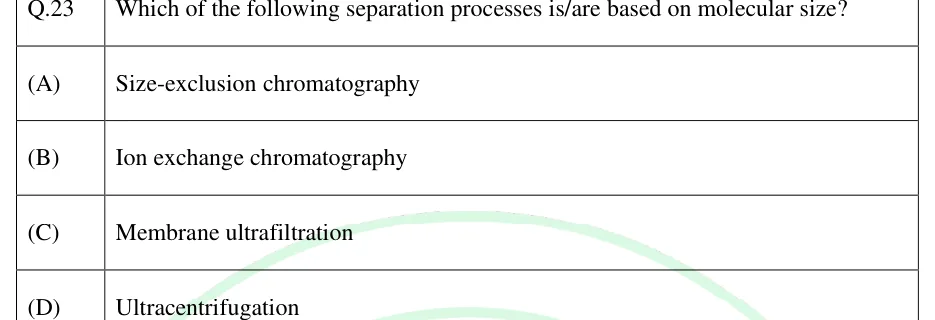
Which of the following separation processes is/are based on molecular size?
Size-exclusion chromatography
Ion exchange chromatography
Membrane ultrafiltration
Ultracentrifugation
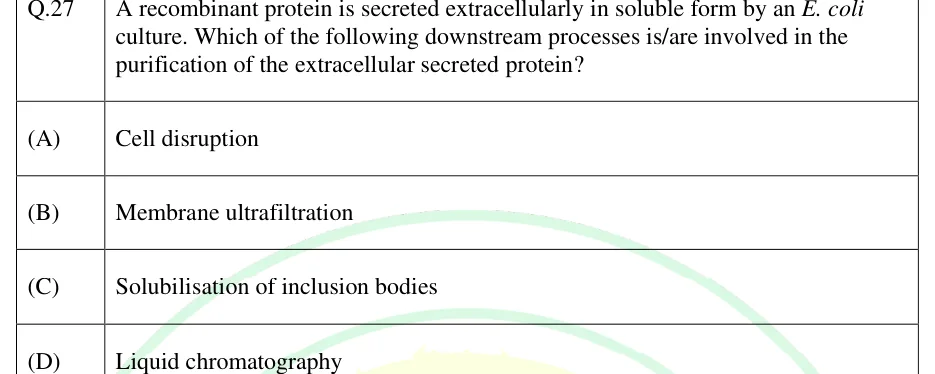
A recombinant protein is secreted extracellularly in soluble form by an E. coli culture. Which of the following downstream processes is/are involved in the purification of the extracellular secreted protein?
Cell disruption
Membrane ultrafiltration
Solubilisation of inclusion bodies
Liquid chromatography
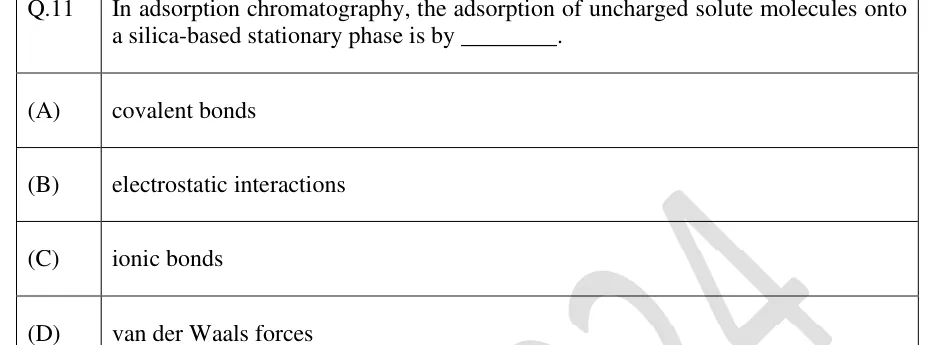
In adsorption chromatography, the adsorption of uncharged solute molecules onto a silica-based stationary phase is by ________.
covalent bonds
electrostatic interactions
ionic bonds
van der Waals forces
Aqueous two-phase extraction is used to recover -amylase from a solution. A polypropylene glycol-dextran mixture is added and the solution separates into upper and lower phases. The partition coefficient is 4.0 and the ratio of upper to lower phase volume is 5.0. The enzyme recovery or yield (in percentage, rounded off to the nearest integer) is ________.
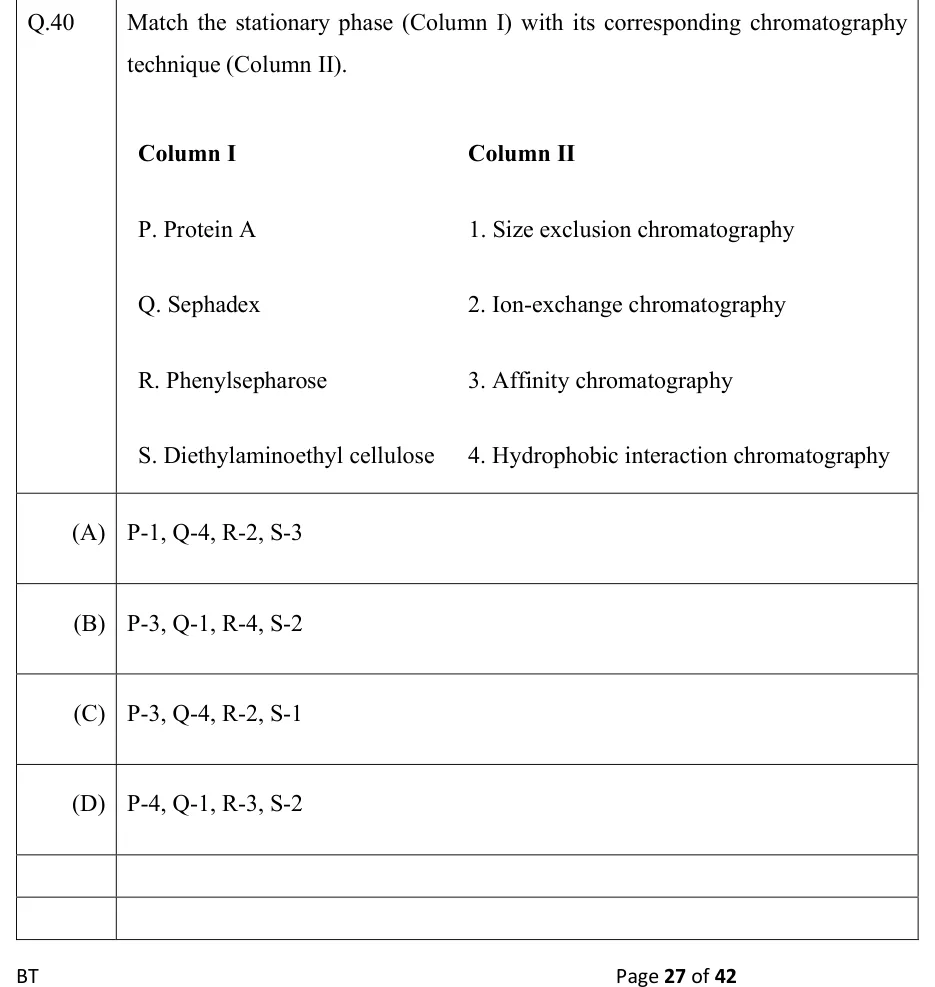
Match the stationary phase (Column I) with its corresponding chromatography technique (Column II).
| Column I | Column II |
|---|---|
| P. Protein A | 1. Size exclusion chromatography |
| Q. Sephadex | 2. Ion-exchange chromatography |
| R. Phenylsepharose | 3. Affinity chromatography |
| S. Diethylaminoethyl cellulose | 4. Hydrophobic interaction chromatography |
P-1, Q-4, R-2, S-3
P-3, Q-1, R-4, S-2
P-3, Q-4, R-2, S-1
P-4, Q-1, R-3, S-2
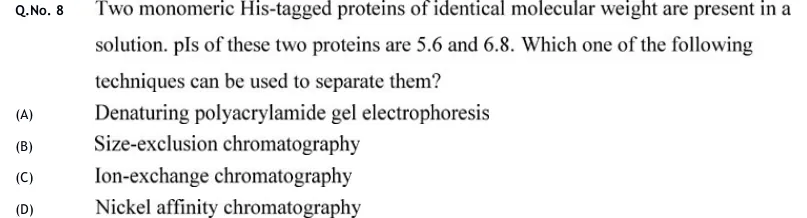
Two monomeric His-tagged proteins of identical molecular weight are present in a solution. pIs of these two proteins are 5.6 and 6.8. Which one of the following techniques can be used to separate them?
Denaturing polyacrylamide gel electrophoresis
Size-exclusion chromatography
Ion-exchange chromatography
Nickel affinity chromatography
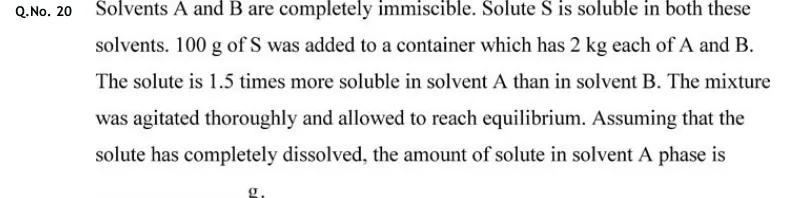
Solvents A and B are completely immiscible. Solute S is soluble in both these solvents. 100 g of S was added to a container which has 2 kg each of A and B. The solute is 1.5 times more soluble in solvent A than in solvent B. The mixture was agitated thoroughly and allowed to reach equilibrium. Assuming that the solute has completely dissolved, the amount of solute in solvent A phase is ________ g.
In a cross-flow filtration process, the pressure drop () driving the fluid flow is 2 atm, inlet feed pressure () is 3 atm and filtrate pressure () is equal to atmospheric pressure. The average transmembrane pressure drop () is ________ atm.
PRACTICE
A protein with isoelectric point 5.0 is dissolved in a 20 mM buffer at pH 7.5. Which column and elution strategy will bind the protein and then recover it?
CM-cellulose (a cation exchanger); elute with a decreasing NaCl gradient
DEAE-cellulose (an anion exchanger); elute with an increasing NaCl gradient
DEAE-cellulose (an anion exchanger); elute with a decreasing NaCl gradient
Phenyl-agarose (hydrophobic interaction); load in the 20 mM buffer and elute with increasing ammonium sulphate
Answer: (B)
At pH 7.5, above the pI of 5.0, the protein carries a net negative charge.
A negatively charged protein binds a positively charged anion exchanger such as DEAE at low ionic strength; it would not bind CM-cellulose.
Raising the salt concentration lets the salt anions compete for the charged groups, so the protein elutes with an increasing NaCl gradient; a decreasing gradient (C) never releases it. Hydrophobic interaction needs high salt to bind and decreasing salt to elute, the reverse of option D.
Yeast cells are disrupted in a batch bead mill and protein release follows first-order kinetics. After 2.0 min, 40 % of the releasable protein has been released. The time (in min) needed to release 90 % of the releasable protein is ______ (round off to two decimal places).
Answer: (accepted range )
with : , so .
For 90 % release: .
min.
On a 25 cm column, two proteins elute at 8.0 min and 9.0 min, with baseline peak widths of 0.8 min and 1.0 min respectively. If the plate height, retention factors and selectivity stay unchanged, the minimum column length (in cm) needed to reach a resolution of 1.5 is ______ (round off to one decimal place).
Answer: (accepted range )
Present resolution: .
With , and fixed, (retention times grow as , peak widths only as ).
cm.
Which of the following statements about filtration and ultrafiltration of bioprocess streams are correct?
In constant-pressure cake filtration with negligible filter-medium resistance, the filtrate volume collected is proportional to the square root of the filtration time.
In the gel-polarisation (pressure-independent) regime of ultrafiltration, doubling the transmembrane pressure doubles the permeate flux.
In tangential-flow ultrafiltration, increasing the cross-flow velocity raises the boundary-layer mass-transfer coefficient and hence the limiting flux.
An observed rejection coefficient of zero for a solute means that the membrane retains it completely.
Answer: (A), (C)
A: with , , so . Correct.
B: in this regime , which does not depend on pressure; extra pressure only thickens the gel layer. Incorrect.
C: the limiting flux is , and increases with cross-flow velocity. Correct.
D: means , so the solute passes freely. Incorrect.
A pilot disc-stack centrifuge with a sigma factor of 1200 m² gives the required clarification of a broth at a feed rate of 0.30 m³/h. For the same broth and the same clarification, the feed rate (in m³/h) that a production disc-stack centrifuge with a sigma factor of 18 000 m² can handle is ______.
Answer: (accepted range )
Equal separation performance means equal .
m³/h.
A weak organic acid (p = 4.0) is extracted from an aqueous broth into butyl acetate. Only the undissociated acid enters the solvent, with a partition coefficient of 50 (organic/aqueous). The broth is held at pH 3.0 and contacted once, to equilibrium, with an equal volume of butyl acetate. The percentage of the acid recovered in the solvent is ______ (round off to one decimal place).
Answer: (accepted range )
Apparent partition coefficient for a weak acid: .
Equal volumes, so the extraction factor .
Fraction recovered , i.e. 97.8 %.
In a preparative ultracentrifuge rotor the liquid extends from = 6.0 cm to = 12.0 cm. The rotor runs at 40 000 rpm. The time (in min) needed to pellet a particle of sedimentation coefficient 100 S (in the run medium) that starts at is ______ (round off to one decimal place).
Answer: (accepted range )
rad/s, so ; s.
s.
min. Check with the clearing factor: , and h min.
OFFICIAL GATE 2027 SYLLABUS WORDING
Copied from the GATE 2027 syllabus; see all 2027 syllabi.
GATE BT
Filtration - membrane filtration, ultra filtration; Centrifugation - high speed and ultra; Cell disruption; Principles of chromatography - ion exchange, gel filtration, hydrophobic interaction, affinity, GC, HPLC and FPLC; Extraction, adsorption and drying
Preparing in Kolkata? IAE Academy's course for GATE BT.