IAE Academy

GATE BT

Media formulation and sterilisation

Media formulation is the design of a growth medium that supplies every element, energy source and growth factor a cell needs, in the right amounts, followed by optimisation of the recipe by statistical experimental design; sterilisation then removes contaminating organisms from that medium and from the aeration air before the fermentation starts. The standard calculations are nutrient requirements from biomass composition and yield, run counts for experimental designs, D and z values, and the Del factor that fixes the holding time of a batch or continuous steriliser, together with the bed depth of an air filter. The conventions matter as much as the formulas: natural log for , the Del factor and the filter constant ; base-10 log for the D value, the z value and ; temperature in kelvin in the Arrhenius equation.

7 previous-year questions · 7 solved · 6 practice questions

Medium design and elemental requirements

A fermentation medium must supply everything that ends up in the cells and products: carbon and energy, nitrogen, phosphorus, sulfur, the other macro-elements, trace metals, any growth factors the organism cannot make, and water. An aerobe also needs oxygen, which is supplied through the gas phase rather than the recipe.

A rational design starts from what the cells are made of. If the target biomass concentration and the elemental composition of dry cells are known, an element balance gives the minimum amount of each nutrient. The carbon source is sized with the yield coefficient instead, because only part of it becomes biomass: the rest is respired for energy or goes into products.

A commonly used average formula for ash-free dry microbial biomass is , which is 24.6 g per C-mol, so carbon is about 49% and nitrogen about 11% of the ash-free dry weight. Real cells vary with the organism and the growth conditions, so use the composition a question gives you.

SUBSTRATE NEEDED FOR A BIOMASS TARGET

and in g/L, in g dry cells per g substrate. For a limiting substrate used up completely, . Maintenance and product formation lower the observed yield, so use the yield measured under the same conditions.

ELEMENT BALANCE FOR A NUTRIENT COMPOUND

in g/L; = mass fraction of element E in dry biomass, = biomass to be formed (g/L), = mass fraction of E in the nutrient compound (for N in , ). This is a minimum: it assumes the compound is the only source of E and that all of it is taken up.

Requirement

Typical sources

Points to remember

Carbon and energy

Glucose, sucrose, lactose, starch, glycerol, molasses, plant oils, methanol

A rapidly used sugar such as glucose can cause catabolite repression of enzymes and secondary metabolites; a slowly used carbon source or fed-batch feeding avoids it

Nitrogen

Ammonium salts, ammonia, urea, nitrate; corn steep liquor, soybean meal, yeast extract, peptones

Uptake of acidifies the medium and uptake of nitrate makes it more alkaline; complex nitrogen sources also supply vitamins and amino acids

Phosphorus

Potassium or sodium phosphates

Needed for nucleic acids, phospholipids and ATP; phosphate also buffers the medium; excess phosphate represses some secondary metabolites

Sulfur

Sulfates, cysteine, methionine

For sulfur-containing amino acids and coenzymes

Macro-minerals (K, Mg)

Salts such as KCl, ,

Required at concentrations above about mol/L; is an enzyme cofactor and stabilises ribosomes and membranes; is an enzyme cofactor and the main intracellular cation

Calcium and iron

, ; iron(II) or iron(III) salts

Needed in intermediate amounts, so some texts class them as macro-elements and others as trace elements; iron is needed for cytochromes and iron–sulfur proteins and precipitates at neutral pH unless it is chelated

Trace elements (Zn, Cu, Mn, Co, Mo, Ni)

Metal salts, often present as impurities in complex ingredients and in tap water

Required below about mol/L, mainly as enzyme cofactors; chelators such as EDTA or citrate keep them in solution; several are toxic in excess

Growth factors

Vitamins, amino acids, purines and pyrimidines; yeast extract

Essential only for organisms (for example auxotrophs) that cannot make them

Other additives

Precursors, inducers, buffers (, phosphate), antifoams, selective agents

A precursor is built into the product (phenylacetic acid into penicillin G); an inducer switches on expression of a gene

Feature

Defined (synthetic) medium

Complex (natural) medium

Composition

Every component and its concentration known

Contains ingredients of undefined composition (yeast extract, peptone, corn steep liquor, molasses)

Batch-to-batch reproducibility

High

Lower, because ingredient composition varies

Growth and productivity

Often lower unless carefully designed

Often higher; supplies growth factors

Cost at industrial scale

Usually higher

Usually lower; many ingredients are agro-industrial by-products

Downstream processing

Easier; fewer impurities

Harder; colour, foaming and impurities

Typical use

Physiology and kinetics studies, element balances, many biopharmaceuticals

Large-scale production of antibiotics and lower-value products

The carbon-to-nitrogen (C:N) ratio decides what the cells make. A balanced ratio supports growth. A high C:N ratio (nitrogen limitation) diverts carbon into storage products such as lipids and polyhydroxybutyrate in organisms that make them, and favours many secondary metabolites, which are typically formed after growth slows.

Some components must be sterilised separately and mixed after cooling. Reducing sugars heated with amino compounds undergo Maillard (browning) reactions, which destroy both and can form inhibitory products. Phosphates heated with calcium or magnesium salts form insoluble precipitates. Heat-labile components such as vitamins, antibiotics, serum and some proteins are sterilised by filtration through a 0.2 µm membrane instead of by heat. Such a filter removes bacteria and fungi from a liquid but not viruses, and some mycoplasmas can pass it, which is why 0.1 µm filters are used where mycoplasma matters, as with serum for animal-cell culture.


EXAM TIP

Size the carbon source with , not with the carbon content of biomass. A carbon balance alone gives the carbon that ends up in cells; the carbon respired to for energy is extra, and the yield coefficient already includes it.

Medium optimisation by statistical design

In one-factor-at-a-time (OFAT) optimisation, one component is varied while all others are held fixed. It is simple, but it needs many runs, it cannot detect interactions between components, and when components do interact it can stop well short of the true optimum.

Statistical design varies several factors together according to a plan, so that main effects and interactions are estimated from few runs. It is usually done in two stages: screening, to find which of many components matter, and then optimisation of the few that do, often with a steepest-ascent step between the two to move the experimental region towards the optimum.

CODED FACTOR LEVEL

= actual level (for example g/L), = centre value, = step from the centre to the high level (half the distance between the low and high levels). The low level codes to , the high level to and the centre to 0.

MAIN EFFECT IN A TWO-LEVEL DESIGN

Mean response over all runs at the high level minus the mean over all runs at the low level. A positive effect means that raising the factor raises the response within the range tested. An interaction effect is found the same way, grouping the runs by the sign of the product . In a regression on coded variables the coefficient is half the effect, , because changes by 2 between the levels.

Design

Purpose

Number of runs

Notes

One-factor-at-a-time

Rough optimisation

Many; grows with factors × levels

Cannot estimate interactions

Full factorial

All main effects and interactions at two levels

Fits a linear model with interactions; added centre points detect curvature but cannot say which factor causes it

Fractional factorial

Screening with fewer runs

Some effects are aliased (confounded) with others

Plackett–Burman

Screening many factors

, a multiple of 4, for up to factors

Main effects only; interactions are assumed negligible

Central composite (CCD)

Response surface (second-order model)

with a full-factorial core

Factorial points, axial (star) points at and centre points; five levels per factor (), or three when

Box–Behnken

Response surface (second-order model)

for to 5

Three levels per factor; no runs at the corners of the cube

RESPONSE SURFACE (QUADRATIC) MODEL

Number of coefficients (10 for ). Fitted by least squares; the stationary point comes from setting every , and it may be a maximum, a minimum or a saddle point, so its nature must be checked before it is called the optimum.

AXIAL DISTANCE FOR A ROTATABLE CCD

= number of factorial points ( for a full-factorial core). For a full-factorial core: for , for , for . A face-centred CCD uses (three levels) and is not rotatable.

PATH OF STEEPEST ASCENT

From a fitted first-order model in coded units, runs are made along the path on which each coded factor changes in proportion to its coefficient (a factor with a negative coefficient is decreased), until the response stops improving; a response-surface design is then placed around that point.

The significance of each term is judged by analysis of variance (F-test and p-value), the quality of fit by and a lack-of-fit test, and the model is confirmed by running experiments at the predicted optimum. Artificial neural networks and genetic algorithms are also used to model and search the response when it is strongly nonlinear.

EXAM TIP

Count runs from the formula, not from memory: a CCD for has non-centre runs, so with 6 centre points it has 20 runs; a Box–Behnken design for has 12 non-centre runs. A quadratic model in factors needs at least distinct runs and at least three levels of each factor. A two-level factorial cannot fit one whatever its size: at every factorial point, so the cannot be separated from .

Thermal death kinetics: D value and z value

Moist heat (saturated steam) kills by denaturing proteins and nucleic acids and is far more effective than dry heat at the same temperature; 121 °C corresponds to saturated steam at about 1 atm (15 psi) above atmospheric pressure. Bacterial spores are the most heat-resistant common contaminants, so their kinetics set the design.

At a constant temperature, the number of viable organisms falls by first-order kinetics: a plot of (or ) against time is a straight line.

FIRST-ORDER THERMAL DEATH

= number of viable organisms (use the total number in the vessel for design, not the concentration); = specific death rate constant in min or s. Holds at constant temperature.

DECIMAL REDUCTION TIME (D VALUE)

Time at a fixed temperature for a 90% kill (one log cycle). and must refer to the same temperature.

TEMPERATURE DEPENDENCE OF THE DEATH RATE (ARRHENIUS)

in kelvin, J mol K, = activation energy for death in J mol, has the units of .

Z VALUE

= temperature rise that reduces tenfold, assuming falls linearly with temperature. It is a temperature difference, so its value is the same in °C and K.

LINK BETWEEN Z AND THE ACTIVATION ENERGY

From equating the Arrhenius and z-value descriptions between and (in kelvin). The two models are not exactly equivalent, so a z value obtained this way applies to the temperature range it was calculated over. A large means a small , that is, a strongly temperature-sensitive process.

Q10

Factor by which the death rate rises for a 10 °C rise in temperature ( in °C).

F VALUE (EQUIVALENT TIME AT A REFERENCE TEMPERATURE)

Converts a varying temperature history into minutes at ( and in °C, = z value of the target organism). The standard uses °C and °C; mainly used in food and pharmaceutical sterilisation.

Real survivor curves can show a shoulder (a delay before killing starts, for example from clumps or spore activation) or tailing (a more resistant subpopulation). Design calculations nevertheless use first-order kinetics with data for the most resistant expected contaminant, conventionally the spores of the thermophile Geobacillus stearothermophilus (formerly Bacillus stearothermophilus), whose D value at 121 °C is of the order of minutes.

Because falls exponentially it never reaches zero, so sterility is a probability. The design value is the expected number of survivors per batch: means about one contaminated batch in 1000. Terminal sterilisation of pharmaceutical products is designed to a stricter sterility assurance level, conventionally per unit.

PROBABILITY THAT A BATCH IS CONTAMINATED

= expected number of surviving organisms per batch; survivors are assumed to be Poisson-distributed between batches. For , .

EXAM TIP

Keep the two logarithms apart: and the Del factor use , the D value uses . A reduction of log cycles is a Del factor of , and . Mixing them gives an answer wrong by a factor of 2.303.

Del factor and batch sterilisation

The Del factor is the design criterion for sterilisation: the natural log of the ratio of the number of organisms before to the number after. It is fixed by the number of spores the batch starts with (concentration × volume) and by the acceptable risk (how many may survive), and not by the temperature. The temperature programme then decides how the required is delivered.

DEL (DESIGN) FACTOR

Dimensionless, natural log. (spore concentration × medium volume), = acceptable number of survivors per batch (for example ).

BATCH CYCLE: HEATING, HOLDING AND COOLING

and are the integrals of over the heating and cooling temperature–time profiles; the holding period at constant temperature supplies the rest.

SCALE-UP AT EQUAL CONTAMINATION RISK

For the same spore concentration and the same acceptable per batch, a larger vessel needs a larger Del factor, because it starts with more spores.

Heating or cooling method

Temperature–time profile

Shape

Direct steam sparging

Hyperbolic

Electrical heating at constant rate

Linear

Steam in a coil or jacket (heat source at constant )

Exponential

Cooling water in a coil or jacket (inlet , flow , specific heat )

Exponential

In the table, = medium temperature at the start of the period, = initial mass of medium, = its specific heat, = enthalpy of the steam relative to the raw medium temperature, = steam mass flow rate, = overall heat-transfer coefficient and = heat-transfer area. With sparging, the condensed steam adds to the medium mass, which is why appears. All four assume a well-mixed medium, constant physical properties and no heat losses.

Finding the holding time of a batch steriliser

  1. Compute , choose the acceptable (for example ) and find .

  2. From the heating profile , find at each time with the Arrhenius equation and integrate (graphically, or by the trapezoidal or Simpson's rule) up to the holding temperature to get . For spores, the part of the profile below about 100 °C contributes little, because for spore activation energies of a few hundred kJ mol, at 100 °C is roughly two orders of magnitude smaller than at 121 °C.

  3. Do the same over the cooling profile to get .

  4. Subtract: , then .

  5. If nutrient loss matters, repeat the integral with the nutrient's own Arrhenius constants to estimate how much is destroyed over the whole cycle (next formula).

NUTRIENT RETAINED OVER THE CYCLE

= concentration of a heat-labile nutrient, = its first-order destruction rate constant, and = its Arrhenius constants, integrated over the same heating, holding and cooling profile as the Del factor.

WORKED EXAMPLE

A 50 m batch of medium contains viable spores per mL. The acceptable risk is one contaminated batch in 1000. For the spores, min at 121 °C. Integrating the heating and cooling profiles gives and . Find the holding time at 121 °C.

Solution
  1. Initial number of spores: , using 1 m = mL.

  2. One contaminated batch in 1000 means surviving spores per batch.

  3. Total Del factor: .

  4. Holding contribution: .

  5. Holding time: min.

  6. Check: ignoring heating and cooling would give min, which over-sterilises the medium and destroys more nutrients.

Answer: About 9.1 min at 121 °C.

EXAM TIP

In a large fermenter, heating and cooling take long enough to deliver a large share of the required Del factor. Leaving them out errs on the safe side for sterility, but it lengthens the holding time and increases nutrient destruction. The bigger the vessel, the slower it heats and cools (less heat-transfer area per unit volume), so heating and cooling deliver a larger and less controllable share of the Del factor, and nutrient destruction rises; this is one reason large volumes are sterilised continuously.

Continuous (HTST) sterilisation

Continuous sterilisation heats the medium quickly to a high temperature, typically 130–150 °C, holds it in an insulated holding tube for seconds to a few minutes, and cools it quickly (high temperature, short time: HTST). Heating is by direct steam injection or by plate or spiral heat exchangers; cooling is by flash expansion through a valve into a vacuum chamber or by heat exchangers. In heat-exchanger systems the hot sterile medium preheats the incoming cold medium (regenerative heat recovery), which cuts steam and cooling-water use.

The reason HTST works is that the activation energy for spore death is much larger than that for the thermal destruction of most nutrients and vitamins. Raising the temperature therefore raises the death rate far more than the nutrient destruction rate, and the same Del factor is reached in a much shorter time with much less nutrient loss.

HOLDING TUBE IN PLUG FLOW

= mean velocity, = volumetric flow rate, = tube internal diameter, = holding-tube length, at the holding temperature. Valid for a flat (turbulent) velocity profile, negligible axial dispersion and near-instant heating and cooling; otherwise add and .

HOLDING TUBE WITH AXIAL DISPERSION

= axial dispersion coefficient; first-order death, closed-vessel boundary conditions. As this reduces to plug flow, , and as to a completely mixed vessel, . For large , , so dispersion always lowers the Del factor.

COMPLETELY MIXED CONTINUOUS VESSEL

Steady state. Far poorer than plug flow at the same mean residence time, because part of the fluid leaves almost as soon as it enters.

Aspect

Batch (in the fermenter)

Continuous (HTST)

Temperature and time

About 121 °C, holding for minutes to tens of minutes, plus long heating and cooling periods

Typically 130–150 °C, holding for seconds to a few minutes

Nutrient damage

Higher

Lower for the same Del factor

Energy

Little or no heat recovery; high peak steam demand

Regenerative heat recovery; steady, lower steam demand

Control and scale-up

Del factor depends on slow, size-dependent heating and cooling

Uniform and reproducible; straightforward to scale

Equipment and risk

Simple, low capital; vessel is sterilised together with the medium

Higher capital; the fermenter must be sterilised separately and the medium transferred aseptically

Difficult media

Copes with suspended solids and foaming media

Solids and foaming cause problems; direct steam injection dilutes the medium with condensate

WORKED EXAMPLE

The medium of the previous example (required ) is sterilised continuously at 140 °C instead. For the spores, min at 121 °C and kJ mol. The medium flows at 10 m h through a holding tube of 0.10 m internal diameter. Assume plug flow and instantaneous heating (steam injection) and cooling (flash). Find (a) at 140 °C, (b) the holding time, (c) the holding-tube length and (d) the z value of the spores between 121 and 140 °C.

Solution
  1. Temperatures: K, K, so K.

  2. (a) , so and min.

  3. (b) The required Del factor does not change with temperature (it depends only on and ): min s.

  4. (c) m/s, so m.

  5. (d) °C.

  6. If the flow were laminar, the centreline fluid would move at and spend only 8.7 s in the tube; designing for it would double the length to about 12.3 m.

Answer: (a) about 127 min; (b) about 17.4 s; (c) about 6.15 m; (d) about 11.1 °C.

EXAM TIP

Size a holding tube for the fastest fluid, not the average. In laminar flow the maximum velocity is twice the mean, so the shortest residence time is half the mean; in turbulent flow the profile is much flatter (maximum about 1.2 times the mean). That is why holding tubes are run in turbulent flow, with the Reynolds number above about 4000.

EXAM TIP

With direct steam injection the condensate dilutes the medium, and flash cooling removes water as vapour; account for both when a question asks for the final medium volume or concentration.

Sterilisation of air by filtration

An aerobic fermentation needs a large, continuous flow of sterile air. Heat sterilisation of that much air is uneconomic: dry heat kills far more slowly than moist heat, so the air would need much higher temperatures, and gases transfer heat poorly (the heat of adiabatic compression helps but is not relied on). UV light and chemical treatment are unreliable, so air is sterilised by filtration.

Two types are used. Depth filters are beds of fibres (glass wool, other fibrous media) whose gaps are larger than the organisms; they capture particles by several mechanisms, so removal is probabilistic and follows a log-penetration law. Membrane (surface) filters are hydrophobic polymer membranes such as PTFE or PVDF with a 0.2 µm liquid rating, which retain bacteria by sieving and, in dry gas, also capture much smaller particles by the same mechanisms as a depth filter; they are usually fitted as steam-sterilisable cartridges after prefilters. Exhaust gas is filtered too when the organism must be contained.

Capture mechanisms in a fibrous depth filter

  1. Inertial impaction: the particle cannot follow the air streamline around a fibre and hits it; stronger for larger particles and higher velocity.

  2. Interception: a particle following a streamline touches the fibre because of its own size; depends on the ratio of particle to fibre diameter.

  3. Diffusion (Brownian motion): small particles wander off the streamlines onto fibres; strongest for small particles at low velocity.

  4. Electrostatic attraction between charged particles and fibres.

  5. Gravitational settling: minor at usual velocities.

Because impaction strengthens and diffusion weakens as air velocity rises, the collection efficiency passes through a minimum at an intermediate velocity, and filters are operated away from it. In the same way, particles of a few tenths of a micrometre, too small for strong impaction and too large for strong diffusion, penetrate most easily.

DEPTH-FILTER PENETRATION

= filter constant (per unit depth), which depends on air velocity, fibre diameter and packing; = bed depth that removes 90%, so . Collection efficiency , so .

FILTER BED DEPTH FOR A WHOLE FERMENTATION

= organisms per m of air, = air flow rate (m per unit time), = duration of the fermentation, = acceptable number of organisms passing in that time (for example ).

DEPTH FILTER FROM SINGLE-FIBRE EFFICIENCY

= volume fraction of fibres in the bed, = fibre diameter, = single-fibre collection efficiency (combined impaction, interception and diffusion) based on the interstitial velocity. It shows why is proportional to bed depth: every layer of fibres removes the same fraction of what reaches it.

EXAM TIP

Keep air filters dry. A wet depth filter loses efficiency and can let organisms grow through, so compressor air is cooled and reheated or passed through a coalescer to stay above its dew point.

EXAM TIP

In filter problems, is the total number of organisms delivered over the whole run (), not the concentration in air, and converts to with : .

PREVIOUS-YEAR QUESTIONS

7 questions from the BT papers

Try each question first, then open the answer. We placed each question under a topic ourselves; the exam paper does not label topics.

See these papers in full: GATE BT 2026 · GATE BT 2024 · GATE BT 2022 · GATE BT 2019

GATE 2026 BT Q.59

GATE 2026 · BTQ.59 · 2 marks · NAT

A batch sterilizer is being operated at 121 °C for sterilizing a medium containing microbial cells. Assume that the thermal deactivation of cells is a first order process with a death rate constant of 0.69 min at 121 °C. If the initial concentration of microbes in the medium is cells m, the time taken to reduce the microbial load to a final concentration of 10 cells m is ________ min. (rounded off to the nearest integer)

Answer and solution
See the question in the paper
GATE 2026 BT Q.59: answer and solution

GATE 2026 BT Q.62

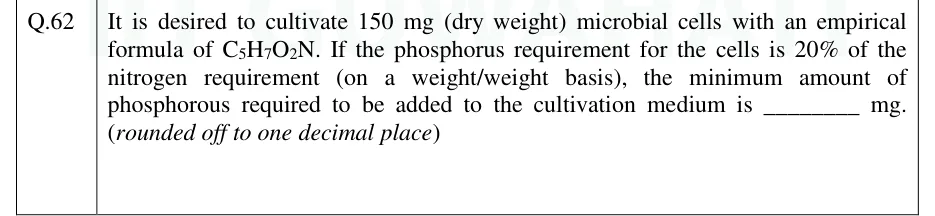
GATE 2026 · BTQ.62 · 2 marks · NAT

It is desired to cultivate 150 mg (dry weight) microbial cells with an empirical formula of . If the phosphorus requirement for the cells is 20% of the nitrogen requirement (on a weight/weight basis), the minimum amount of phosphorous required to be added to the cultivation medium is ________ mg. (rounded off to one decimal place)

Answer and solution
See the question in the paper
GATE 2026 BT Q.62: answer and solution

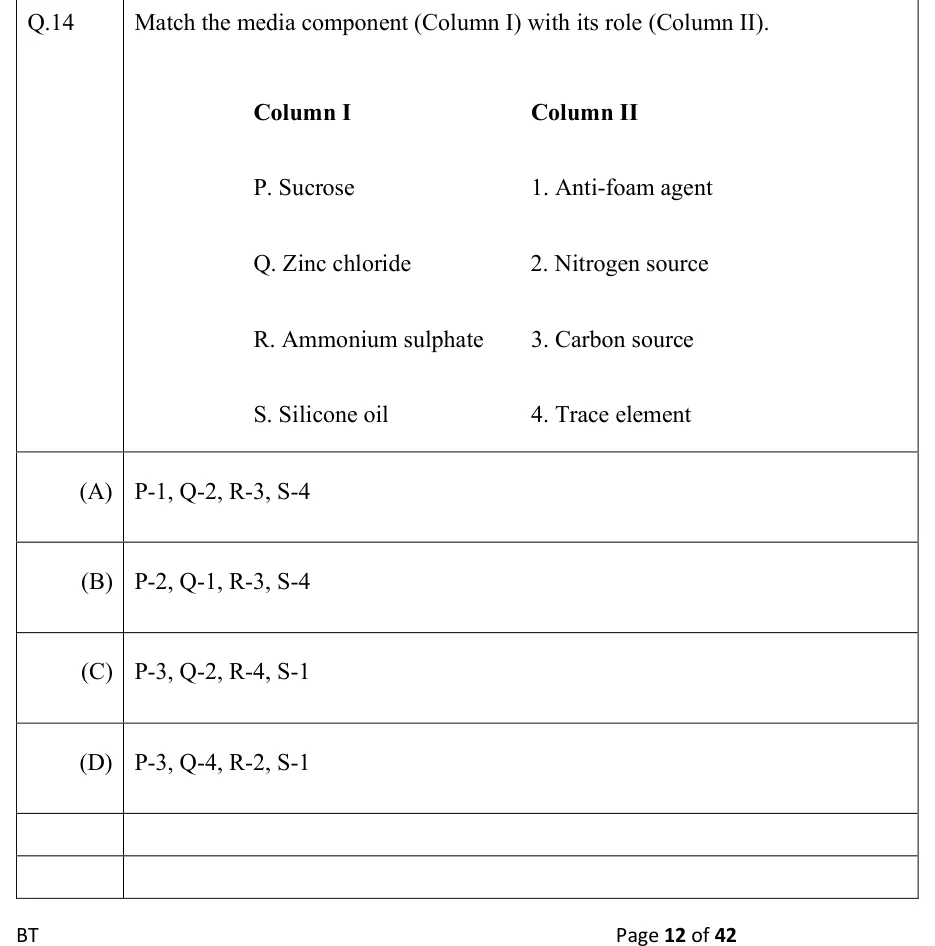
GATE 2022 BT Q.14

GATE 2022 · BTQ.14 · 1 mark · MCQ

Match the media component (Column I) with its role (Column II).

| Column I | Column II |
|---|---|
| P. Sucrose | 1. Anti-foam agent |
| Q. Zinc chloride | 2. Nitrogen source |
| R. Ammonium sulphate | 3. Carbon source |
| S. Silicone oil | 4. Trace element |

  1. (A)

    P-1, Q-2, R-3, S-4

  2. (B)

    P-2, Q-1, R-3, S-4

  3. (C)

    P-3, Q-2, R-4, S-1

  4. (D)

    P-3, Q-4, R-2, S-1

Answer and solution
See the question in the paper
GATE 2022 BT Q.14: answer and solution

GATE 2022 BT Q.63

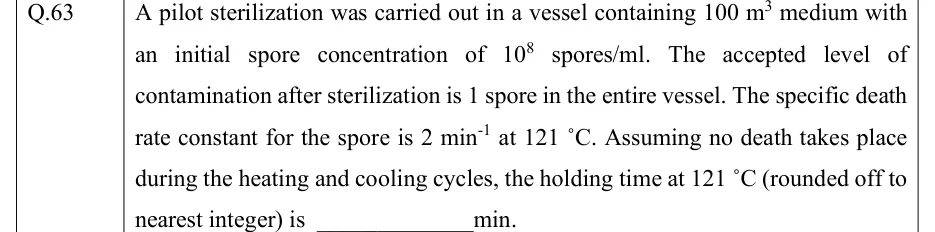
GATE 2022 · BTQ.63 · 2 marks · NAT

A pilot sterilization was carried out in a vessel containing 100 m medium with an initial spore concentration of spores/ml. The accepted level of contamination after sterilization is 1 spore in the entire vessel. The specific death rate constant for the spore is 2 min at 121 °C. Assuming no death takes place during the heating and cooling cycles, the holding time at 121 °C (rounded off to nearest integer) is ________ min.

Answer and solution
See the question in the paper
GATE 2022 BT Q.63: answer and solution

GATE 2019 BT Q.54

GATE 2019 · BTQ.54 · 2 marks · NAT

An industrial fermentor containing 10,000 L of medium needs to be sterilized. The initial spore concentration in the medium is spores . The desired probability of contamination after sterilization is . The death rate of spores at 121 °C is . Assume that there is no cell death during heating and cooling phases. The holding time of the sterilization process is __________ min (rounded off to the nearest integer).

Answer and solution
See the question in the paper
GATE 2019 BT Q.54: answer and solution

PRACTICE

6 questions to test yourself

PRACTICE 11 mark · NAT

A defined medium is to support the formation of 30 g/L of dry biomass that contains 12% nitrogen by mass. Ammonium sulfate, , is the only nitrogen source and all of it is taken up. Using atomic masses N = 14, H = 1, S = 32 and O = 16, the minimum ammonium sulfate concentration required, in g/L, is ______ (rounded to two decimal places).

Answer and solution

Answer: (accepted range )

  1. Nitrogen needed: g N per litre.

  2. Molar mass of g/mol, containing 28 g N, so .

  3. Ammonium sulfate needed g/L.

PRACTICE 21 mark · MCQ

The decimal reduction time of a spore population is 20 min at 110 °C and 2.5 min at 120 °C. Assuming varies linearly with temperature, the time needed at 130 °C for a 6-log (99.9999%) reduction is closest to

  1. (A)

    0.31 min

  2. (B)

    1.88 min

  3. (C)

    2.50 min

  4. (D)

    15.0 min

Answer and solution

Answer: (B)

  1. °C, so falls by a factor of 8 for every 10 °C.

  2. min.

  3. A 6-log reduction takes min, closest to 1.88 min. (Option A is itself, option C is , and option D is .)

PRACTICE 32 marks · MSQ

Which of the following statements is/are correct?

  1. (A)

    For the same Del factor, sterilising at a higher temperature for a shorter time destroys less of a heat-labile nutrient, because the activation energy for spore death is larger than that for the nutrient's thermal degradation.

  2. (B)

    If the spore concentration and the acceptable number of surviving spores per batch are fixed, a 100 m fermenter needs the same Del factor as a 1 m fermenter.

  3. (C)

    A Plackett–Burman design with 12 runs can estimate the main effects of up to 11 medium components.

  4. (D)

    For the same mean residence time, a completely mixed continuous vessel achieves a larger Del factor than a plug-flow holding tube.

Answer and solution

Answer: (A), (C)

  1. A: correct. With , a temperature rise speeds up spore death more than nutrient destruction, so the required is reached with less nutrient loss.

  2. B: incorrect. is 100 times larger, so the required Del factor is larger by .

  3. C: correct. A Plackett–Burman design in runs ( a multiple of 4) screens up to factors, here 11.

  4. D: incorrect. A completely mixed vessel gives , far less kill than plug flow's at the same .

PRACTICE 42 marks · NAT

A 40 m batch of medium contains viable spores per mL and is to be sterilised so that the expected number of surviving spores per batch is . The D value of the spores at 121 °C is 2.0 min. The heating and cooling periods contribute Del factors of 8.5 and 4.5 respectively. Treating death as first order, the holding time needed at 121 °C, in minutes, is ______ (rounded to two decimal places).

Answer and solution

Answer: (accepted range )

  1. .

  2. .

  3. .

  4. min.

  5. min.

PRACTICE 52 marks · NAT

An aerobic fermentation runs for 72 h with an air flow of 20 m min. The inlet air carries 500 viable organisms per m. A fibrous depth filter at the design air velocity has cm (the bed depth that removes 90% of the organisms). If the acceptable number of organisms passing through the filter during the whole fermentation is , the required bed depth, in cm, is ______ (rounded to one decimal place).

Answer and solution

Answer: (accepted range )

  1. Organisms reaching the filter: .

  2. .

  3. cm.

  4. cm. (Equivalently, log cycles × 5 cm = 53.2 cm.)

PRACTICE 61 mark · MCQ

A rotatable central composite design is set up for 4 medium components, with a full factorial core and 6 centre points. The total number of runs and the axial distance (in coded units) are

  1. (A)

    30 runs,

  2. (B)

    30 runs,

  3. (C)

    24 runs,

  4. (D)

    38 runs,

Answer and solution

Answer: (A)

  1. Factorial points: . Axial points: . Centre points: 6. Total .

  2. For rotatability, .

  3. Option B uses the for ; option C leaves out the centre points; option D counts axial points and uses the for .

OFFICIAL GATE 2027 SYLLABUS WORDING

Copied from the GATE 2027 syllabus; see all 2027 syllabi.

GATE BT

Upstream and Downstream Processing: Media formulation and optimization; Sterilization of air and media

Preparing in Kolkata? IAE Academy's course for GATE BT.