IAE Academy

GATE BT

Batch, fed-batch and continuous bioreactors, and scale-up

A bioreactor can be run as a batch, as a fed-batch or continuously (a chemostat). All three are described by the same mass balances on cells, substrate, product and oxygen; only the inflow and outflow terms change. The topic is mostly quantitative: you solve a question by writing the balance that fits the mode of operation and knowing the conditions behind each standard result. That covers steady states and washout in a chemostat, feed rates in fed-batch, from oxygen data, how speed and power change on scale-up, and the residence time an enzyme reactor needs for a given conversion.

24 previous-year questions · 23 solved · 7 practice questions

Batch, fed-batch and continuous operation

Every bioreactor calculation starts from one balance on the liquid in the vessel: accumulation = in − out + generation − consumption. The three modes differ only in the flow terms. In a batch run nothing enters or leaves after inoculation (apart from air, exhaust gas and small additions of acid, base or antifoam), so the volume is constant while , and change with time. In fed-batch medium is added but nothing is withdrawn, so rises. In continuous operation medium enters and broth leaves at the same flow , so is constant and, after start-up, the culture settles to a steady state.

Conventions used throughout: concentrations in g/L (biomass as dry cell weight), time in h, specific growth rate in h, dilution rate in h with the working (liquid) volume, yield in g cells per g substrate, in g/L, and natural logarithms. is the initial substrate concentration in a batch and the feed concentration in a chemostat or fed-batch. Oxygen concentrations are in mg/L or mmol/L (1 mmol O = 32 mg). A few letters are reused and are defined where they appear: is product concentration in the balances, total pressure in the oxygen section and shaft power in the agitation section; is the recycle ratio under cell recycle and the growth-associated constant in product formation; alone is the recycle concentration factor, while and are dissolved-oxygen concentrations; is a first-order rate constant for cell death or for enzyme deactivation.

MONOD KINETICS

= maximum specific growth rate (h); = saturation constant, the substrate concentration at which (g/L). For , . Every result below that contains assumes this form, with a single growth-limiting substrate.

Feature

Batch

Fed-batch

Continuous (chemostat)

Liquid flows during the run

None after inoculation

Feed in, nothing out

Feed in = broth out (flow )

Volume

Constant

Rises:

Constant

Specific growth rate

Changes through the lag, exponential (), deceleration, stationary and death phases

Set by the feed: at quasi-steady state, or held constant by exponential feeding

Chosen by the operator: at steady state

Substrate concentration

Starts high, falls to near zero

Kept low by the feed rate

Constant and low,

Strengths

Simple; each run is a fresh, contained lot; suits products formed after growth stops

High cell density; avoids substrate inhibition, overflow metabolism and catabolite repression; caps O demand and heat load

Usually the highest volumetric productivity for growth-associated products; steady product quality; growth studies at a chosen

Weaknesses

Down-time between runs lowers average productivity

Needs feed control; the run ends when the vessel is full

Contamination and strain-instability risk over long runs; washout at high

EXPONENTIAL GROWTH AND DOUBLING TIME

Exponential phase of a batch culture, where so that ; no lag and no death.

BATCH YIELD BALANCE

Constant yield, substrate used only for growth. When the substrate is exhausted () the biomass reaches its maximum, .

BATCH GROWTH TIME

Time to grow from to if the cells grow at the whole time ( negligible, lag ignored).

BATCH TIME WITH MONOD KINETICS (INTEGRATED)

Exact result with Monod kinetics and constant yield, with no lag and no death; and are linked by the yield balance. When is negligible beside it reduces to , the exponential-growth result. With , reaching exactly takes infinite time, so the formula is used for a stated final or .

BATCH PRODUCTIVITY

Averaged over the whole cycle. = turnaround time per cycle: harvesting, cleaning, sterilising, filling and lag.

EXAM TIP

Batch productivity is averaged over the WHOLE cycle, including the turnaround time ; leaving out overstates it. The log in is the natural log. Using gives a time 2.303 times too small.

The chemostat: balances, washout and optimum dilution rate

A chemostat is a well-mixed vessel fed with sterile medium that contains the limiting substrate at , at flow rate . Broth is removed at the same , so stays constant. Because the contents are well mixed, the outflow carries the reactor concentrations , and . Dividing the balances by brings in the dilution rate , whose reciprocal is the mean residence time.

CHEMOSTAT BIOMASS BALANCE

No cells in the feed (sterile), cell death neglected. At steady state with this gives : the feed rate sets the growth rate.

CHEMOSTAT SUBSTRATE BALANCE

Substrate used only for growth (no maintenance term), with constant.

STEADY-STATE SUBSTRATE CONCENTRATION

Monod kinetics with . It does not depend on and holds only for .

STEADY-STATE BIOMASS CONCENTRATION

From the substrate balance at steady state. Proportional to ; it rises linearly with , and nearly in proportion to it when .

WASHOUT (CRITICAL) DILUTION RATE

Found by setting (so ). For cells leave faster than they can grow and the culture washes out. Without recycle, for any finite .

FINDING THE MONOD CONSTANTS FROM CHEMOSTAT DATA

Monod kinetics with at each steady state. Measure at several dilution rates: a plot of against is a straight line with intercept and slope .

VOLUMETRIC BIOMASS PRODUCTIVITY

Grams of cells per litre of reactor per hour. For a product, .

DILUTION RATE FOR MAXIMUM PRODUCTIVITY

From with Monod kinetics, no maintenance and no death. It lies below , and close to it when .

MAXIMUM CHEMOSTAT PRODUCTIVITY

Productivity at . The substrate concentration there is .

How the steady state moves with : at low , is small and . As approaches , rises steeply toward and falls to zero. The productivity rises almost linearly, peaks at and drops to zero at . Because lies close to , where changes steeply with , a small rise in or a small fall in (from a change in temperature or pH) can push a culture run at toward washout, so in practice a chemostat is run a little below . When maintenance or cell death is included, also falls at very low .

CONTINUOUS VS BATCH PRODUCTIVITY (ESTIMATE)

Assumes and (both need ), , and batch growth at . The ratio is usually well above 1. That is why continuous culture gives higher volumetric productivity for growth-associated products, as long as sterility and strain stability can be maintained over a long run.

WORKED EXAMPLE · CHEMOSTAT STEADY STATE AND OPTIMUM

A 2.0 L chemostat is fed sterile medium with g/L of glucose at 0.60 L/h. The organism follows Monod kinetics with h, g/L and g/g (no maintenance, no death). Find (a) the steady-state and , (b) the biomass productivity, (c) the washout dilution rate, and (d) the maximum possible productivity and the at which it occurs.

Solution
  1. h. This is below , so a steady state is possible (confirmed in step 5).

  2. g/L.

  3. g/L.

  4. g/(L h).

  5. h, so h is safely below washout.

  6. , so h.

  7. g/(L h).

  8. Check: at h, h, so g/L, g/L and g/(L h).

Answer: g/L, g/L, g/(L h), h, h with g/(L h).

EXAM TIP

Chemostat traps: (1) has no in it. A stronger feed raises , not (and raises slightly). (2) uses the working liquid volume, not the vessel's total volume. (3) Check before using the steady-state formulas. If the answer is washout (, ), not a negative concentration. (4) Keep units consistent: if is in L/min, is in min and must match the units of .

Chemostat variants: cell recycle, maintenance, products, stages and the turbidostat

Cell recycle. A separator placed after the reactor (a settler, a centrifuge or a membrane) returns part of the cells to the vessel. Convention: the recycle ratio is the recycle flow divided by the fresh feed flow . The concentration factor is the cell concentration in the recycle stream divided by in the reactor (). The separator is assumed not to change the substrate concentration, the fresh feed is sterile, and is based on the fresh feed.

GROWTH RATE WITH CELL RECYCLE

From the steady-state biomass balance on the reactor (no death). A balance on the separator shows that , where is the cell concentration in the effluent that leaves the system, so the factor lies between 0 and 1: cells grow more slowly than the liquid is diluted.

STEADY STATE WITH CELL RECYCLE

Monod kinetics. Same form as the simple chemostat, with replaced by in . is raised by the factor .

WASHOUT WITH CELL RECYCLE

Recycle raises the washout dilution rate, so with enough recycle ( close to 1) can exceed without washout.

Effect of recycle: at a given the reactor holds more cells and leaves less substrate unconverted. It can also run at a higher dilution rate, which raises volumetric productivity. The net biomass leaving the system per unit reactor volume per hour is . The same idea underlies activated-sludge treatment and perfusion culture of animal cells.

MAINTENANCE (PIRT) RELATION

= true growth yield; = maintenance coefficient (g substrate per g cells per h). In a chemostat and , so a plot of against is a straight line with slope and intercept .

STEADY-STATE BIOMASS WITH MAINTENANCE

Applies when substrate is also consumed for maintenance (, no death). is still . falls as .

PRODUCT IN A CHEMOSTAT

Product-free feed, no product degradation. = specific product formation rate (g product per g cells per h), written in the Luedeking–Piret form with growth-associated and non-growth-associated (this is unrelated to the recycle ratio). So .

CHEMOSTAT WITH CELL DEATH

First-order death at rate (h) acting on the viable cells ; dead cells take up no substrate, and is the growth yield. Washout now occurs at .

SECOND STAGE OF TWO CHEMOSTATS IN SERIES

Equal volumes, all fresh feed to stage 1, for each stage, no extra cells or substrate added to stage 2. Stage 1 behaves as a simple chemostat. Combining the two equations gives , and with Monod kinetics closes the set. Stage 2 grows more slowly (), which suits products made at low growth rates.

Turbidostat. Here the biomass concentration (read as optical density) is held at a set value, and a controller varies to keep it there. The steady-state balances are the same (), but is the set variable and follows from it. A turbidostat is stable at high dilution rates close to , the region near where a chemostat drifts toward washout. It is used to keep cells growing near their maximum rate or to select fast-growing variants. It needs a reliable online biomass sensor, which is hard to achieve at high cell density or with wall growth.

Chemostat vs turbidostat

Feature

Chemostat

Turbidostat

Set by the operator

Feed rate , and so

Biomass concentration (via optical density)

Control

No feedback loop: a constant-rate pump sets , and the limiting substrate regulates growth by itself

Feedback loop that adjusts

Stable operating range

Low to moderate

High , close to

What limits growth

A limiting nutrient at low

Nutrients in excess; near

Fed-batch operation

A fed-batch run starts as a batch. Once the initial substrate is nearly used up, a concentrated feed (, far higher than any concentration in the reactor) is added at a controlled rate , with no outflow. The reasons: keep low to avoid substrate inhibition, overflow metabolism (acetate in E. coli, ethanol from the Crabtree effect in baker's yeast) and catabolite repression; hold the oxygen demand and heat load to what the vessel can supply; and reach high cell densities.

VOLUME IN FED-BATCH

Liquid is only added, never withdrawn.

FED-BATCH BALANCES ON TOTAL AMOUNTS

No biomass in the feed, nothing withdrawn, substrate used only for growth. Write fed-batch balances on total amounts (, ), because changes.

FED-BATCH BALANCES AS CONCENTRATIONS

Obtained from the total-amount balances using . They look like the chemostat equations, but here changes with time; under constant feed it falls as grows.

TOTAL BIOMASS UNDER CONSTANT FEED

Holds once substrate is used as fast as it is fed ( small and steady, ). is the total mass of cells, and under constant feed it rises linearly, not exponentially.

SPECIFIC GROWTH RATE UNDER CONSTANT FEED

Applies when all the fed substrate is consumed as it arrives. It falls continuously as the total biomass grows.

QUASI-STEADY STATE (CONSTANT FEED)

Approached as the run proceeds: with constant feed , so tends to , after which and . Because keeps rising, and so fall with time, and the residual falls too.

EXPONENTIAL FEEDING FOR CONSTANT GROWTH RATE

Holds at a chosen , with kept constant at . is the total biomass when exponential feeding starts (). It follows from and the substrate balance with constant. If maintenance matters, replace by . If , use in the denominator.

PRODUCT BALANCE IN FED-BATCH

No product in the feed, no outflow.

Feeding strategies

  1. Constant feed: the simplest. Once the quasi-steady state is reached, falls as grows, and total biomass rises linearly.

  2. Linearly increasing or stepped feed: partly keeps up with the growing biomass.

  3. Exponential feed: holds constant, typically below the growth rate at which overflow metabolism starts.

  4. Feedback feeding (DO-stat, pH-stat): feed is added when the dissolved oxygen rises or the pH shifts, both signs that the substrate has run out.

WORKED EXAMPLE · CONSTANT-FEED FED-BATCH

A fed-batch culture holds 2.0 L of broth with 20 g/L biomass when constant feeding starts: L/h of medium with g/L glucose, g/g. Glucose is consumed as fast as it is fed (). After 10 h, find the volume, the total biomass, the biomass concentration, and .

Solution
  1. L.

  2. Biomass formed per hour g/h.

  3. Initial total biomass g, so g and g/L.

  4. h. At the start it was h, so falls continuously under constant feed. (The assumption needs above 0.375 h; otherwise glucose would accumulate at the start.)

  5. h. Here , so is still rising toward g/L, where would equal (the true quasi-steady state).

Answer: L, g, g/L, h, h.

EXAM TIP

Under constant feed the specific growth rate is NOT constant: at quasi-steady state , which falls as grows. Only exponential feeding holds fixed. Do not confuse the concentration (g/L) with the total biomass (g): the linear-growth law is for .

Oxygen transfer: Henry's law, OTR, OUR and kLa

Oxygen dissolves poorly in water, so in aerobic cultures it is usually the first nutrient to become limiting. On its way from bubble to cell it meets several resistances in series. For a sparingly soluble gas the liquid film around the bubble dominates, so the transfer rate is written with the liquid-side volumetric coefficient : (m/s) times the interfacial area per unit liquid volume (m/m). therefore has units of s or h.

HENRY'S LAW

= dissolved O concentration in equilibrium with the gas; = Henry's constant for O in the medium at the operating temperature (pressure per concentration, for example atm L/mmol); = mole fraction of O in the gas (0.21 for air); = total pressure. rises in proportion to the O partial pressure (O-enriched air, higher head pressure). It falls with temperature and with dissolved salts and sugars. Air-saturated pure water at 25 °C and 1 atm holds only about 8 mg/L (about 0.26 mmol/L), and less at higher temperatures.

OXYGEN TRANSFER RATE (OTR)

= dissolved O in the broth. With in mmol/L and in h, OTR is in mmol/(L h). The maximum OTR is , reached when .

OXYGEN UPTAKE RATE (OUR)

= specific O uptake rate (mmol O per g cells per h). It does not depend on above the critical dissolved-oxygen concentration , and falls below it.

DISSOLVED-OXYGEN BALANCE

Well-mixed liquid. At steady state OTR = OUR.

OXYGEN-LIMITED DESIGN

The smallest that keeps at a given cell density, or the largest cell density a given can support.

Dynamic gassing-out method (with respiring cells)

  1. With the culture at a steady dissolved-oxygen (DO) level, switch the air off. DO falls in a straight line with (OUR constant while ; surface aeration neglected), so the slope gives OUR.

  2. Switch the air back on before DO falls below , so that respiration is not disturbed.

  3. While DO recovers, at every point .

  4. Rearrange: . A plot of against is a straight line with slope and intercept .

  5. The method assumes the DO probe responds much faster than .

STATIC GASSING-OUT (NO OXYGEN UPTAKE)

Cell-free medium: strip the O with N, then aerate starting from . The slope of against is . Valid when the DO probe responds much faster than .

Sulphite oxidation. In , catalysed by Cu or Co, the reaction is fast enough to keep dissolved O at essentially zero, so OTR . The remaining sulphite is titrated (iodometrically) at intervals, and the O transfer rate is half the sulphite consumption rate. The test is run in a sulphite solution, not in broth. Its ionic strength changes bubble coalescence, so the found can differ considerably from the value in the real medium.

KLA FROM SULPHITE OXIDATION

2 mol of sulphite consume 1 mol of O, and throughout.

OUR FROM AN EXHAUST-GAS BALANCE

Steady-state gas-phase balance: = gas volumetric flow at pressure and temperature ; = gas constant; = liquid volume. It neglects the small change in total molar gas flow (an inert-gas balance corrects for it). Then , with read from the DO probe.

WORKED EXAMPLE · DYNAMIC GASSING-OUT

A culture with g/L sits at a steady dissolved-oxygen level of 5.0 mg/L. The air is switched off and the DO falls linearly from 5.0 to 3.0 mg/L in 40 s. The saturation concentration in the medium is mg/L. Find (a) the OUR and , (b) , and (c) the highest cell concentration this vessel could support at the same if DO must stay above a critical value of 1.0 mg/L (assume does not change).

Solution
  1. With the air off, , so OUR mg/(L s) mg O/(L h), which is mmol/(L h).

  2. mg O/(g h), or 1.13 mmol/(g h).

  3. Before the air was switched off the DO was steady, so OTR = OUR: , giving h ( s).

  4. g/L.

Answer: OUR = 180 mg O/(L h), = 36 mg O/(g h), = 90 h, = 15 g/L.

EXAM TIP

(1) While the air is off, the slope is (the OUR), with no in it. comes only from the re-aeration curve or from a steady-state balance. (2) In sulphite oxidation, 2 mol of sulphite consume 1 mol of O; forgetting the ½ doubles . (3) in s × 3600 gives h; O in mg/L ÷ 32 gives mmol/L. (4) Raising (O-enriched air, higher back-pressure) increases the driving force without, to a first approximation, changing .

Agitation power and scale-up

Agitation mixes the broth, breaks gas into small bubbles (raising and so ), keeps cells suspended and helps heat transfer. Take a stirred tank with impeller diameter turning at (rev/s), holding a liquid of density and viscosity (the subscript avoids a clash with the growth rate). Two dimensionless groups govern the power it draws:

IMPELLER REYNOLDS NUMBER

in rev/s (not rad/s, not rpm). In a baffled tank, flow is laminar below about 10 and fully turbulent above about .

POWER NUMBER

= ungassed shaft power (W, with in kg/m, in rev/s and in m). For a given impeller and baffled-tank geometry, depends only on .

LAMINAR REGIME

Power does not depend on density ( is a geometry constant).

TURBULENT REGIME

Fully turbulent, baffled tank: power does not depend on viscosity. For a six-blade Rushton turbine is about 5 to 6. Doubling multiplies by 8; doubling multiplies it by 32.

GASSED POWER

Empirical correlation (Michel–Miller form) for the gassed power ; is the gas volumetric flow and depends on the geometry and on the units used. Gas collects in cavities behind the blades and lowers their drag, so at the same . falls as the aeration number rises, until the impeller floods: gas then rises past the impeller without being dispersed.

SUPERFICIAL GAS VELOCITY, AERATION RATE AND TIP SPEED

= tank diameter; vvm = volume of gas per volume of liquid per minute, so in the vvm expression is per minute. Tip speed is a common index of the highest shear, which occurs near the impeller.

KLA CORRELATION (GENERAL FORM)

Empirical: , and depend on geometry and on whether the medium is coalescing. Holding and constant on scale-up is a common way to aim for constant .

MIXING TIME, TURBULENT REGIME

Geometrically similar tanks, fully turbulent: mixing time is inversely proportional to impeller speed. Circulation time scales as .

Scale-up. Under geometric similarity every length scales as , so and grow as the cube root of volume. In the turbulent regime and . Each scale-up criterion holds one quantity fixed, and that fixes how must change:

GENERAL SCALE-UP RULE FOR IMPELLER SPEED

for constant ; for constant tip speed (); for constant ; for constant mixing time (constant ). Turbulent regime at both scales, geometric similarity, ungassed power.

CONSTANT POWER PER UNIT VOLUME

Turbulent regime, geometric similarity. Tip speed then rises as and mixing time as .

Scale-up by 5 times in impeller diameter (125 times in volume), fully turbulent at both scales

Held constant

Tip speed ratio

ratio

Mixing time ratio

0.342

125

1

1.71

8.55

2.92

(mixing time)

1

3125

25

5

25

1

Tip speed

0.200

25

0.200

1

5

5

0.0400

0.200

0.0016

0.200

1

25

Scale-up trade-offs

  1. No single criterion keeps everything the same, so scale-up is always a compromise.

  2. Constant (a common starting point for aerobic cultures, together with constant to hold ): tip speed rises and mixing time lengthens, so a large vessel has gradients of substrate, pH and DO that the small one did not.

  3. Constant tip speed protects shear-sensitive cells but cuts as , which lowers .

  4. Constant mixing time would need to rise as , which is impractical at production scale.

  5. Constant makes collapse (as ); it is not used for aerobic cultures.

  6. Heat: the surface-to-volume ratio falls as while heat generation scales with , so a jacket alone stops being enough and internal coils are needed.

  7. Gas: at constant vvm, rises in proportion to (flooding risk); at constant , vvm falls. Hydrostatic pressure at the bottom of a tall vessel raises there but also raises the dissolved CO.

WORKED EXAMPLE · SCALE-UP AT CONSTANT P/V

A 10 L fermenter (impeller diameter 0.080 m, six-blade turbine, ) runs at 600 rpm with a broth of density 1000 kg/m and viscosity 0.001 Pa s. It is scaled up to a geometrically similar 10 000 L vessel. Find (a) the ungassed power and at small scale, (b) the large-scale impeller speed, power and tip speed at constant , and (c) the speed if constant tip speed were used instead, with the resulting .

Solution
  1. rev/s. , which is turbulent, so is constant.

  2. W, so W/m.

  3. The volume grows 1000 times, so every length grows 10 times: m.

  4. Constant : rev/s rpm. Large-scale , still turbulent, so is unchanged.

  5. kW. Check: kW.

  6. Tip speed: small m/s; large m/s, up by times. Mixing time goes up by times.

  7. Constant tip speed: rev/s rpm (, turbulent). changes by , so W/m.

Answer: (a) W, kW/m. (b) rpm, kW, tip speed 5.41 m/s (from 2.51 m/s). (c) 60 rpm, with falling to about 164 W/m.

EXAM TIP

(1) Use in rev/s in and : rpm ÷ 60. (2) At constant , falls but tip speed RISES, a common option trap. (3) Power and power per unit volume behave differently: at constant tip speed still rises (as ) while falls (as ).

Microbial and enzyme reactors

Reactor configurations. The balances above assume an ideal, well-mixed stirred tank. Other configurations are chosen for shear-sensitive cells, for immobilized cells or enzymes, or to avoid moving parts:

Bioreactor types

Type

How it works

Strengths and limits

Stirred tank

Impeller on a shaft, baffles and a gas sparger; contents well mixed

The most versatile; high and copes with viscous broths better than gas-driven vessels; costs agitation power, and the impeller creates shear

Bubble column

Tall vessel; gas sparged at the base provides both aeration and mixing; no moving parts

Simple and low shear; mixing and gas dispersion weaken in viscous broths

Airlift

Gas sparged into a riser only; the gas-free downcomer is denser, so liquid circulates between them (internal draft tube or external loop)

Low shear, no moving parts and a defined circulation path; suits shear-sensitive cells and low-viscosity broths

Packed bed

Immobilized cells or enzyme on particles in a fixed bed; liquid flows through, close to plug flow

High catalyst loading and no need to separate catalyst from product; pressure drop, channelling, and poor removal of gas and heat

Fluidized bed

Upflow of liquid (and gas) keeps the immobilized particles suspended

Lower pressure drop and better mixing and mass transfer than a packed bed; the flow must stay within the range that fluidizes the particles without carrying them out

Membrane reactor

A membrane (ultrafiltration, hollow fibre) holds back the enzyme or cells while product passes through

Continuous use of a soluble enzyme; perfusion culture; membrane fouling limits run length

Enzyme reactors use either free enzyme (in a batch, or continuously with an ultrafiltration membrane to keep the enzyme in) or immobilized enzyme (in a packed bed or a stirred tank). The kinetics are Michaelis–Menten, , with in concentration per time (for example mM/min, based on the reactor volume) and in concentration units. The conversion is , with the initial or inlet concentration. The design equations for the three ideal reactors, with no inhibition and constant enzyme activity, are:

BATCH ENZYME REACTOR (INTEGRATED MICHAELIS–MENTEN)

Constant enzyme activity, no inhibition. In conversion form: .

PLUG-FLOW (PACKED-BED) ENZYME REACTOR

The batch equation with residence time in place of (ideal plug flow). Use and on the same basis. For an immobilized enzyme limited by diffusion, the local rate is times the intrinsic rate; because varies with , this integrated form then holds only where is roughly constant along the bed.

CSTR ENZYME REACTOR

Well mixed, with the enzyme kept in the vessel; the whole reactor runs at the outlet concentration . In conversion form: .

FIRST-ORDER LIMIT (S MUCH SMALLER THAN KM)

Natural log. In the zero-order limit (), for both reactors.

ENZYME DEACTIVATION

First-order loss of active enzyme; in h or min.

BATCH REACTOR WITH FIRST-ORDER DEACTIVATION

As the right side tends to , which caps the conversion that can ever be reached.

CSTR vs PFR for an enzyme reaction

Feature

CSTR (stirred tank)

PFR / packed bed

Substrate concentration seen by the enzyme

Uniform, equal to the low outlet value

Falls from at the inlet to at the outlet

Residence time for a given conversion (Michaelis–Menten)

Longer

Shorter

Substrate inhibition

Favoured: the enzyme works at low

Worse: enzyme near the inlet sees high

Product inhibition

Worse: the whole vessel is at the outlet product concentration

Favoured

Operation

Easy pH and temperature control; suits slurries and insoluble substrates; enzyme easy to top up

Pressure drop, channelling and bed compaction; flow is lowered over time to hold conversion as the enzyme deactivates

With immobilized enzyme the observed rate is times the intrinsic rate. The effectiveness factor accounts for diffusion inside the pores and through the liquid film around the particle; for Michaelis–Menten kinetics , and it rises toward 1 as the substrate concentration at the particle surface rises well above . Smaller particles, faster flow past the particles and lower enzyme loading all raise .

EFFECTIVENESS FACTOR, FIRST-ORDER REACTION IN A SPHERICAL PARTICLE

Internal diffusion only, first-order limit (, so with per unit particle volume); = particle radius, = effective diffusivity of the substrate inside the particle. as , and for large (strong diffusion limitation). The modulus is also defined as , which changes the form of , so check which definition a question uses.

EXAM TIP

For Michaelis–Menten kinetics, a CSTR always needs a longer residence time (a larger volume) than a PFR for the same conversion, and the gap widens as the conversion rises. A stirred tank can still be the better choice under substrate inhibition, where working at low can make it the smaller reactor, and for autocatalytic reactions such as cell growth, where the stirred tank keeps the cells that seed the reaction.

PREVIOUS-YEAR QUESTIONS

24 questions from the BT papers

Try each question first, then open the answer. One shows the official answer only. We placed each question under a topic ourselves; the exam paper does not label topics.

See these papers in full: GATE BT 2026 · GATE BT 2025 · GATE BT 2024 · GATE BT 2023 · GATE BT 2022 · GATE BT 2020 · GATE BT 2019

GATE 2026 BT Q.44

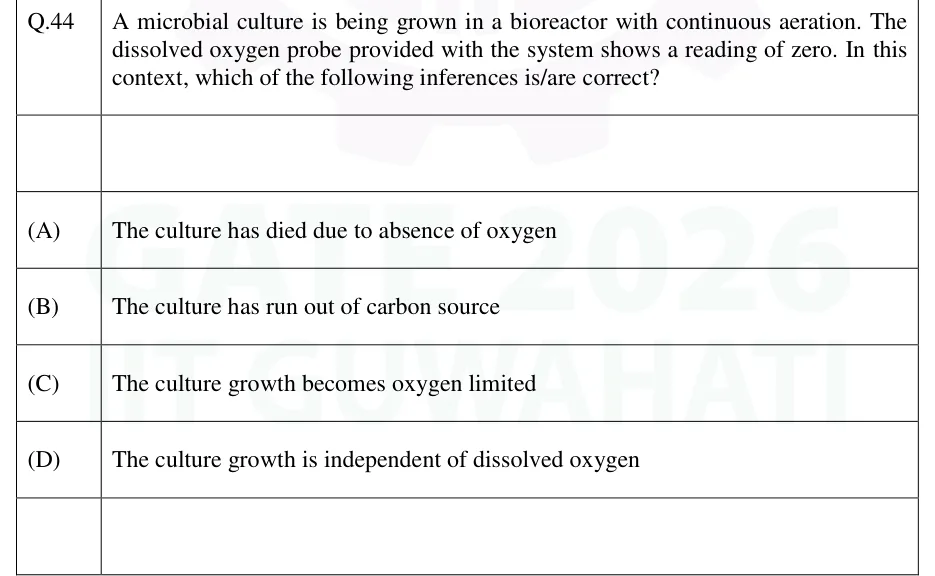
GATE 2026 · BTQ.44 · 2 marks · MSQ

A microbial culture is being grown in a bioreactor with continuous aeration. The dissolved oxygen probe provided with the system shows a reading of zero. In this context, which of the following inferences is/are correct?

  1. (A)

    The culture has died due to absence of oxygen

  2. (B)

    The culture has run out of carbon source

  3. (C)

    The culture growth becomes oxygen limited

  4. (D)

    The culture growth is independent of dissolved oxygen

Official answer
See the question in the paper
GATE 2026 BT Q.44: official answer

GATE 2026 BT Q.46

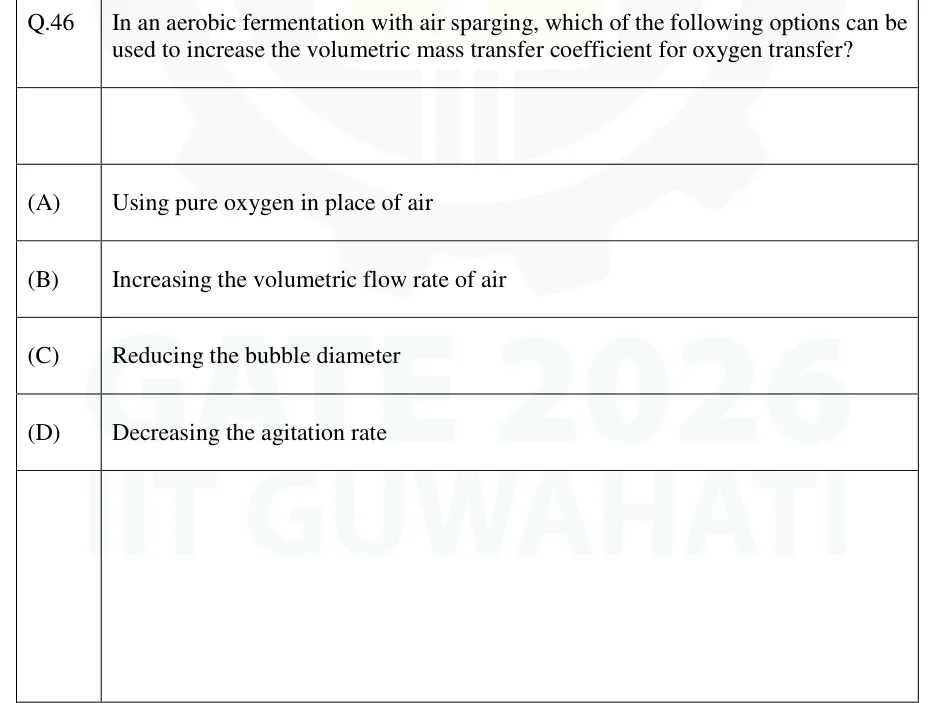
GATE 2026 · BTQ.46 · 2 marks · MSQ

In an aerobic fermentation with air sparging, which of the following options can be used to increase the volumetric mass transfer coefficient for oxygen transfer?

  1. (A)

    Using pure oxygen in place of air

  2. (B)

    Increasing the volumetric flow rate of air

  3. (C)

    Reducing the bubble diameter

  4. (D)

    Decreasing the agitation rate

Answer and solution
See the question in the paper
GATE 2026 BT Q.46: answer and solution

GATE 2026 BT Q.61

GATE 2026 · BTQ.61 · 2 marks · NAT

A microbe that follows Monod growth kinetics on a limiting substrate (maximum specific growth rate of 0.5 and Monod constant of 0.1 ) is cultivated in a continuous reactor for microbial growth (chemostat) with sterile feed. Given that the chemostat volume is 5 L and inlet concentration of limiting substrate is 10 , the minimum inlet feed flow rate for chemostat washout is ______ . (rounded off to one decimal place)

Answer and solution
See the question in the paper
GATE 2026 BT Q.61: answer and solution

GATE 2025 BT Q.44

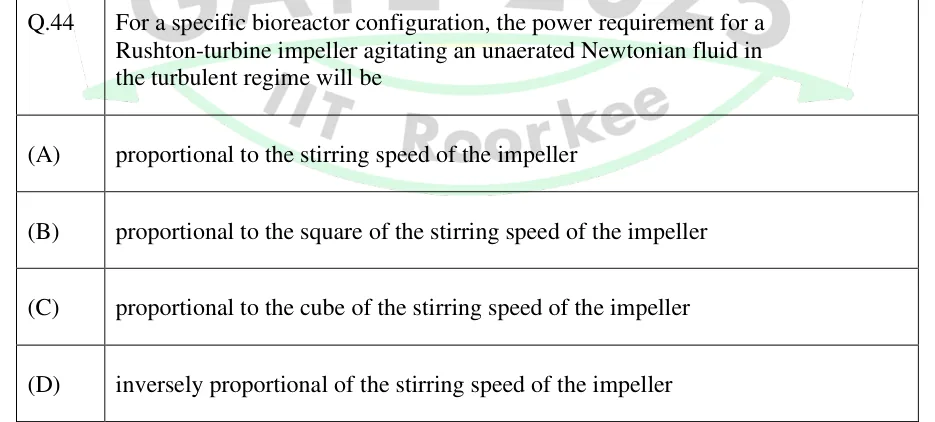
GATE 2025 · BTQ.44 · 2 marks · MCQ

For a specific bioreactor configuration, the power requirement for a Rushton-turbine impeller agitating an unaerated Newtonian fluid in the turbulent regime will be

  1. (A)

    proportional to the stirring speed of the impeller

  2. (B)

    proportional to the square of the stirring speed of the impeller

  3. (C)

    proportional to the cube of the stirring speed of the impeller

  4. (D)

    inversely proportional of the stirring speed of the impeller

Answer and solution
See the question in the paper
GATE 2025 BT Q.44: answer and solution

GATE 2025 BT Q.62

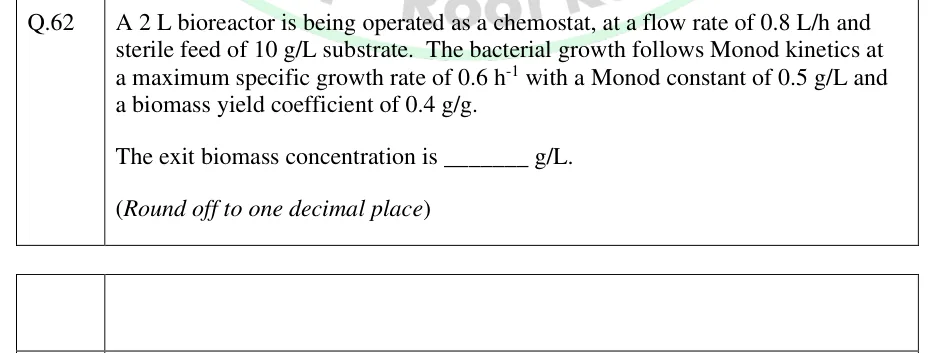
GATE 2025 · BTQ.62 · 2 marks · NAT

A 2 L bioreactor is being operated as a chemostat, at a flow rate of 0.8 L/h and sterile feed of 10 g/L substrate. The bacterial growth follows Monod kinetics at a maximum specific growth rate of 0.6 h with a Monod constant of 0.5 g/L and a biomass yield coefficient of 0.4 g/g.

The exit biomass concentration is _______ g/L.

(Round off to one decimal place)

Answer and solution
See the question in the paper
GATE 2025 BT Q.62: answer and solution

GATE 2024 BT Q.14

GATE 2024 · BTQ.14 · 1 mark · MCQ

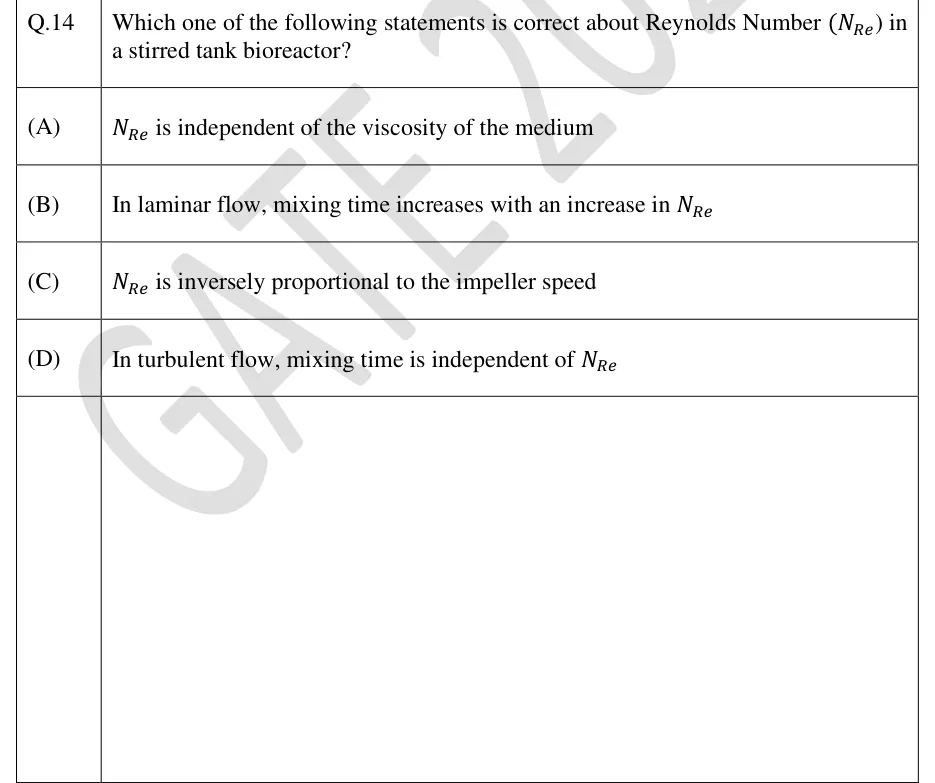
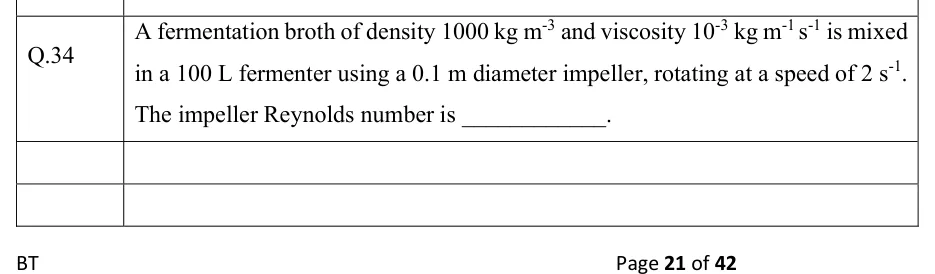
Which one of the following statements is correct about Reynolds Number () in a stirred tank bioreactor?

  1. (A)

    is independent of the viscosity of the medium

  2. (B)

    In laminar flow, mixing time increases with an increase in

  3. (C)

    is inversely proportional to the impeller speed

  4. (D)

    In turbulent flow, mixing time is independent of

Answer and solution
See the question in the paper
GATE 2024 BT Q.14: answer and solution

GATE 2024 BT Q.53

GATE 2024 · BTQ.53 · 2 marks · MSQ

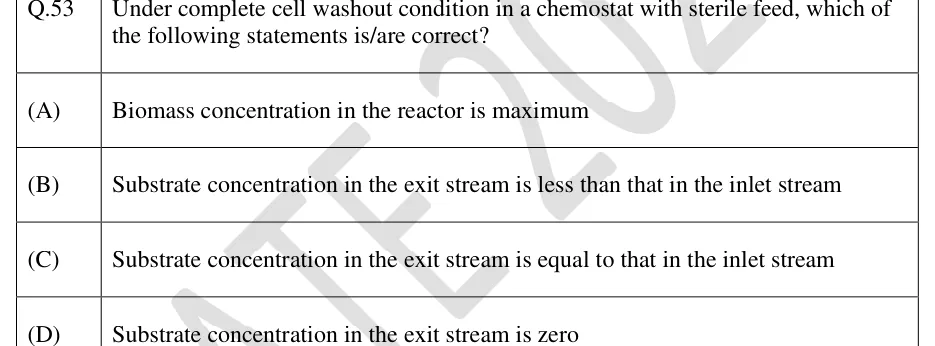
Under complete cell washout condition in a chemostat with sterile feed, which of the following statements is/are correct?

  1. (A)

    Biomass concentration in the reactor is maximum

  2. (B)

    Substrate concentration in the exit stream is less than that in the inlet stream

  3. (C)

    Substrate concentration in the exit stream is equal to that in the inlet stream

  4. (D)

    Substrate concentration in the exit stream is zero

Answer and solution
See the question in the paper
GATE 2024 BT Q.53: answer and solution

GATE 2024 BT Q.55

GATE 2024 · BTQ.55 · 2 marks · NAT

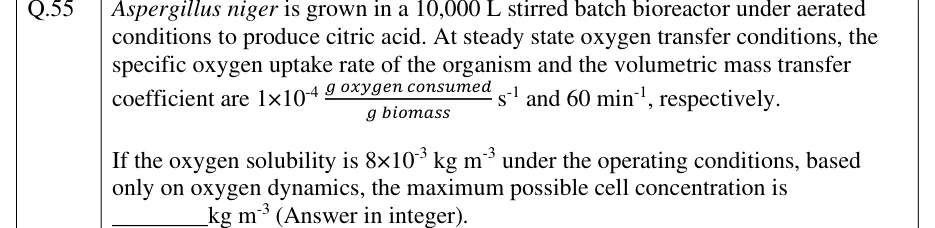
Aspergillus niger is grown in a 10,000 L stirred batch bioreactor under aerated conditions to produce citric acid. At steady state oxygen transfer conditions, the specific oxygen uptake rate of the organism and the volumetric mass transfer coefficient are and , respectively.

If the oxygen solubility is under the operating conditions, based only on oxygen dynamics, the maximum possible cell concentration is ________ (Answer in integer).

Answer and solution
See the question in the paper
GATE 2024 BT Q.55: answer and solution

GATE 2024 BT Q.56

GATE 2024 · BTQ.56 · 2 marks · NAT

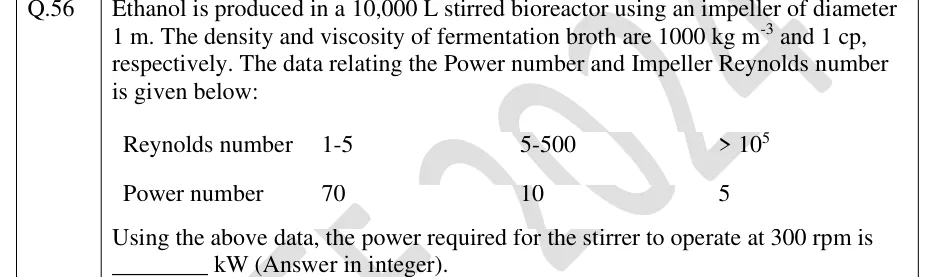
Ethanol is produced in a 10,000 L stirred bioreactor using an impeller of diameter 1 m. The density and viscosity of fermentation broth are and 1 cp, respectively. The data relating the Power number and Impeller Reynolds number is given below:

| Reynolds number | 1-5 | 5-500 | |
|---|---|---|---|
| Power number | 70 | 10 | 5 |

Using the above data, the power required for the stirrer to operate at 300 rpm is ________ kW (Answer in integer).

Answer and solution
See the question in the paper
GATE 2024 BT Q.56: answer and solution

GATE 2024 BT Q.59

GATE 2024 · BTQ.59 · 2 marks · NAT

A fermentor is filled with medium at a rate of . A leak develops at the bottom of the fermentor when the medium in the fermentor reaches . The rate of medium leakage is , where '' is the time at which the leak begins.

The volume of medium in the fermentor after 10 min of leakage is ________ L (Answer in integer).

Answer and solution
See the question in the paper
GATE 2024 BT Q.59: answer and solution

GATE 2024 BT Q.60

GATE 2024 · BTQ.60 · 2 marks · NAT

A fed batch process is running at quasi-steady state with respect to substrate and biomass concentration. At 2 h, the culture volume is 500 L with a constant sterile inlet feed at 50 L h of glucose. The culture kinetic parameters and are 0.2 h and 0.1 g L, respectively.

The substrate concentration in the reactor will be ________ g L (rounded off to one decimal place).

Answer and solution
See the question in the paper
GATE 2024 BT Q.60: answer and solution

GATE 2024 BT Q.61

GATE 2024 · BTQ.61 · 2 marks · NAT

Consider scale-up of fungal fermentation from a 20 L model-type to 20,000 L prototype stirred tank reactor. The model-type and prototype have the same aspect ratio during scale-up. The impeller speed in the model-type is 500 rpm and the scale-up criterion is constant shear.

The impeller speed in the prototype reactor will be ________ rpm (Answer in integer).

Answer and solution
See the question in the paper
GATE 2024 BT Q.61: answer and solution

GATE 2023 BT Q.53

GATE 2023 · BTQ.53 · 2 marks · NAT

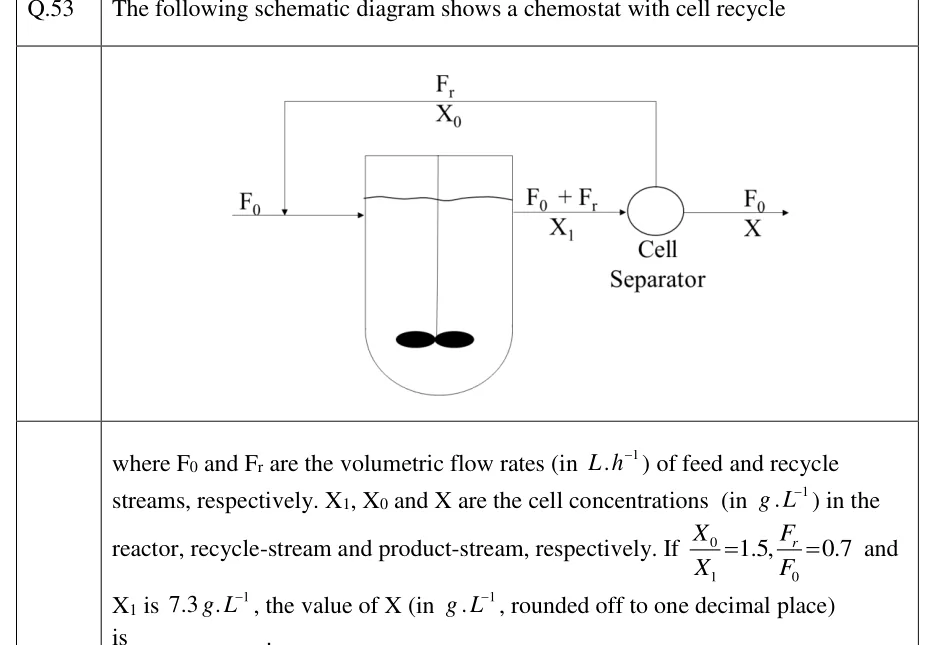
Q.53 The following schematic diagram shows a chemostat with cell recycle

[Figure]

where and are the volumetric flow rates (in ) of feed and recycle streams, respectively. , and are the cell concentrations (in ) in the reactor, recycle-stream and product-stream, respectively. If , and is , the value of (in , rounded off to one decimal place) is ________.

GATE 2023 BT question 53: A stirred-tank reactor (vessel with a liquid surface near the top, a central shaft and an impeller at the bottom).Tap to open full size
Figure from the GATE 2023 BT paper. It is part of the question.
Figure description

A stirred-tank reactor (vessel with a liquid surface near the top, a central shaft and an impeller at the bottom). A feed stream labelled F_0 enters from the left and joins, at a junction just before the reactor inlet, a recycle line coming from above. The reactor outlet on the right is labelled 'F_0 + F_r' above the line and 'X_1' below it, and goes to a circle labelled 'Cell Separator'. From the top of the separator a recycle line runs up, left across the top of the diagram (labelled 'F_r' and 'X_0') and down to meet the feed line before the reactor. From the right side of the separator the product stream leaves, labelled 'F_0' above and 'X' below.

Answer and solution
GATE 2023 BT Q.53: answer and solution

GATE 2022 BT Q.58

GATE 2022 · BTQ.58 · 2 marks · NAT

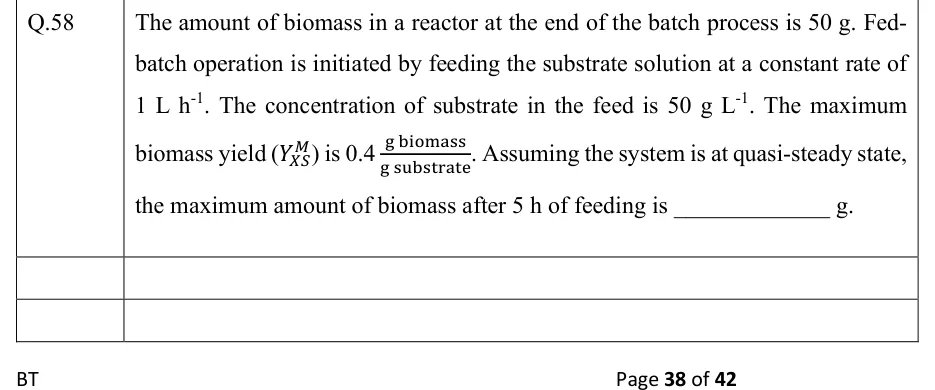
The amount of biomass in a reactor at the end of the batch process is 50 g. Fed-batch operation is initiated by feeding the substrate solution at a constant rate of . The concentration of substrate in the feed is . The maximum biomass yield () is . Assuming the system is at quasi-steady state, the maximum amount of biomass after 5 h of feeding is ________ g.

Answer and solution
See the question in the paper
GATE 2022 BT Q.58: answer and solution

GATE 2022 BT Q.60

GATE 2022 · BTQ.60 · 2 marks · NAT

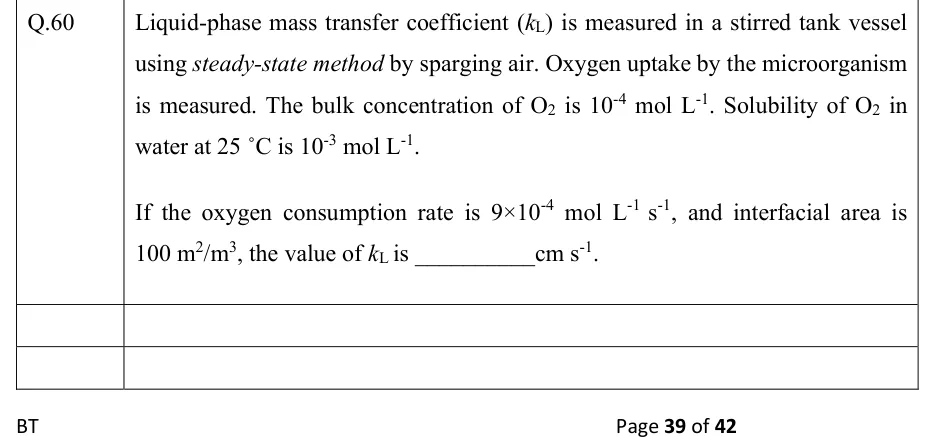
Liquid-phase mass transfer coefficient () is measured in a stirred tank vessel using steady-state method by sparging air. Oxygen uptake by the microorganism is measured. The bulk concentration of is . Solubility of in water at is .

If the oxygen consumption rate is , and interfacial area is , the value of is ________ .

Answer and solution
See the question in the paper
GATE 2022 BT Q.60: answer and solution

GATE 2020 BT Q.22

GATE 2020 · BTQ.22 · 1 mark · NAT

To facilitate mass transfer from a gas to a liquid phase, a gas bubble of radius is introduced into the liquid. The gas bubble then breaks into 8 bubbles of equal radius. Upon this change, the ratio of the interfacial surface area to the gas phase volume for the system changes from to . The value of is ________.

Answer and solution
See the question in the paper
GATE 2020 BT Q.22: answer and solution

GATE 2020 BT Q.49

GATE 2020 · BTQ.49 · 2 marks · NAT

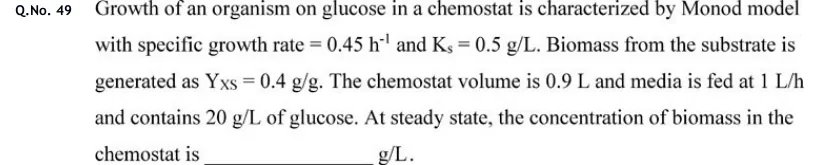
Growth of an organism on glucose in a chemostat is characterized by Monod model with specific growth rate = 0.45 h and K = 0.5 g/L. Biomass from the substrate is generated as Y = 0.4 g/g. The chemostat volume is 0.9 L and media is fed at 1 L/h and contains 20 g/L of glucose. At steady state, the concentration of biomass in the chemostat is ________ g/L.

Answer and solution
See the question in the paper
GATE 2020 BT Q.49: answer and solution

GATE 2019 BT Q.43

GATE 2019 · BTQ.43 · 2 marks · MCQ

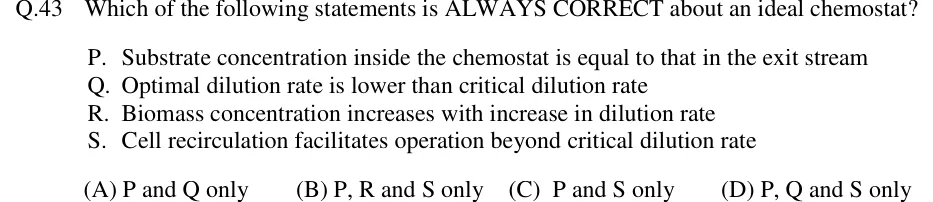
Which of the following statements is ALWAYS CORRECT about an ideal chemostat?

P. Substrate concentration inside the chemostat is equal to that in the exit stream

Q. Optimal dilution rate is lower than critical dilution rate

R. Biomass concentration increases with increase in dilution rate

S. Cell recirculation facilitates operation beyond critical dilution rate

  1. (A)

    P and Q only

  2. (B)

    P, R and S only

  3. (C)

    P and S only

  4. (D)

    P, Q and S only

Answer and solution
See the question in the paper
GATE 2019 BT Q.43: answer and solution

GATE 2019 BT Q.52

GATE 2019 · BTQ.52 · 2 marks · NAT

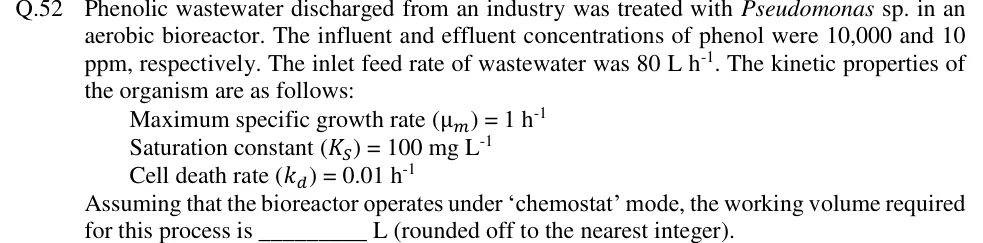
Phenolic wastewater discharged from an industry was treated with Pseudomonas sp. in an aerobic bioreactor. The influent and effluent concentrations of phenol were 10,000 and 10 ppm, respectively. The inlet feed rate of wastewater was . The kinetic properties of the organism are as follows:

Maximum specific growth rate

Saturation constant

Cell death rate

Assuming that the bioreactor operates under 'chemostat' mode, the working volume required for this process is ________ L (rounded off to the nearest integer).

Answer and solution
See the question in the paper
GATE 2019 BT Q.52: answer and solution

GATE 2019 BT Q.55

GATE 2019 · BTQ.55 · 2 marks · NAT

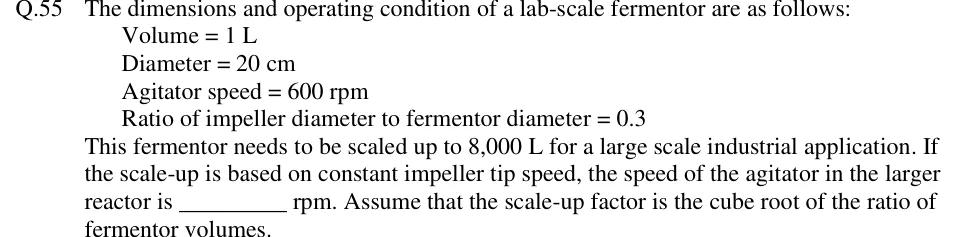
The dimensions and operating condition of a lab-scale fermentor are as follows:
Volume = 1 L
Diameter = 20 cm
Agitator speed = 600 rpm
Ratio of impeller diameter to fermentor diameter = 0.3
This fermentor needs to be scaled up to 8,000 L for a large scale industrial application. If the scale-up is based on constant impeller tip speed, the speed of the agitator in the larger reactor is _________ rpm. Assume that the scale-up factor is the cube root of the ratio of fermentor volumes.

Answer and solution
See the question in the paper
GATE 2019 BT Q.55: answer and solution

PRACTICE

7 questions to test yourself

PRACTICE 12 marks · NAT

A chemostat of 5.0 L working volume is fed sterile medium containing 10 g/L of the limiting substrate at 1.25 L/h. The organism follows Monod kinetics with h and g/L, and g/g (no maintenance, no cell death). The steady-state biomass productivity, in g/(L h), is ______ (rounded off to two decimal places).

Answer and solution

Answer: (accepted range )

  1. h. h, so there is no washout.

  2. g/L.

  3. g/L.

  4. g/(L h).

PRACTICE 21 mark · MCQ

A fully turbulent, baffled stirred bioreactor is scaled up to a geometrically similar vessel whose impeller diameter is 4 times larger, keeping the impeller tip speed constant. The power input per unit volume in the large vessel, relative to the small vessel, is

  1. (A)

    unchanged

  2. (B)

    1/4 of the small-scale value

  3. (C)

    1/16 of the small-scale value

  4. (D)

    4 times the small-scale value

Answer and solution

Answer: (B)

  1. Constant tip speed: , so .

  2. Turbulent: and , so .

  3. Ratio .

PRACTICE 31 mark · NAT

In a sulphite-oxidation test (Cu catalyst), the sulphite concentration in the vessel falls at a steady 36 mmol/(L h), and the dissolved oxygen stays at zero throughout. The oxygen saturation concentration in the sulphite solution is 0.24 mmol/L. The volumetric mass-transfer coefficient , in h, is ______.

Answer and solution

Answer: (accepted range )

  1. , so OTR mmol O/(L h).

  2. , so OTR , giving h.

PRACTICE 42 marks · MCQ

A soluble enzyme with mM and mM/min (per unit reactor volume; no inhibition, no deactivation, enzyme retained in the reactor) acts on a feed with mM. The residence times needed for 80% conversion in an ideal CSTR and in an ideal PFR are, respectively, closest to

  1. (A)

    16.0 min and 11.2 min

  2. (B)

    11.2 min and 16.0 min

  3. (C)

    8.0 min and 11.2 min

  4. (D)

    16.0 min and 8.0 min

Answer and solution

Answer: (A)

  1. 80% conversion gives mM and mM.

  2. CSTR: min.

  3. PFR: min.

PRACTICE 52 marks · NAT

In chemostat runs on sterile feed with no cell death, the observed yield is 0.25 g/g at h and 0.40 g/g at h. Assuming the maintenance relation holds, the maintenance coefficient , in g substrate per g cells per h, is ______ (rounded off to two decimal places).

Answer and solution

Answer: (accepted range )

  1. At steady state . At h: .

  2. At h: .

  3. Subtract: , so g/(g h).

  4. Check: , so g/g, and matches the first run.

PRACTICE 62 marks · NAT

A fed-batch culture is switched to exponential feeding to hold the specific growth rate at 0.20 h ( h). When exponential feeding starts, the reactor holds 50 g of cells in total. The feed contains 400 g/L glucose, g/g, maintenance is negligible, and the glucose concentration in the reactor is negligible compared with the feed concentration. The feed rate needed 5.0 h after exponential feeding starts, in L/h, is ______ (rounded off to three decimal places).

Answer and solution

Answer: (accepted range )

  1. , with g/L.

  2. L/h.

  3. L/h.

  4. Check: total biomass at 5.0 h g, growing at g/h, which uses g/h of glucose, or L/h of feed.

PRACTICE 72 marks · MSQ

Consider a Monod organism grown on sterile feed, with no maintenance and no cell death unless stated. Which of the following statements is/are correct?

  1. (A)

    In a chemostat at steady state, the specific growth rate equals the dilution rate.

  2. (B)

    In a chemostat at a fixed dilution rate below washout, doubling the feed substrate concentration doubles the steady-state substrate concentration .

  3. (C)

    With cell recycle (recycle ratio , concentration factor ), a dilution rate greater than can be sustained without washout if is large enough.

  4. (D)

    In a fed-batch culture at quasi-steady state under a constant feed rate, the specific growth rate stays constant with time.

Answer and solution

Answer: (A), (C)

  1. A: the steady-state biomass balance with gives . Correct.

  2. B: does not contain , so is unchanged. Incorrect.

  3. C: , where the factor lies between 0 and 1. The washout rate exceeds once , that is, once is close enough to 1. Correct.

  4. D: at quasi-steady state , and rises with time, so falls. Incorrect.

OFFICIAL GATE 2027 SYLLABUS WORDING

Copied from the GATE 2027 syllabus; see all 2027 syllabi.

GATE BT

Batch, fed-batch and continuous processes; Microbial and enzyme reactors; Optimization and scale up

Preparing in Kolkata? IAE Academy's course for GATE BT.