
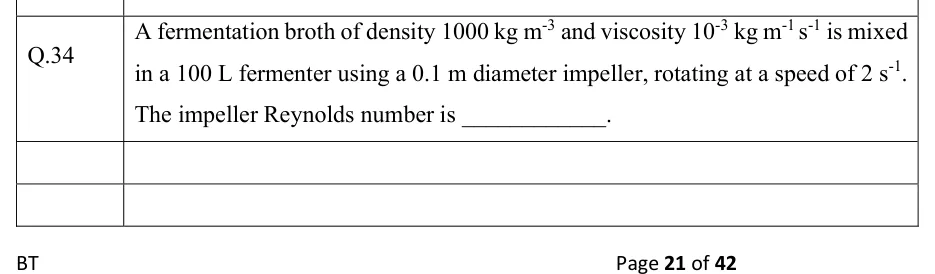
A fermentation broth of density and viscosity is mixed in a fermenter using a diameter impeller, rotating at a speed of . The impeller Reynolds number is ____________.
GATE 2022 BT Q.34: solution and answer
Answer and solution
ANSWER
The impeller Reynolds number is .
Official answer: 20000Source: Official answer key, GATE 2022 BT (IIT Kharagpur)
Impeller Reynolds number: . Here is the broth density, is the impeller speed in revolutions per second, is the impeller diameter and is the broth viscosity.
Data in SI units: , , (so ) and .
The characteristic length is the impeller diameter, not a dimension of the tank. The vessel volume therefore does not enter the calculation.
Units check: , which is dimensionless, as a Reynolds number must be.
. This is above about , the value usually taken as the start of fully turbulent flow in a stirred vessel. In a baffled vessel the power number is constant in that regime.
KEY IDEA
For a stirred tank, the Reynolds number is built from the impeller: . is in revolutions per second and is the impeller diameter. The tank volume only tests whether you know which length to use.
WATCH OUT FOR
Three slips are common. The first is turning into angular speed (), which gives about ; the stirred-tank Reynolds number uses revolutions per second. The second is writing instead of , which gives . The third is working a tank diameter out of the volume and using it as the length scale.
From the GATE 2022 BT paper. Every question of this paper · Download the full paper · All 24 Bioreactor operation questions, with notes
More Bioreactor operation questions
- GATE 2022 BT Q.60 · NAT · 2 marksLiquid-phase mass transfer coefficient (k_L) is measured in a stirred tank vessel using *steady-state…
- GATE 2020 BT Q.22 · NAT · 1 markTo facilitate mass transfer from a gas to a liquid phase, a gas bubble of radius r is introduced into the…
- GATE 2020 BT Q.49 · NAT · 2 marksGrowth of an organism on glucose in a chemostat is characterized by Monod model with specific growth rate =…
- GATE 2019 BT Q.43 · MCQ · 2 marksWhich of the following statements is ALWAYS CORRECT about an ideal chemostat? P.