
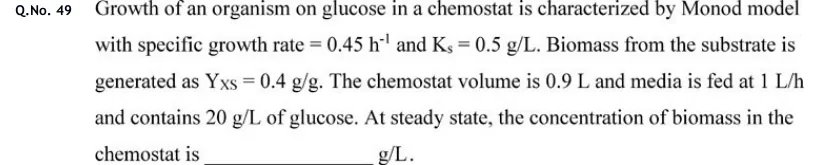
Growth of an organism on glucose in a chemostat is characterized by Monod model with specific growth rate = 0.45 h and K = 0.5 g/L. Biomass from the substrate is generated as Y = 0.4 g/g. The chemostat volume is 0.9 L and media is fed at 1 L/h and contains 20 g/L of glucose. At steady state, the concentration of biomass in the chemostat is ________ g/L.
GATE 2020 BT Q.49: solution and answer
Answer and solution
ANSWER
The dilution rate is higher than the washout limit (and higher than ), so the culture washes out. At steady state the biomass concentration is 0 g/L.
Official answer: 0Source: Official answer key, GATE 2020 BT (IIT Delhi)
Symbols: the printed specific growth rate is the Monod maximum, ; saturation constant ; biomass yield on glucose ; feed glucose ; feed flow ; volume . The feed contains only medium, so it is sterile ().
Dilution rate: .
Biomass balance on a chemostat with sterile feed: . A steady state with needs . But Monod gives for any finite , so can never reach when .
Critical (washout) dilution rate, reached when the reactor substrate equals the feed: .
Since , cells are removed faster than they can grow: for every , so the culture washes out.
The only steady state is the washout one: and .
Check: blindly using gives a negative concentration, which confirms that no non-trivial steady state exists. The biomass concentration at steady state is .
KEY IDEA
A chemostat can hold cells at steady state only if for some reachable substrate level, so must be below the washout limit . Always compare with before using the steady-state formulas. If , the only steady state is , .
WATCH OUT FOR
Plugging straight into and without checking for washout. That gives and a meaningless . A negative means no non-trivial steady state exists. Taking instead of is also wrong, even though here it still leads to washout.
From the GATE 2020 BT paper. Every question of this paper · Download the full paper · All 24 Bioreactor operation questions, with notes
More Bioreactor operation questions
- GATE 2019 BT Q.52 · NAT · 2 marksPhenolic wastewater discharged from an industry was treated with *Pseudomonas* sp. in an aerobic bioreactor.
- GATE 2019 BT Q.55 · NAT · 2 marksThe dimensions and operating condition of a lab-scale fermentor are as follows: Volume = 1 L Diameter = 20…
- GATE 2026 BT Q.44 · MSQ · 2 marksA microbial culture is being grown in a bioreactor with continuous aeration.
- GATE 2026 BT Q.46 · MSQ · 2 marksIn an aerobic fermentation with air sparging, which of the following options can be used to increase the…