IAE Academy

GATE 2026 BT Q.46: solution and answer

GATE 2026 · BTQ.46 · 2 marks · MSQ

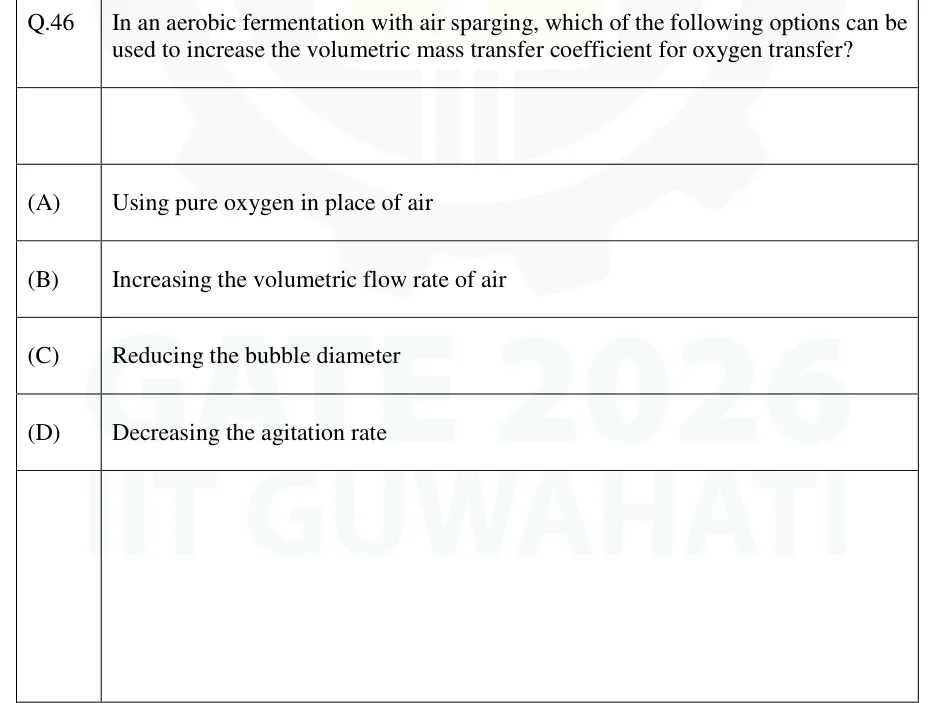
In an aerobic fermentation with air sparging, which of the following options can be used to increase the volumetric mass transfer coefficient for oxygen transfer?

  1. (A)

    Using pure oxygen in place of air

  2. (B)

    Increasing the volumetric flow rate of air

  3. (C)

    Reducing the bubble diameter

  4. (D)

    Decreasing the agitation rate

See the question in the paper

Answer and solution

ANSWER

Options (B) and (C): a higher air flow rate and a smaller bubble diameter both raise . Pure oxygen raises the driving force , not , and less agitation lowers .

Official answer: B, CSource: Official answer key, GATE 2026 BT (IIT Guwahati)

  1. Oxygen transfer rate: . Here is the liquid-film mass transfer coefficient, is the gas-liquid interfacial area per unit volume of the gas-liquid dispersion, is the saturation (equilibrium) dissolved-oxygen concentration and is the actual dissolved-oxygen concentration. The question asks only about the product , not about the OTR as a whole.

  2. Interfacial area of a bubble swarm: , where is the gas holdup (volume fraction of gas in the dispersion) and is the mean (Sauter) bubble diameter. So , and with it , goes up when goes up or goes down.

  3. Empirical correlation (van't Riet type) for a sparged, stirred vessel: , with the gassed power input per unit volume, the superficial gas velocity and a constant for the system. Both exponents and are positive, so rises with more power input and with more gas flow.

  4. (A) Pure oxygen raises the partial pressure of in the gas about 4.8-fold (), so by Henry's law , and with it the driving force , rises about 4.8-fold. and depend on hydrodynamics and fluid properties (bubble size, holdup, turbulence, diffusivity, viscosity), not on the composition of the gas, so does not change. The OTR rises, but does not. Not correct.

  5. (B) A higher volumetric air flow rate means a higher superficial gas velocity , which raises the gas holdup and therefore ; in the correlation with . increases. Correct.

  6. (C) A smaller gives more interfacial area per unit volume (). Small bubbles also rise more slowly and stay longer in the liquid, which raises and increases further. Very small bubbles can have a somewhat lower (they behave like rigid spheres), but the rise in outweighs it, so increases. Correct.

  7. (D) Less agitation means a lower , so bubbles are broken up less (larger ), holdup falls and there is less turbulence at the interface. decreases. Not correct.

  8. Options B and C raise .

KEY IDEA

depends on hydrodynamics. Anything that raises the interfacial area or the interfacial turbulence (more gas flow, smaller bubbles, more power input) raises it. Changing the gas composition changes only the saturation concentration , so it changes the driving force in and leaves alone.

WATCH OUT FOR

Ticking (A) because pure oxygen does raise the oxygen transfer rate. It does that by raising (the driving force), not the volumetric mass transfer coefficient . The question asks about , not OTR.

From the GATE 2026 BT paper. Every question of this paper · Download the full paper · All 24 Bioreactor operation questions, with notes

More Bioreactor operation questions