
IAE Academy

GATE 2023 IN Q.48: solution and answer

GATE 2023 · INQ.48 · 2 marks · NAT

Consider a standard negative feedback configuration with and the controller . The root-locus of is presented in the figure below. The gain at rad/s. The value of is ______ (rounded off to one decimal place).
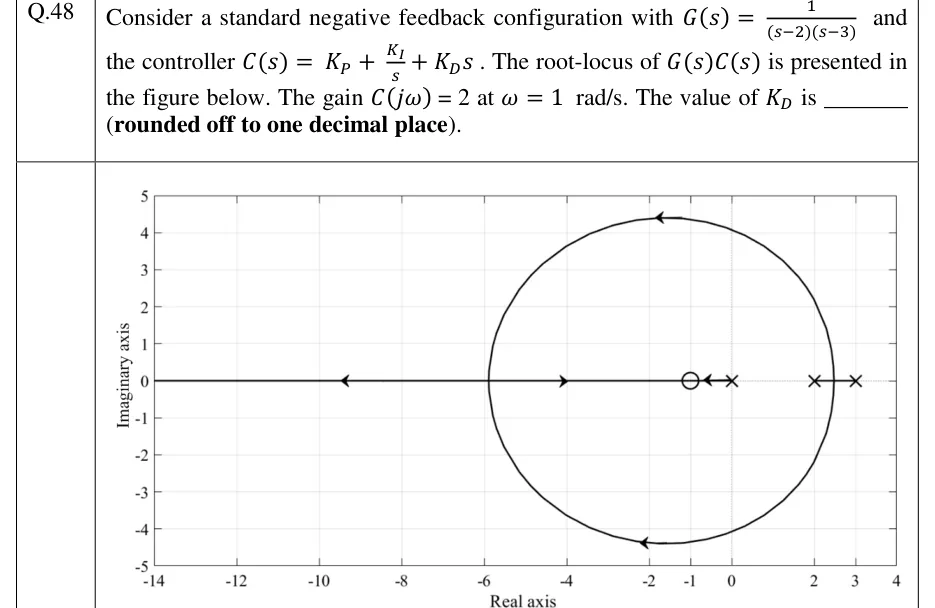
GATE 2023 IN question 48: Root-locus plot.Tap to open full size
Figure from the GATE 2023 IN paper. It is part of the question.
Figure description

Root-locus plot. Horizontal axis 'Real axis' from -14 to 4 (tick labels -14, -12, -10, -8, -6, -4, -2, -1, 0, 2, 3, 4). Vertical axis 'Imaginary axis' from -5 to 5. Open-loop poles (x) at s = 0, s = 2 and s = 3. There is a single zero marker (o) at s = -1, and no other zero is visible anywhere on the plot. Real-axis locus: a short segment from the pole at 0 to the zero at -1, with an arrow pointing left toward -1. A plain segment (no arrowheads) joins the poles at 2 and 3. A closed, nearly circular complex branch pair leaves the real axis at about s = 2.5, rises to about +4.4j near Re = -1.8 (arrow pointing left), falls symmetrically to about -4.4j (arrow pointing left), and meets the real axis again at a break-in point near s = -5.9. From that break-in point one branch runs right along the real axis toward the zero at -1 (arrow near -4 pointing right). The other runs left toward minus infinity (arrow near -9.5 pointing left). The whole real axis to the left of -1 is on the locus.

Answer and solution

ANSWER

. The root locus forces a double zero at , so , , and .

Official answer: 0.9 to 1.1Source: Official answer key, GATE 2023 IN (IIT Kanpur)

  1. Write the PID as one fraction: . So has poles at and at most two zeros, the roots of the PID numerator.

  2. Real-axis rule: a point on the real axis is on the locus if the total number of real poles and zeros to its right is odd. For a point in there are 3 poles to the right, which is odd, so the segment from to is on the locus. The plot also shows the whole real axis left of on the locus. If were a single zero (either , or a second zero further left), a point just left of would see poles and zeros to its right. That is even, so the point would not be on the locus, which contradicts the figure. Only one zero marker is drawn, so the second zero must also sit at : the PID has a double zero at , and left of the count is (odd).

  3. Branch check: 3 poles and 2 finite zeros give asymptote, at . This matches the single branch running to on the plot. The pole at ends on one of the zeros at , and the branch coming right from the break-in point ends on the other.

  4. Breakaway check with . Setting and cancelling the factor gives with roots , and . The root at is not on the locus, since only 2 poles lie to its right. The other two are the breakaway point near and the break-in point near seen on the plot, which confirms the double zero at .

  5. So . That gives and , and The drawn locus is the positive-gain locus, and its gain is , so .

  6. Evaluate at : Checking term by term: . is real and positive, so reading 'gain ' either literally or as a magnitude gives the same equation.

  7. Set , so (and hence , ).

KEY IDEA

Read the controller's zeros off the root locus. A PID adds a pole at the origin and two zeros. The whole real axis left of is on the locus, which by the odd-count rule is only possible if both zeros sit at . So , and at the proportional, integral and derivative terms combine into the real number .

WATCH OUT FOR

Taking the single 'o' marker as a single zero, . That leaves undetermined (or wrongly zero), and it contradicts the plot, because a single zero at would take the real axis left of off the locus. Overlapping zeros are drawn as one marker, so count them with the real-axis rule, not by eye. A second slip is using instead of in the magnitude, which gives .

From the GATE 2023 IN paper. Every question of this paper · Download the full paper · All 10 Compensators & PID questions, with notes

More Compensators & PID questions