IAE Academy

GATE 2023 EE Q.38: solution and answer

GATE 2023 · EEQ.38 · 2 marks · MCQ

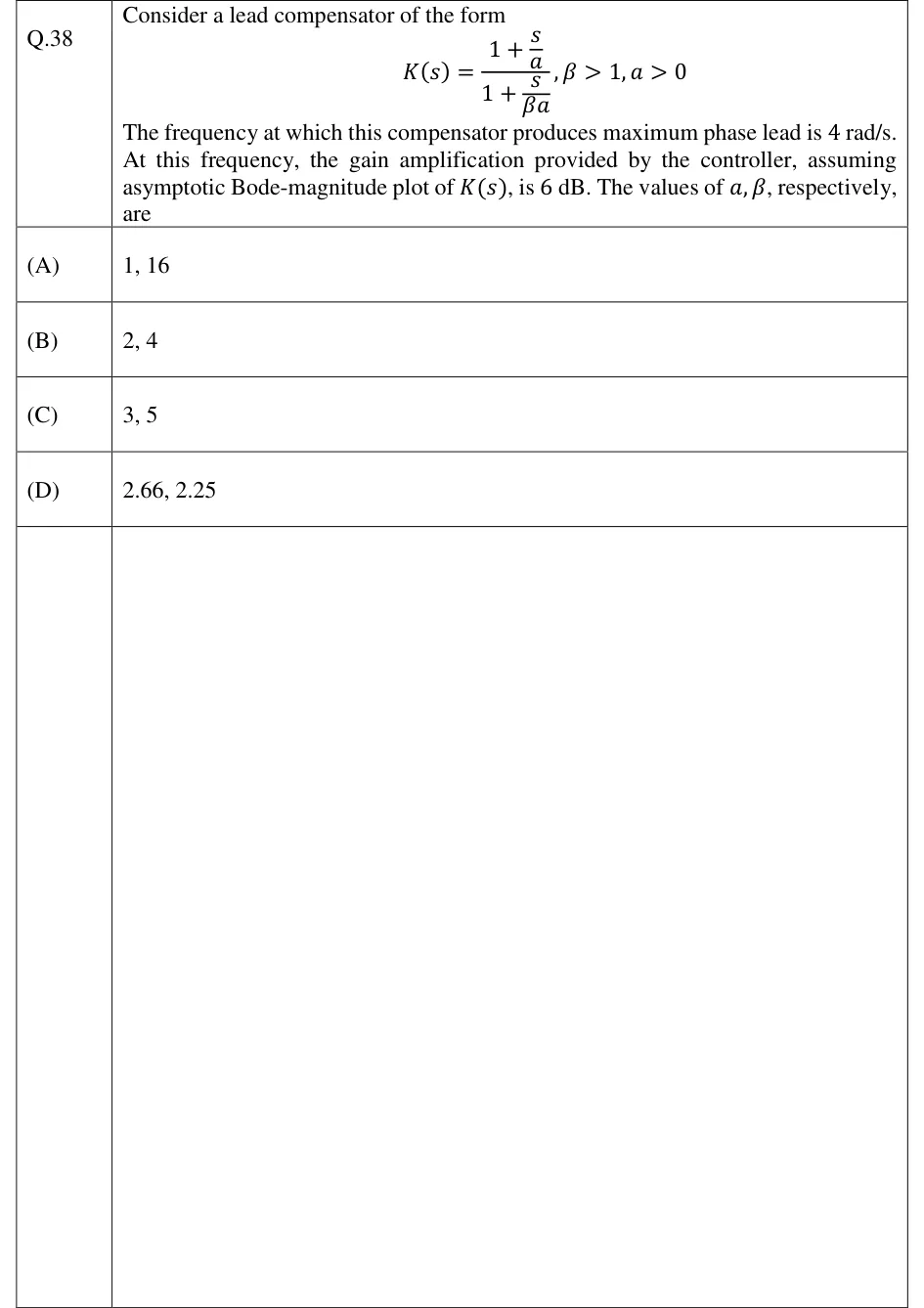
Consider a lead compensator of the form

The frequency at which this compensator produces maximum phase lead is 4 rad/s. At this frequency, the gain amplification provided by the controller, assuming asymptotic Bode-magnitude plot of , is 6 dB. The values of , respectively, are

  1. (A)

    1, 16

  2. (B)

    2, 4

  3. (C)

    3, 5

  4. (D)

    2.66, 2.25

See the question in the paper

Answer and solution

ANSWER

(B): , . Maximum phase lead occurs at , and the gain there is , which gives and so .

Official answer: BSource: Official answer key, GATE 2023 EE (IIT Kanpur)

  1. Corner frequencies: the zero is at and the pole at . Because , the zero comes before the pole, so this is a lead network.

  2. Maximum phase lead occurs at the geometric mean of the two corner frequencies:

  3. Asymptotic Bode magnitude: it is 0 dB up to , then rises at until . Since , lies on this rising segment, so

  4. Set this equal to 6 dB: (the 6 dB in the question is the usual rounding of , i.e. a gain of 2).

  5. Substitute into the condition:

  6. Check each option against both conditions, and : (A) , but . Fails on gain. (B) and . Meets both. (C) . Fails on frequency (and ). (D) , but . Fails on gain. Only (B), , satisfies both.

KEY IDEA

For a lead network , the maximum phase lead occurs at the geometric mean of the corners, . The gain there is , which is dB, or half the high-frequency gain of dB. The asymptotic and exact values agree at this frequency: . One condition fixes , and the other then fixes .

WATCH OUT FOR

Using (the high-frequency gain, reached only above ) as the gain at . Setting gives , and then puts the answer near (D). Option (A) catches students who check only and ignore the gain condition. Another slip is placing at the arithmetic mean of the corners instead of the geometric mean.

From the GATE 2023 EE paper. Every question of this paper · Download the full paper · All 10 Compensators & PID questions, with notes

More Compensators & PID questions