
IAE Academy

GATE 2025 IN Q.50: solution and answer

GATE 2025 · INQ.50 · 2 marks · MSQ

The plant in the feedback control system shown in the figure is , where and . The type(s) of controller that CANNOT stabilize the plant is/are
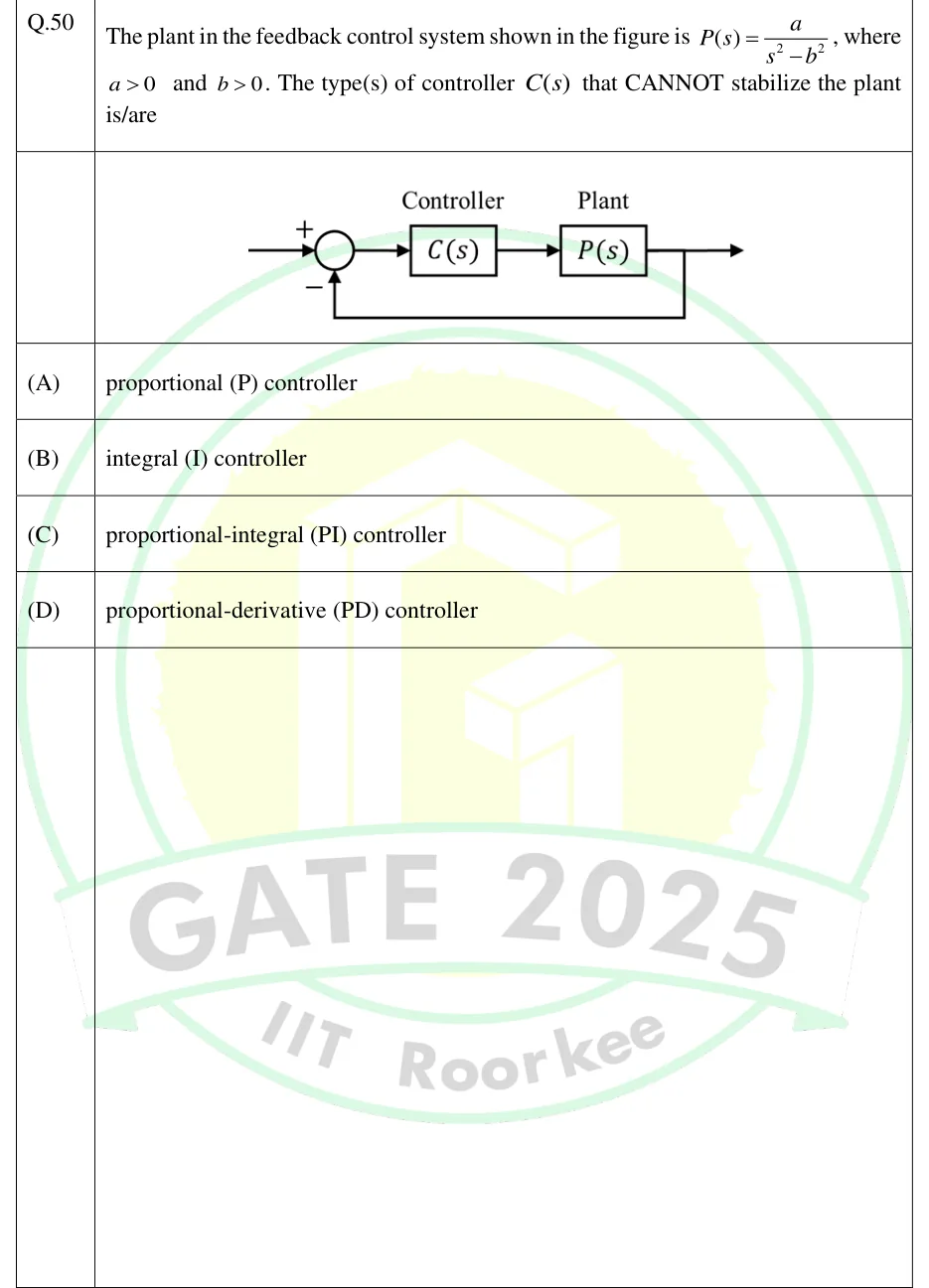
GATE 2025 IN question 50: Unity negative feedback loop.Tap to open full size
Figure from the GATE 2025 IN paper. It is part of the question.
Figure description

Unity negative feedback loop. The reference input enters a summing junction with sign + on the input and sign − on the feedback path. The junction output feeds a block labelled 'Controller' C(s), which feeds in series a block labelled 'Plant' P(s). The output of P(s) is the system output (arrow to the right) and is also fed back directly (gain 1, no block) to the − input of the summing junction.

  1. (A)

    proportional (P) controller

  2. (B)

    integral (I) controller

  3. (C)

    proportional-integral (PI) controller

  4. (D)

    proportional-derivative (PD) controller

Answer and solution

ANSWER

P, I and PI controllers cannot stabilize . Only a PD controller with and can. Answer: (A), (B), (C).

Official answer: A, B, CSource: Official answer key, GATE 2025 IN (IIT Roorkee)

  1. Closed-loop characteristic equation for unity negative feedback: (after clearing any denominator of ). The plant on its own has poles at , so one pole is in the right half-plane and the controller has to move it. Test used throughout: a polynomial can have all its roots in the open left half-plane only if every coefficient is present and all have the same sign. For a second-order polynomial this condition is also sufficient.

  2. P controller, : There is no term. If the roots are , one of them real and positive. If there is a double root at . If the roots are , which only gives sustained oscillation (marginal stability). No real puts both roots in the left half-plane, so P cannot stabilize the plant.

  3. I controller, : multiply through by : The term is missing, and the coefficient is whatever is. The necessary condition fails for every , so I cannot stabilize the plant.

  4. PI controller, : multiply through by : The coefficient is zero for every choice of and . That coefficient equals minus the sum of the three roots, so the roots always sum to zero and cannot all have negative real parts. (In the Routh array the row starts with a zero for the same reason.) So PI cannot stabilize the plant.

  5. PD controller, : A second-order polynomial is stable exactly when all its coefficients are positive. Since , that holds for and . For example, with and the equation is , whose roots are both in the left half-plane. So PD can stabilize the plant.

  6. Why this happens: write , so the characteristic polynomial is . The plant polynomial has no damping () term. With P, is a constant, so no term appears. With I or PI, gives , and has degree at most 1, so nothing can fill the slot. Only the derivative term in adds the missing coefficient.

  7. So the controllers that CANNOT stabilize the plant are P, I and PI: options (A), (B) and (C).

KEY IDEA

Form the closed-loop characteristic polynomial and apply the necessary condition for stability: every coefficient present and positive. The plant has no (damping) term. P cannot add one. An integrator raises the order to three but always leaves the coefficient at zero. Only derivative action () supplies the missing term.

WATCH OUT FOR

Treating P control with as stabilizing. It puts the poles at , which is only marginally stable (sustained oscillation), not asymptotically stable. Another mistake is assuming PI must work because it has two gains to tune: the coefficient stays zero whatever and are. Also watch the word CANNOT, which makes some candidates mark only (D).

From the GATE 2025 IN paper. Every question of this paper · Download the full paper · All 10 Compensators & PID questions, with notes

More Compensators & PID questions