GATE 2024 EE Q.17
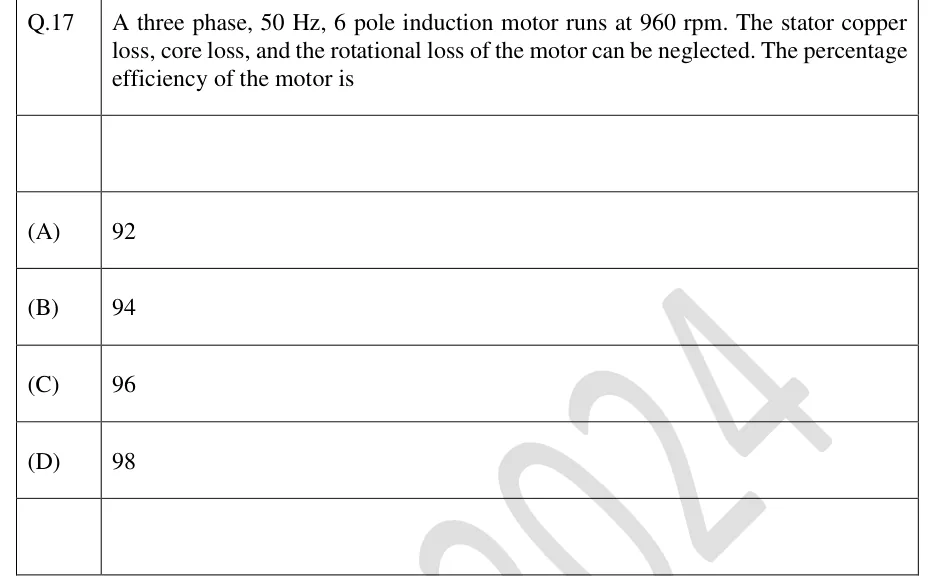
A three phase, 50 Hz, 6 pole induction motor runs at 960 rpm. The stator copper loss, core loss, and the rotational loss of the motor can be neglected. The percentage efficiency of the motor is
- (A)
92
- (B)
94
- (C)
96
- (D)
98

IN THE EE SYLLABUS
Losses in an electric machine split into two groups. Constant losses are the iron (core) loss, which is hysteresis plus eddy current, together with friction and windage and, in a shunt DC machine, the shunt field copper loss. Variable losses grow with load: the I²R copper loss, stray load loss, and in DC machines the brush contact loss. Efficiency is output/input. With output proportional to current, efficiency is maximum when the losses that scale as I² equal the constant losses. The topic covers classifying each loss, separating hysteresis from eddy current loss using core-loss data at two frequencies, how core loss scales with voltage and frequency, and computing efficiency, the load for maximum efficiency and all-day efficiency for transformers, DC machines and induction motors.
2 previous-year questions · 2 solved · 5 practice questions
Every electric machine converts input power to output power, and some power is dissipated inside it as heat. These dissipations are called losses. The ratio of useful output power to input power is the machine's efficiency. This topic covers three things: classifying a loss correctly; separating hysteresis loss from eddy current loss using core-loss data at different frequencies; and computing efficiency, and the load at which efficiency is maximum, for transformers, DC machines and induction motors.
Conventions used throughout:
Loss type | Where it occurs | Depends on | Constant or variable with load? |
|---|---|---|---|
Copper () loss | Armature/stator/rotor windings, transformer windings, field windings | Winding current and winding resistance | Variable (as ) for load-carrying windings. Shunt or separately excited field copper loss is constant when the field current is constant |
Hysteresis loss | Magnetic core (laminations) | Peak flux density , frequency of flux reversal, core material | Constant for a transformer at fixed and . In a DC machine the armature core sees ( poles, in rpm), so the loss is constant at fixed flux and speed |
Eddy current loss | Magnetic core (laminations) | , , lamination thickness , core resistivity | Constant under the same conditions as hysteresis loss |
Mechanical (friction + windage) loss | Bearings, brushes, air resistance (rotating machines only) | Speed | Roughly constant at a fixed speed |
Brush contact loss (DC machines) | Brush–commutator contact | Armature current (brush voltage drop ) | Variable, proportional to (not ) |
Stray load loss | Leakage-flux effects and extra eddy currents in conductors and structural parts caused by load current | Load current (taken as proportional to ) | Variable |
Hysteresis loss and eddy current loss together make up the core loss or iron loss ().
In a transformer:
In a DC machine, iron loss + friction and windage + shunt field copper loss form the constant loss. Armature copper loss, brush contact loss and stray load loss form the variable loss.
In an induction motor, stator iron loss + friction and windage form the constant loss. Stator and rotor copper losses plus stray load loss form the variable loss.
EXAM TIP
Watch the word "stray". For DC machines (for example, in no-load or Swinburne-type test calculations), "stray losses" is often used to mean the rotational losses: iron loss + friction + windage. Those are constant. "Stray load loss", on the other hand, is load-dependent and variable. Use the definition the problem gives. If a separate stray load loss figure is given, it goes on the variable side.
HYSTERESIS LOSS (STEINMETZ'S LAW)
is a material constant and is the core volume. The exponent (the Steinmetz coefficient) depends on the core material, and 1.6 is the classical value. A problem will state the exponent to use, or will say only that at constant .
EDDY CURRENT LOSS
is the lamination thickness, and (core resistivity). This form assumes sinusoidal flux and thin laminations. At the same , and core volume, halving cuts to one quarter. This is why cores are laminated rather than solid.
TOTAL CORE LOSS VS. FREQUENCY
Valid only when is held constant across the tests. A core-loss separation test is designed exactly this way.
To separate and experimentally, excite the core at the same peak flux density but at two or more frequencies, and measure the total core loss at each. At fixed , and . So a plot of against is a straight line, : the intercept gives the hysteresis coefficient and the slope gives the eddy current coefficient. Solving the same relation as simultaneous equations, without plotting, gives the identical answer.
Write for each test frequency, with fixed.
Substitute the known pairs to get simultaneous equations in and .
Solve for (hysteresis loss per hertz) and (eddy loss per hertz squared).
Hysteresis loss at any frequency is and eddy loss is . As a check, their sum must reproduce each given total core loss.
WHY B_MAX FOLLOWS V/F (SINUSOIDAL SUPPLY)
is the number of turns of the winding and the net core area. The winding resistance and leakage drops are neglected, so . If and are changed in the same ratio (constant ), stays fixed.
CORE-LOSS SCALING WITH SUPPLY VOLTAGE AND FREQUENCY (SAME WINDING)
Follows from . At constant voltage, the eddy current loss does not depend on frequency, and the hysteresis loss falls as frequency rises (with a Steinmetz exponent of 1.6).
WORKED EXAMPLE
A transformer designed for 50 Hz has hysteresis loss 600 W and eddy current loss 400 W at rated voltage. It is operated at the same voltage but at 60 Hz. Take the Steinmetz exponent as 1.6. Find the new core loss.
At constant : , so .
Eddy loss , so it is unchanged: W.
Hysteresis loss ratio .
New hysteresis loss W.
New core loss W.
Answer: About 937.8 W (hysteresis ≈ 537.8 W, eddy unchanged at 400 W).
EXAM TIP
If a question changes both and while keeping constant, stays fixed automatically. Then and apply directly.
EFFICIENCY (GENERAL)
Applies to any machine: motor, generator or transformer. Express , and every loss in the same unit (W or kW). The last form is convenient for a motor, when the electrical input is known.
CONDITION FOR MAXIMUM EFFICIENCY
Assumes the output is proportional to the load current (fixed terminal voltage and power factor), a constant loss that does not depend on load, and a variable loss that scales as . Setting then gives the condition shown. Any loss that is proportional to (such as the DC brush-drop loss) drops out of the condition. For a transformer, the load (kVA) at which efficiency is maximum does not depend on power factor. The value of does depend on it, and is highest at unity power factor.
LOAD FRACTION (AND CURRENT) FOR MAXIMUM EFFICIENCY
is the fraction of rated (full) load, the constant loss, and the full-load variable () loss. Valid when the constant loss stays fixed and the variable loss scales as . For a transformer, the load at maximum efficiency is (kVA).
EFFICIENCY AT A FRACTION X OF FULL LOAD (TRANSFORMER)
is the rated apparent power in VA (with the losses in W), and is the load power factor. Use this form for efficiency at, say, half load or three-quarter load rather than full load.
ALL-DAY (ENERGY) EFFICIENCY OF A TRANSFORMER
Output energy over input energy across 24 hours. is the time in hours spent at load fraction , with output . The core loss applies for all 24 h while the transformer is energised, even at no load. The copper loss applies only while the transformer carries load.
WORKED EXAMPLE
A 20 kVA transformer has full-load copper loss of 500 W and iron loss of 320 W. Find (a) the efficiency at half load, unity power factor, and (b) the load (in kVA) at which efficiency is maximum.
At half load, . Output W.
Copper loss at half load W. Iron loss stays at W (constant).
Input W.
.
Part (b): .
Load at maximum efficiency kVA, at any power factor.
Answer: (a) η ≈ 95.74% at half load; (b) maximum efficiency occurs at 16 kVA (80% of full load).
EXAM TIP
For a DC or induction machine, replace with the actual output at that load. When the problem is given in amperes, use the armature or line current in place of . The maximum-efficiency condition is the same: the loss that scales as equals the constant loss.
Machine | Main constant losses | Main variable losses | Point to remember |
|---|---|---|---|
Transformer | Core (hysteresis + eddy) loss, measured by the OC test at rated voltage | Copper loss ( in both windings), measured by the SC test at rated current | No friction or windage loss, because nothing rotates |
DC machine | Iron loss + friction and windage + shunt field copper loss (constant when the field current is constant) | Armature copper loss () + brush contact loss () + stray load loss | Maximum efficiency when armature loss (plus any stray load loss) equals the constant losses |
Induction motor | Stator iron loss + friction and windage. Rotor iron loss is usually neglected because the rotor frequency is low at normal slip | Stator and rotor copper loss + stray load loss | Rotor copper loss = slip × air-gap power |
INDUCTION MOTOR POWER SPLIT
is the per-unit slip, with rpm. is the power crossing the air gap: stator input minus stator copper and stator iron losses. The ratio holds for three-phase totals, or per phase if used consistently. So and . Shaft output = − friction and windage − stray load loss. Because of this chain, efficiency can never exceed , and in practice is below it.
EXAM TIP
When losses are given as percentages of rated output or input, convert them to watts first using the rating. Then apply the same efficiency and maximum-efficiency formulas. Do not average percentages directly.
PREVIOUS-YEAR QUESTIONS
Try each question first, then open the answer. We placed each question under a topic ourselves; the exam paper does not label topics.
See these papers in full: GATE EE 2024
A three phase, 50 Hz, 6 pole induction motor runs at 960 rpm. The stator copper loss, core loss, and the rotational loss of the motor can be neglected. The percentage efficiency of the motor is
92
94
96
98
A 5 kW, 220 V DC shunt motor has 0.5 Ω armature resistance including brushes. The motor draws a no-load current of 3 A. The field current is constant at 1 A. Assuming that the core and rotational losses are constant and independent of the load, the current (in amperes) drawn by the motor while delivering the rated load, for the best possible efficiency, is _______ (rounded off to 2 decimal places).
PRACTICE
In a core-loss separation test on a transformer, the total core loss was measured at two frequencies with held constant: 1000 W at 50 Hz and 380 W at 25 Hz. Using and , find the hysteresis loss (in W) at 50 Hz.
Answer: (accepted range )
Set up two equations: and .
Double the second equation: . Subtract it from the first: , so .
Then .
Hysteresis loss at 50 Hz W.
Check: eddy loss W, and W.
For a transformer supplying a load at constant voltage and power factor, whose copper loss varies as the square of the load current and whose core loss is constant, efficiency is maximum when:
The copper (variable) loss equals the constant loss
The copper loss is zero
The iron loss is zero
The copper loss is twice the iron loss
Answer: (A)
. Setting gives .
So efficiency is maximum when the copper (variable) loss at that load equals the constant (core) loss.
Neither loss is zero at that point, and there is no factor of 2.
A transformer is rated 10 kVA and supplies full load at 0.8 power factor lagging. At full load, the copper loss is 400 W and the iron loss is 225 W. Find the full-load efficiency (in %).
Answer: (accepted range )
Output power W.
Total losses at full load W.
Input power W.
.
For the same transformer (full-load copper loss = 400 W, iron loss = 225 W), find the fraction of full load (as a decimal) at which efficiency is maximum.
Answer: (accepted range )
Condition for maximum efficiency: .
So .
: maximum efficiency occurs at 75% of full load.
A transformer is connected to a supply of rated voltage and rated frequency, and its load is increased from no-load to full-load. Which of the following losses stay essentially constant (independent of load current) over this range?
Hysteresis loss
Winding copper loss
Eddy current loss
Stray load loss
Answer: (A), (C)
, and both are fixed by the supply. The primary leakage-impedance drop is small, so is essentially constant with load.
Hysteresis loss depends on and , so it stays essentially constant.
Eddy current loss depends on and (and on lamination thickness and resistivity, which are fixed), so it also stays essentially constant.
Winding copper loss is . It rises with load current, so it is variable.
Stray load loss comes from leakage flux produced by the load current, so it also rises with load and is variable.
OFFICIAL GATE 2027 SYLLABUS WORDING
Copied from the GATE 2027 syllabus; see all 2027 syllabi.
GATE EE
Types of losses and efficiency calculations of electric machines
Preparing in Kolkata? IAE Academy's course for GATE EE.