
IAE Academy

GATE 2026 EE Q.22: solution and answer

GATE 2026 · EEQ.22 · 1 mark · MCQ

The figure shows the single-line diagram of a synchronous generator delivering P = 50 MW of power at unity power factor to an infinite bus. denotes the stator current phasor. If the field excitation is increased, which one of the following options correctly describes its effect on the stator current, power factor, and load angle of the machine?
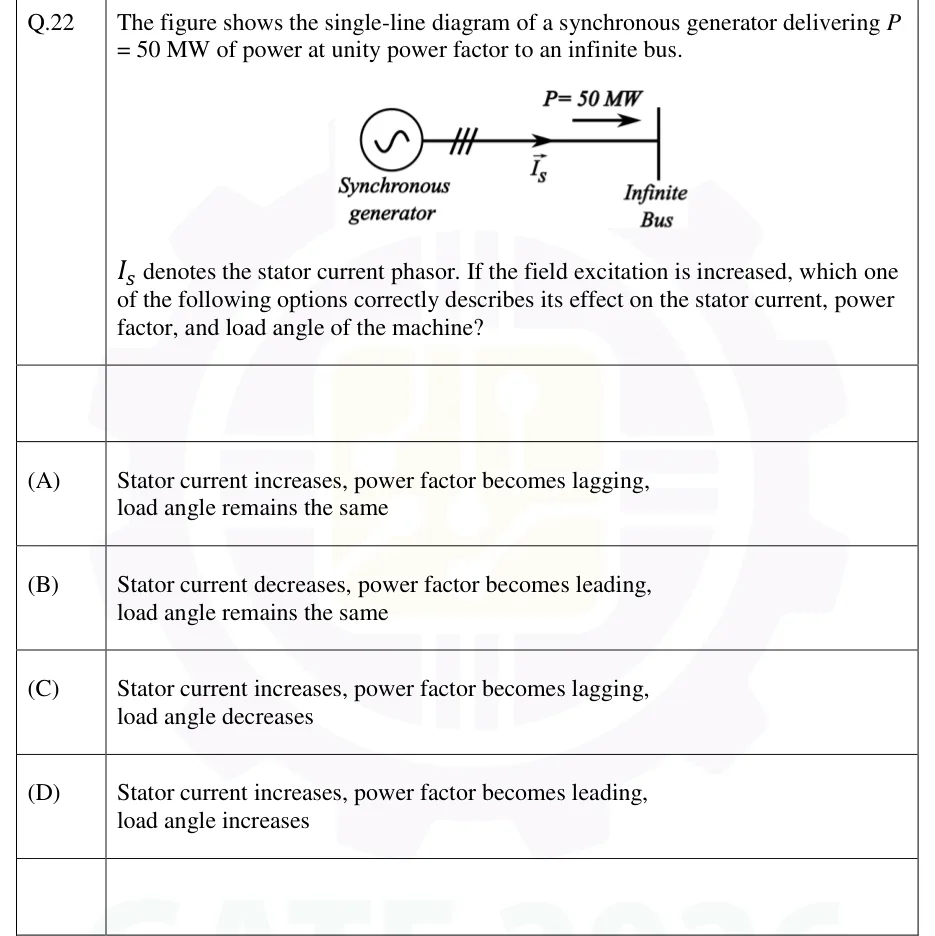
GATE 2026 EE question 22: Single-line diagram: a synchronous generator (circle with a sinusoid symbol) connects through a transformer…Tap to open full size
Figure from the GATE 2026 EE paper. It is part of the question.
Figure description

Single-line diagram: a synchronous generator (circle with a sinusoid symbol) connects through a transformer (three-parallel-slash symbol) to a bus bar labelled 'Infinite Bus'. An arrow on the connecting line, labelled I_s, points from the generator toward the bus, indicating the stator current direction. Above the line, an arrow labelled P = 50 MW points from the generator side toward the infinite bus, indicating real power flow into the bus.

  1. (A)

    Stator current increases, power factor becomes lagging, load angle remains the same

  2. (B)

    Stator current decreases, power factor becomes leading, load angle remains the same

  3. (C)

    Stator current increases, power factor becomes lagging, load angle decreases

  4. (D)

    Stator current increases, power factor becomes leading, load angle increases

Answer and solution

ANSWER

The correct answer is (C): Stator current increases, power factor becomes lagging, load angle decreases.

Official answer: CSource: Official answer key, GATE 2026 EE (IIT Guwahati)

  1. Model: the synchronous generator is connected to an infinite bus, so terminal voltage magnitude V and frequency f are fixed by the bus. Real power delivered, , is set by the prime mover's mechanical input and does not change merely because field excitation is changed.

  2. Power-angle equation: , where E is the internal EMF magnitude, the synchronous reactance, and the load (torque) angle. Since P, V and are all fixed, .

  3. Reactive power delivered to the bus: .

  4. Initial condition: the machine operates at unity power factor, so , which requires — the minimum-stator-current, unity-PF operating point.

  5. Increase field excitation: E increases. Since must stay constant (Step 2) and E is rising, must fall — so the load angle decreases.

  6. Check Q: with E increasing and decreasing (so increasing), the product rises above V, making positive. The generator is now over-excited and supplies lagging reactive power (VARs) to the bus.

  7. Stator current magnitude: with apparent power components P (unchanged) and Q (now nonzero and growing from 0), must increase.

  8. Power factor: the stator current now carries a lagging reactive component (the generator is delivering VARs at its terminals), so the terminal power factor becomes lagging.

  9. Conclusion: stator current increases, power factor becomes lagging, and load angle decreases — this is option (C).

KEY IDEA

On an infinite bus (fixed V, f), real power P is set by the prime mover and stays constant when only field excitation changes. Since with V and fixed, stays constant — so increasing E forces (hence ) to fall. Reactive power starts at zero (unity PF) and rises positive as E increases, making the machine over-excited: it now supplies lagging VARs, so grows and the terminal power factor becomes lagging.

WATCH OUT FOR

Confusing the machine-side excitation change with the load angle direction: many students assume increasing E always increases δ (as it does at constant P and Q on a V-curve sketch), forgetting that on an infinite bus P is the fixed, externally-set quantity while δ is the variable that adjusts — so δ must fall, not rise, to keep constant as E grows. Another common slip is stopping at "generator becomes over-excited, so PF is leading" — for a generator, over-excitation (supplying VARs to the bus) gives a lagging power factor, the opposite convention from a motor.

From the GATE 2026 EE paper. Every question of this paper · Download the full paper · All 11 Synchronous machines questions, with notes

More Synchronous machines questions