
IAE Academy

GATE 2024 EC Q.16: solution and answer

GATE 2024 · ECQ.16 · 1 mark · MCQ

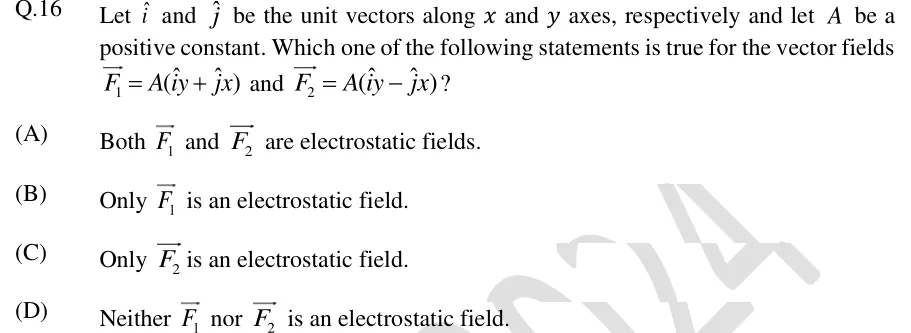
Let and be the unit vectors along and axes, respectively and let be a positive constant. Which one of the following statements is true for the vector fields and ?

  1. (A)

    Both and are electrostatic fields.

  2. (B)

    Only is an electrostatic field.

  3. (C)

    Only is an electrostatic field.

  4. (D)

    Neither nor is an electrostatic field.
See the question in the paper

Answer and solution

ANSWER

(B) Only is an electrostatic field: (with ), while .

Official answer: BSource: Official answer key, GATE 2024 EC (IISc Bengaluru)

  1. A static electric field is conservative. It must satisfy , which is the same as saying for some scalar potential . So we check the curl of each field.

  2. Both fields lie in the -plane and depend only on and , so only the -component of the curl can be non-zero:

  3. For : and , so is irrotational, so it can be an electrostatic field.

  4. Confirm with a potential. Take . Then , so really is the negative gradient of a scalar potential. (Also , so this is the field of a charge-free region.)

  5. For : and , so because .

  6. has non-zero curl, so no scalar potential exists for it. Physically, : the field is everywhere perpendicular to the position vector, so its lines are circles about the origin (a vortex field). A static electric field cannot circulate like this, so is not electrostatic.

  7. Only is an electrostatic field. The answer is (B).

KEY IDEA

A vector field can be an electrostatic field exactly when it is conservative, meaning (equivalently ). The divergence imposes no condition. It only fixes the charge density through .

WATCH OUT FOR

Testing the divergence instead of the curl. Both fields have zero divergence, so a divergence test would wrongly pick (A). The other common slip is a sign error in for : its , so the curl is , not zero.

From the GATE 2024 EC paper. Every question of this paper · Download the full paper · All 23 Electrostatics questions, with notes

More Electrostatics questions