
IAE Academy

GATE 2018 EE Q.26: solution and answer

GATE 2018 · EEQ.26 · 2 marks · MCQ

A transformer with toroidal core of permeability is shown in the figure. Assuming uniform flux density across the circular core cross-section of radius , and neglecting any leakage flux, the best estimate for the mean radius is
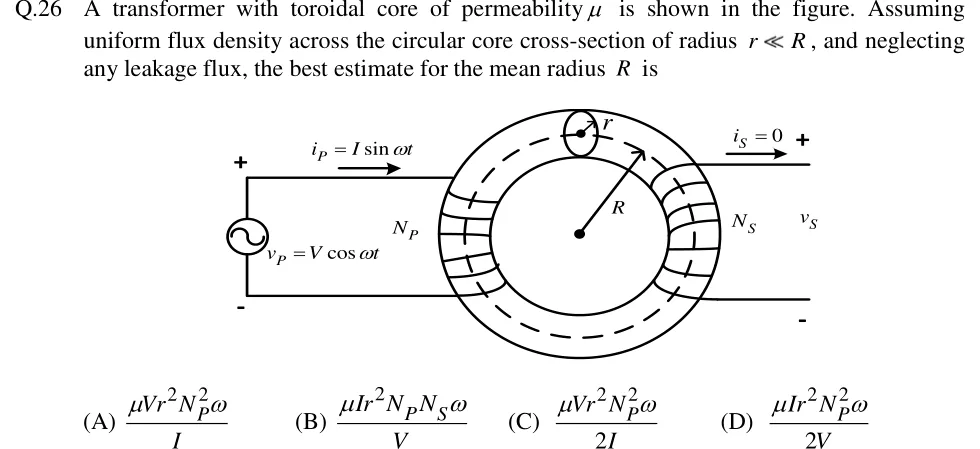
GATE 2018 EE question 26: A toroidal core with mean radius R (dashed mean-path circle, R drawn as an arrow from the centre to the dashed circle) and…Tap to open full size
Figure from the GATE 2018 EE paper. It is part of the question.
Figure description

A toroidal core with mean radius R (dashed mean-path circle, R drawn as an arrow from the centre to the dashed circle) and circular cross-section of radius r (small circle drawn on the top of the ring with r marked). A primary winding of N_P turns is wound on the left side of the toroid and a secondary winding of N_S turns on the right side. The primary is connected to an AC source v_P = V cos(omega t), + terminal at top, - at bottom; the primary current i_P = I sin(omega t) flows along the top wire towards the winding (arrow pointing right). The secondary terminals are open: i_S = 0 (arrow pointing right on the top wire), with output voltage v_S, + at top and - at bottom.

  1. (A)

  2. (B)

  3. (C)

  4. (D)

Answer and solution

ANSWER

The mean radius is , which is option (D).

Official answer: DSource: Official answer key, GATE 2018 EE (IIT Guwahati)

  1. Since , the secondary carries no current, so the core is magnetised by the primary ampere-turns alone.

  2. Apply Ampere's circuital law along the mean circular path of radius : . Because , this is taken as uniform over the cross-section.

  3. The core flux through the circular cross-section of area is

  4. Apply Faraday's law to the primary, neglecting leakage and winding resistance: This has the same form as . That fits a purely inductive magnetising current, which lags the voltage by . Equivalently, the primary self-inductance is and .

  5. Equate the amplitudes: .

  6. Solve for the mean radius: This is option (D).

KEY IDEA

With the secondary open, the primary behaves as a toroidal inductor with . Its voltage and current amplitudes satisfy . Solving this for gives the answer.

WATCH OUT FOR

There are three easy slips. (1) Using the mutual inductance, which gives as in option (B), when it is the PRIMARY voltage and current that are given. The self-inductance goes as . (2) Inverting the relation to as in options (A) and (C). A larger radius means a longer magnetic path and so a SMALLER inductance, so must grow with . (3) Dropping the factor 2 that comes from .

From the GATE 2018 EE paper. Every question of this paper · Download the full paper · All 12 Magnetostatics questions, with notes

More Magnetostatics questions