
IAE Academy

GATE 2018 IN Q.55: solution and answer

GATE 2018 · INQ.55 · 2 marks · NAT

A multi-mode optical fiber with a large core diameter has a core refractive index and cladding refractive index . The maximum value of (in degrees) for which the incident light from air will be guided in the optical fiber is ______.
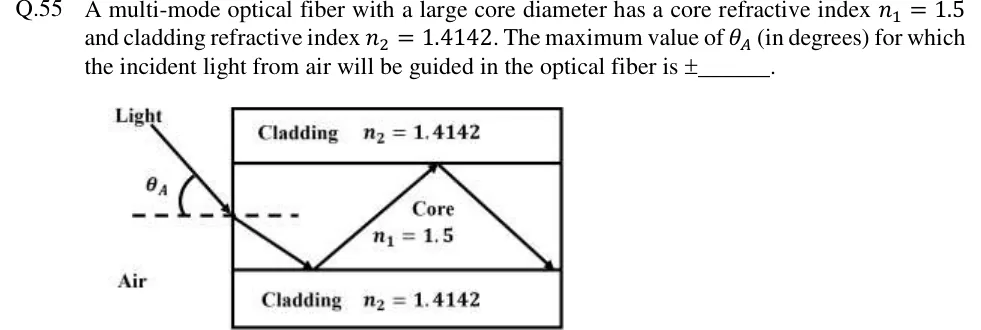
GATE 2018 IN question 55: Longitudinal section of a step-index fiber: a horizontal core strip labelled 'Core, n_1 = 1.5' lies between two cladding…Tap to open full size
Figure from the GATE 2018 IN paper. It is part of the question.
Figure description

Longitudinal section of a step-index fiber: a horizontal core strip labelled 'Core, n_1 = 1.5' lies between two cladding strips, the top one labelled 'Cladding n_2 = 1.4142' and the bottom one labelled 'Cladding n_2 = 1.4142'. The region to the left of the fiber's flat end face is labelled 'Air'. A ray marked 'Light' comes down from the upper left and hits the end face at the fiber axis (shown as a horizontal dashed line). The angle between the incoming ray and the dashed axis is marked theta_A. Inside the core the ray is refracted towards the axis, goes down to the lower core-cladding interface, reflects up to the upper interface, reflects down again and exits at the right, making a zig-zag path of total internal reflections.

Answer and solution

ANSWER

The maximum acceptance angle is , so light is guided for launch angles within .

Official answer: 29 to 31Source: Official answer key, GATE 2018 IN (IIT Guwahati)

  1. What the fibre needs: the ray is guided only if it meets the core–cladding boundary at an angle (measured from the normal to that boundary) of at least the critical angle , so that it is totally internally reflected. The largest launch angle in air that still meets this condition is the acceptance angle.

  2. Critical angle at the core–cladding boundary: . The fibre axis runs parallel to the boundary, so at this limit the ray inside the core makes an angle with the axis.

  3. Snell's law at the air–core end face ( for air): This quantity is the numerical aperture, .

  4. Substitute the values: (Note that , so .)

  5. Acceptance angle: (Keeping every digit gives .)

  6. Result: light from air is guided for launch angles up to from the fibre axis.

KEY IDEA

For a fibre launched from air, the acceptance angle satisfies . This comes from total internal reflection at the core–cladding boundary () together with Snell's law at the end face. Here , so .

WATCH OUT FOR

Answering with the critical angle , or its complement inside the core, , instead of the angle in air. The core-side angle has to be carried through Snell's law at the end face, . Another slip is to take instead of .

From the GATE 2018 IN paper. Every question of this paper · Download the full paper · All 6 Waveguides & fibres questions, with notes

More Waveguides & fibres questions