
IAE Academy

GATE 2020 IN Q.46: solution and answer

GATE 2020 · INQ.46 · 2 marks · NAT

A laser beam of 10 mm beam diameter is focused onto an optical fibre using a thin biconvex lens as shown in the figure. The refractive index of the lens is 1.5. The refractive indices of the core and cladding of the fibre are 1.55 and 1.54 respectively. The minimum value of the focal length of the lens to attain the maximum coupling to the fibre (in mm, rounded off to one decimal place) is ____
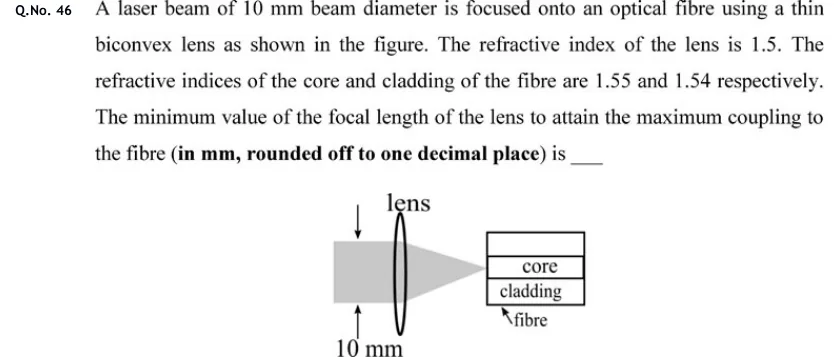
GATE 2020 IN question 46: A collimated laser beam, drawn as a grey horizontal band, travels from left to right.Tap to open full size
Figure from the GATE 2020 IN paper. It is part of the question.
Figure description

A collimated laser beam, drawn as a grey horizontal band, travels from left to right. A downward arrow above it and an upward arrow below it mark its full height, labelled '10 mm' (the beam diameter). The beam hits a thin biconvex lens, drawn as a tall narrow vertical ellipse labelled 'lens'. To the right of the lens the grey beam narrows as a cone to a point at the left (entrance) face of an optical fibre. The fibre is a horizontal rectangle split into three horizontal strips: an unlabelled top strip (the cladding), the middle strip labelled 'core', and the bottom strip labelled 'cladding'. An arrow from below points to the rectangle, labelled 'fibre'. The apex of the cone is on the core at the fibre's end face, and the fibre axis is in line with the lens axis. The figure does not show or name the medium around the fibre; the solution takes it to be air.

Answer and solution

ANSWER

The minimum focal length is .

Official answer: 27.5 to 28.5Source: Official answer key, GATE 2020 IN (IIT Delhi)

  1. Numerical aperture of the fibre. The medium around the fibre is not stated, so take it as air (). With core index and cladding index :

  2. Acceptance half-angle. . A ray that reaches the core face at a larger angle to the axis is not totally internally reflected at the core–cladding boundary, so it leaks out of the core and is lost.

  3. Geometry of the focused beam. The collimated beam has diameter , so its radius is . A thin lens brings a collimated beam to a focus at distance . The edge (marginal) ray therefore meets the axis at a half-angle given by

  4. Condition for maximum coupling. The whole beam enters the guided modes only if the marginal ray, which is the steepest ray, lies inside the acceptance cone: . Since gets smaller as grows, this means . The minimum focal length is the one that puts the marginal ray exactly at .

  5. Convert NA to a tangent.

  6. Minimum focal length.

  7. The lens index is not needed. The refractive index of the lens (1.5) would matter only for working out from the radii of curvature (lensmaker's equation). No radii are given and the question asks for itself, so the index plays no part.

KEY IDEA

For maximum coupling, every ray of the focused cone must lie inside the fibre's acceptance cone. The steepest ray is the marginal ray, at where is the beam radius. Setting with gives the shortest focal length that still couples the whole beam: .

WATCH OUT FOR

Using the full diameter (10 mm) where the geometry needs the radius (5 mm). That doubles the answer to about 56 mm. Other slips: forgetting the square root in ; writing ; treating the lens index 1.5 as part of the NA. Setting instead of gives about 28.4 mm, which happens to fall inside the key range, but the ray geometry is a tangent, not a sine.

From the GATE 2020 IN paper. Every question of this paper · Download the full paper · All 6 Waveguides & fibres questions, with notes

More Waveguides & fibres questions