
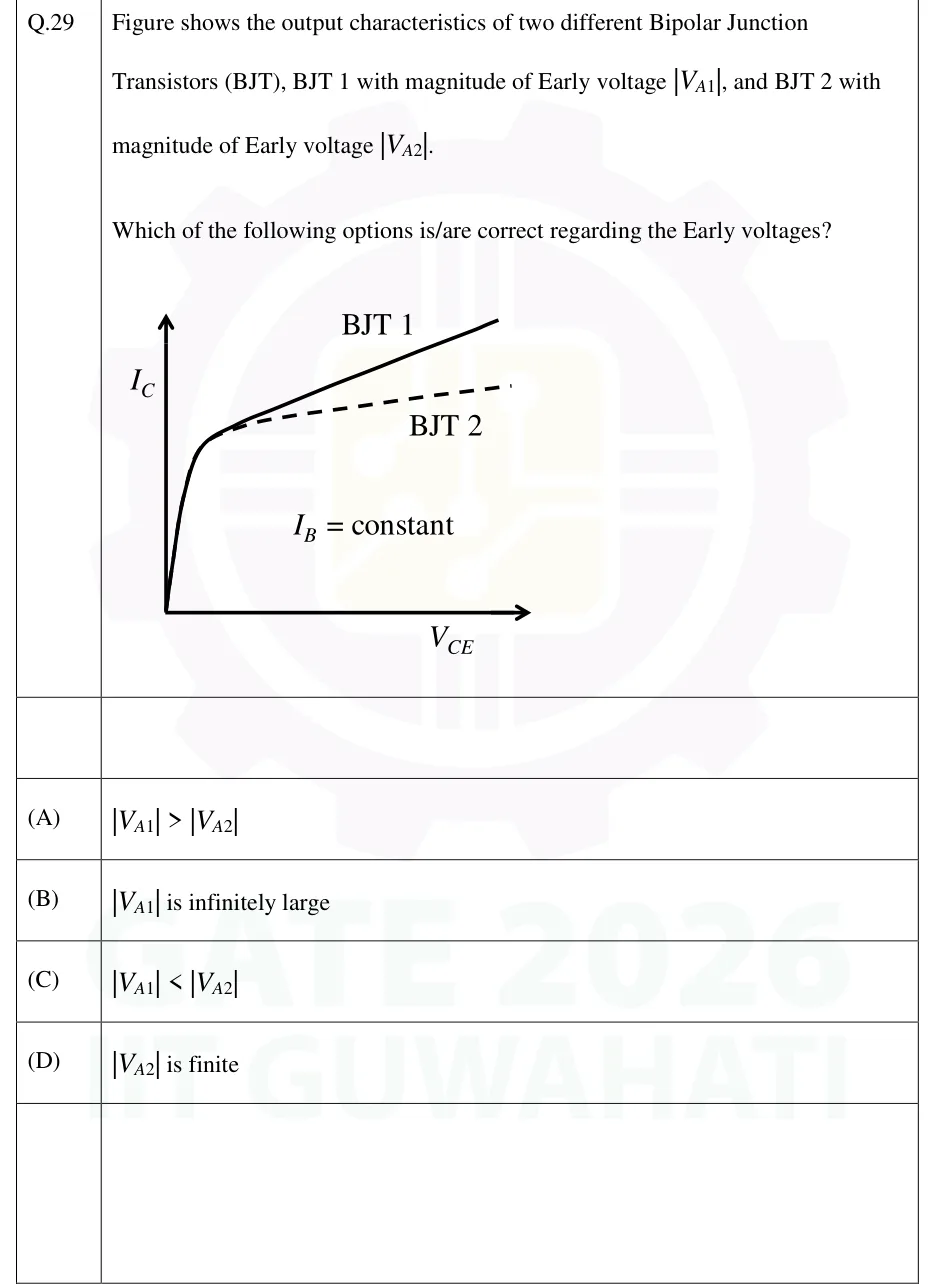
Figure shows the output characteristics of two different Bipolar Junction Transistors (BJT), BJT 1 with magnitude of Early voltage , and BJT 2 with magnitude of Early voltage .
Which of the following options is/are correct regarding the Early voltages?
 Tap to open full size
Figure description
A plot of collector current I_C (vertical axis) versus collector-emitter voltage V_CE (horizontal axis), both axes unlabeled with numeric values (arrows only, origin at bottom-left). Both curves are drawn for a constant base current, I_B = constant (labeled inside the plot). Both curves start at the origin, rise steeply through a curved knee region (the saturation-to-active transition), and then continue upward in the active region as straight, gently-rising lines. The curve labeled 'BJT 1' (solid line) has the steeper slope in the active region and ends higher/further right at the top of the plot. The curve labeled 'BJT 2' (dashed line) branches off from the same knee point as BJT 1 but has a distinctly flatter (much smaller) slope in the active region, ending lower and shorter than BJT 1's curve.
- (A)
- (B)
is infinitely large
- (C)
- (D)
is finite