
IAE Academy

GATE 2024 EC Q.26: solution and answer

GATE 2024 · ECQ.26 · 1 mark · MSQ

The free electron concentration profile in a doped semiconductor at equilibrium is shown in the figure, where the points A, B, and C mark three different positions. Which of the following statements is/are true?
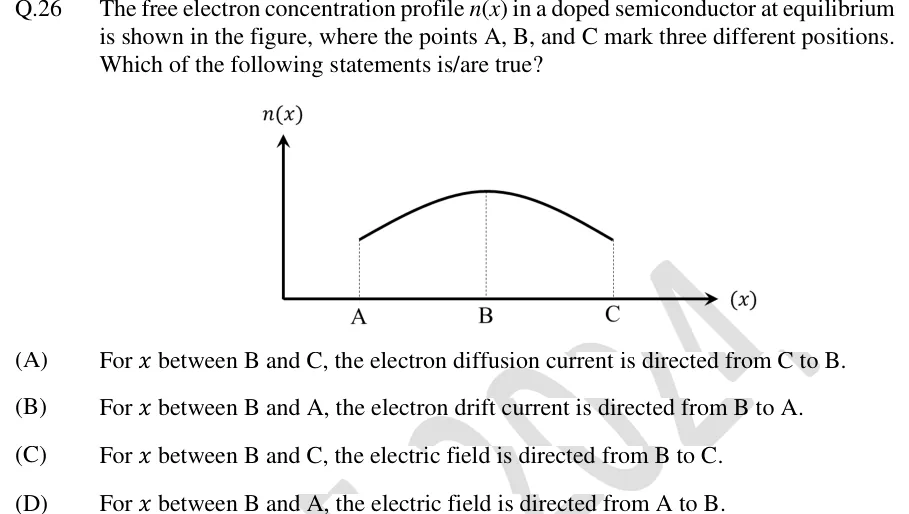
GATE 2024 EC question 26: A plot of n(x) (vertical axis) versus x (horizontal axis).Tap to open full size
Figure from the GATE 2024 EC paper. It is part of the question.
Figure description

A plot of n(x) (vertical axis) versus x (horizontal axis). Over the marked interval the curve starts at a moderate value above point A, rises smoothly to a single maximum (peak) directly above point B, then falls smoothly back down to a lower value above point C. Points A, B, C lie on the x-axis in that left-to-right order (A leftmost, B in the middle below the peak, C rightmost), each joined to the curve by a dotted vertical line.

  1. (A)

    For x between B and C, the electron diffusion current is directed from C to B.

  2. (B)

    For x between B and A, the electron drift current is directed from B to A.

  3. (C)

    For x between B and C, the electric field is directed from B to C.

  4. (D)

    For x between B and A, the electric field is directed from A to B.

Answer and solution

ANSWER

Statements (A), (B) and (C) are true and (D) is false, so the answer is A, B, C.

Official answer: A, B, CSource: Official answer key, GATE 2024 EC (IISc Bengaluru)

  1. Setup — equilibrium condition. At equilibrium the net electron current is zero at every point: where is the magnitude of the electron charge. This means the drift term and the diffusion term are equal in magnitude and opposite in sign at every .

  2. Diffusion current formula. The electron diffusion current density is so its sign is set entirely by the sign of the slope of .

  3. Segment B to C (checks options A and C). Moving from B to C, increases while falls from its peak, so there. Hence : the diffusion current points in the direction, i.e. from C toward B. This confirms statement (A) is true.

  4. From the equilibrium condition, the drift term must balance this: so the drift current is directed in the direction, i.e. from B toward C.

  5. Since with , a positive drift current requires between B and C — the field points in the direction, i.e. from B toward C. This confirms statement (C) is true.

  6. Segment A to B (checks options B and D). Moving from A to B, increases while rises toward the peak, so there, giving : diffusion current points in the direction (from A toward B).

  7. Equilibrium again forces so the drift current is directed in the direction, i.e. from B toward A. This confirms statement (B) is true.

  8. Since here, : the field points in the direction between A and B, i.e. from B toward A — not from A to B. This makes statement (D) false.

  9. Conclusion. Statements (A), (B) and (C) are true and (D) is false.

KEY IDEA

At thermal equilibrium the total electron current is zero everywhere, so wherever n(x) has a non-zero slope, the built-in electric field must produce a drift current that exactly cancels the diffusion current. The sign of dn/dx on each side of the peak therefore fixes the diffusion-current direction, and forcing the drift term to be equal and opposite fixes both the drift-current direction and the electric-field direction on that segment.

WATCH OUT FOR

Reading only the diffusion current off the slope of n(x) and stopping there — e.g. concluding the field must point the same way as the diffusion current, or assuming the field is zero because the material is "at equilibrium." The whole point of the question is that equilibrium forces drift to exactly oppose diffusion, so the field's direction is opposite to what a naive glance at the concentration slope would suggest.

From the GATE 2024 EC paper. Every question of this paper · Download the full paper · All 9 Carrier transport questions, with notes

More Carrier transport questions