IAE Academy

GATE 2018 EC Q.30: solution and answer

GATE 2018 · ECQ.30 · 2 marks · MCQ

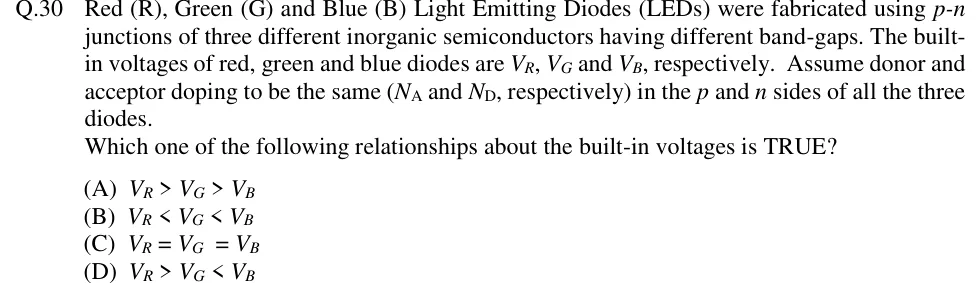
Q.30 Red (R), Green (G) and Blue (B) Light Emitting Diodes (LEDs) were fabricated using - junctions of three different inorganic semiconductors having different band-gaps. The built-in voltages of red, green and blue diodes are , and , respectively. Assume donor and acceptor doping to be the same ( and , respectively) in the and sides of all the three diodes.

Which one of the following relationships about the built-in voltages is TRUE?

  1. (A)

  2. (B)

  3. (C)

  4. (D)

See the question in the paper

Answer and solution

ANSWER

The correct answer is (B): — the built-in voltage increases with the LED's band-gap, and blue LEDs have the largest band-gap.

Official answer: BSource: Official answer key, GATE 2018 EC (IIT Guwahati)

  1. Photon energy (hence LED color) is set by the semiconductor's band-gap : among Red, Green and Blue LEDs, (blue light carries more energy per photon than red).

  2. The built-in voltage of a - junction is where , and , are the same for all three diodes (given).

  3. The intrinsic carrier concentration depends on the band-gap as so a larger gives an exponentially smaller .

  4. Since is fixed, grows as shrinks — i.e. increases as increases.

  5. Applying the band-gap ordering: .

  6. Hence , which is option (B).

KEY IDEA

A wider band-gap semiconductor has a much smaller intrinsic carrier concentration (since ), and since with the same doping in all three diodes, a smaller (larger ) gives a larger .

WATCH OUT FOR

Assuming the built-in voltage is unaffected by band-gap because and are stated to be equal (choosing option C), forgetting that itself is exponentially dependent on and enters the same formula.

From the GATE 2018 EC paper. Every question of this paper · Download the full paper · All 5 Optoelectronics questions, with notes

More Optoelectronics questions