IAE Academy

GATE 2026 EC Q.54: solution and answer

GATE 2026 · ECQ.54 · 2 marks · MSQ

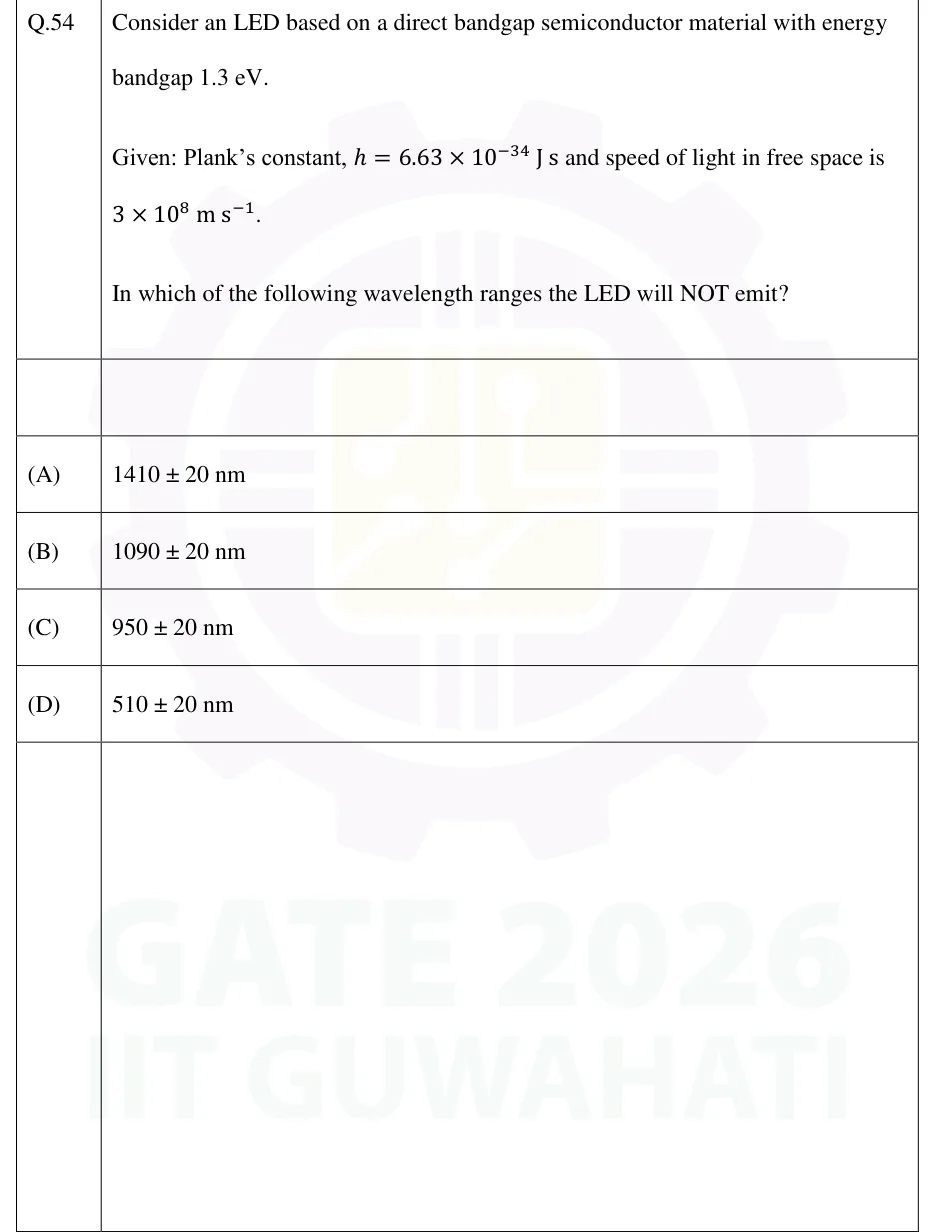
Consider an LED based on a direct bandgap semiconductor material with energy bandgap 1.3 eV.

Given: Plank's constant, J s and speed of light in free space is .

In which of the following wavelength ranges the LED will NOT emit?

  1. (A)

    nm

  2. (B)

    nm

  3. (C)

    nm

  4. (D)

    nm

See the question in the paper

Answer and solution

ANSWER

The LED will NOT emit in ranges (A) nm, (B) nm and (D) nm.

Official answer: A, B, DSource: Official answer key, GATE 2026 EC (IIT Guwahati)

  1. An LED based on a direct-bandgap semiconductor emits photons whose energy is essentially equal to the material's bandgap energy: . So the emission is concentrated at a single wavelength , not spread across an arbitrary range.

  2. Compute : .

  3. Convert to eV·nm using C: .

  4. Find the emission wavelength: .

  5. Check each option's window against nm: (A) – nm does not contain 956 nm. (B) – nm does not contain 956 nm. (C) – nm DOES contain 956 nm. (D) – nm does not contain 956 nm.

  6. Since the LED emits only near nm, it will NOT emit in the ranges that exclude this value: (A), (B) and (D). It WILL emit within range (C), so C is not part of the answer.

KEY IDEA

A direct-bandgap LED emits photons with energy essentially equal to the bandgap energy, so its emission is concentrated at a single wavelength , not spread over the full visible-to-IR spectrum; the LED "does not emit" in any stated window that does not bracket .

WATCH OUT FOR

Trying to match the bandgap to a "range" of wavelengths rather than computing a single sharp emission wavelength and checking which option windows exclude it; also common arithmetic slip: using in the wrong power of ten when converting J to eV, giving a that falls in the wrong window.

From the GATE 2026 EC paper. Every question of this paper · Download the full paper · All 5 Optoelectronics questions, with notes

More Optoelectronics questions