
IAE Academy

GATE 2018 EC Q.45: solution and answer

GATE 2018 · ECQ.45 · 2 marks · NAT

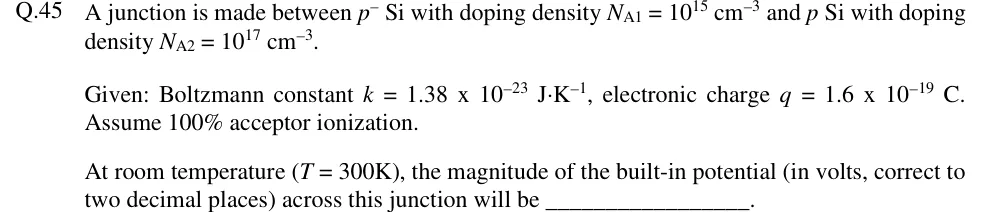
A junction is made between Si with doping density and Si with doping density .

Given: Boltzmann constant , electronic charge . Assume 100% acceptor ionization.

At room temperature (), the magnitude of the built-in potential (in volts, correct to two decimal places) across this junction will be ____.
See the question in the paper

Answer and solution

ANSWER

The magnitude of the built-in potential across this p⁻–p high-low (isotype) Si junction, at T = 300 K, is Vbi ≈ 0.12 V.

Official answer: 0.11 to 0.13Source: Official answer key, GATE 2018 EC (IIT Guwahati)

  1. This is a p⁻–p homojunction (an isotype or "high-low" junction), not a p-n junction: both sides are p-type Si, with on the lightly doped () side and on the heavily doped () side.

  2. With 100% acceptor ionization, the equilibrium hole concentration on each side equals the doping density: and .

  3. For an isotype (p–p) junction, the built-in potential is set directly by the ratio of the majority-carrier (hole) concentrations on the two sides:

  4. Compute the thermal voltage:

  5. Compute the doping ratio:

  6. Combine:

  7. Rounded to two decimal places, the magnitude of the built-in potential is .

KEY IDEA

This is a p⁻–p (isotype / high-low) homojunction, not a p-n junction. Since both sides are p-type, the built-in potential is set by the ratio of the majority-carrier (hole) concentrations on the two sides, not by an /minority-carrier expression: , with .

WATCH OUT FOR

Treating this as a standard p-n junction and reaching for — that formula does not apply here since there is no donor density and no given (and none is needed): both regions are p-type, so the isotype-junction formula using only the two acceptor densities must be used instead.

From the GATE 2018 EC paper. Every question of this paper · Download the full paper · All 9 Semiconductors questions, with notes

More Semiconductors questions