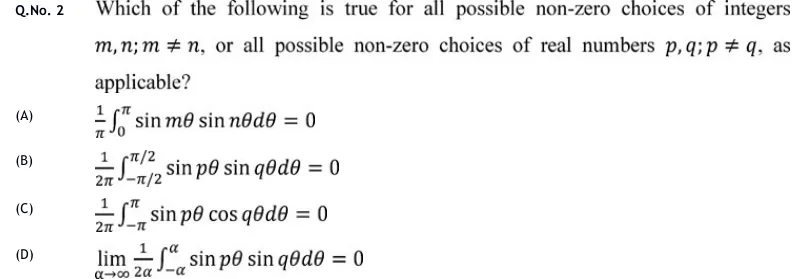
Which of the following is true for all possible non-zero choices of integers , or all possible non-zero choices of real numbers , as applicable?
- (A)
- (B)
- (C)
- (D)

Which of the following is true for all possible non-zero choices of integers , or all possible non-zero choices of real numbers , as applicable?
ANSWER
(C): for all non-zero real , because the integrand is odd and the interval is symmetric.
Official answer: CSource: Official answer key, GATE 2020 EE (IIT Delhi)
The statement has to hold for every allowed choice, so one counter-example rules an option out. Note that still allows , and still allows .
Product-to-sum identity: .
(A): take . Both are non-zero and unequal, so the choice is allowed. Then , so The orthogonality result also needs , so (A) is not always true.
(B): is not a full period, so orthogonality does not apply. For the integrand is , which is even, so (B) is false.
(C): odd-function property. is odd and is even, so satisfies . The integral of an odd function over the symmetric interval is , and this holds for every real .
(D): for the identity gives But is allowed. Then the integrand is and (D) fails.
Only (C) is true for every allowed choice. Answer: (C).
KEY IDEA
The only property that holds for every allowed choice is symmetry: is odd, so its integral over is zero whatever and are. The sine-sine orthogonality results in (A), (B) and (D) need (or ), and (B) also needs a full period, so each one has a counter-example.
WATCH OUT FOR
Choosing (A) or (D) from the memorised orthogonality relation "different frequencies integrate to zero". The question only requires (or ) and non-zero values, so negative values are allowed. With or the product becomes , and its integral (or long-run average) is , not .
From the GATE 2020 EE paper. Every question of this paper · Download the full paper · All 39 Calculus questions, with notes