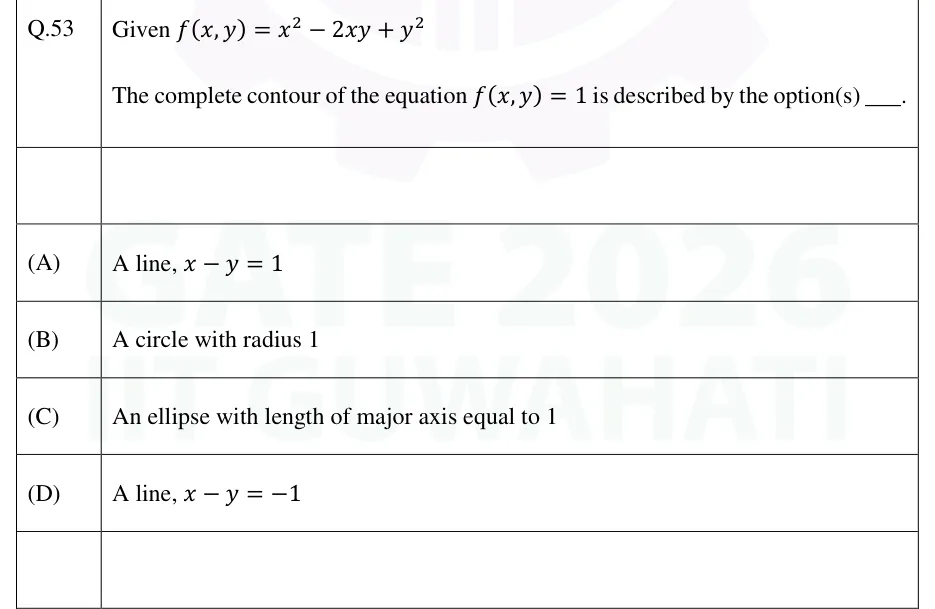
Given
The complete contour of the equation is described by the option(s) ____.
- (A)
A line,
- (B)
A circle with radius 1
- (C)
An ellipse with length of major axis equal to 1
- (D)
A line,

Given
The complete contour of the equation is described by the option(s) ____.
A line,
A circle with radius 1
An ellipse with length of major axis equal to 1
A line,
ANSWER
(A) and (D). The contour is , which is the pair of parallel lines and .
Official answer: A, DSource: Official answer key, GATE 2026 IN (IIT Guwahati)
Spot the perfect square: . The contour is therefore .
Take square roots and keep both signs: . The contour is the pair of parallel lines and .
Check with the conic discriminant. For the quadratic part , here , so . That is the parabolic case, and here it is degenerate: the curve splits into two straight lines. A circle or an ellipse needs , so options (B) and (C) are ruled out.
Check one point on each line. lies on and gives . lies on and gives . Both lines belong to the contour.
The question asks for the complete contour. That contour is exactly the union of the two lines, so (A) and (D) together describe it, and both are correct.
KEY IDEA
is the perfect square , so a level set with is two parallel lines , not a closed curve. The discriminant gives the same answer: it rules out circles and ellipses.
WATCH OUT FOR
Keeping only the positive root and marking (A) alone. The complete contour is both lines, because also holds when . Another trap is to see squared terms with equal coefficients and guess a circle. That ignores the cross term, which turns the expression into a perfect square.
From the GATE 2026 IN paper. Every question of this paper · Download the full paper · All 39 Calculus questions, with notes