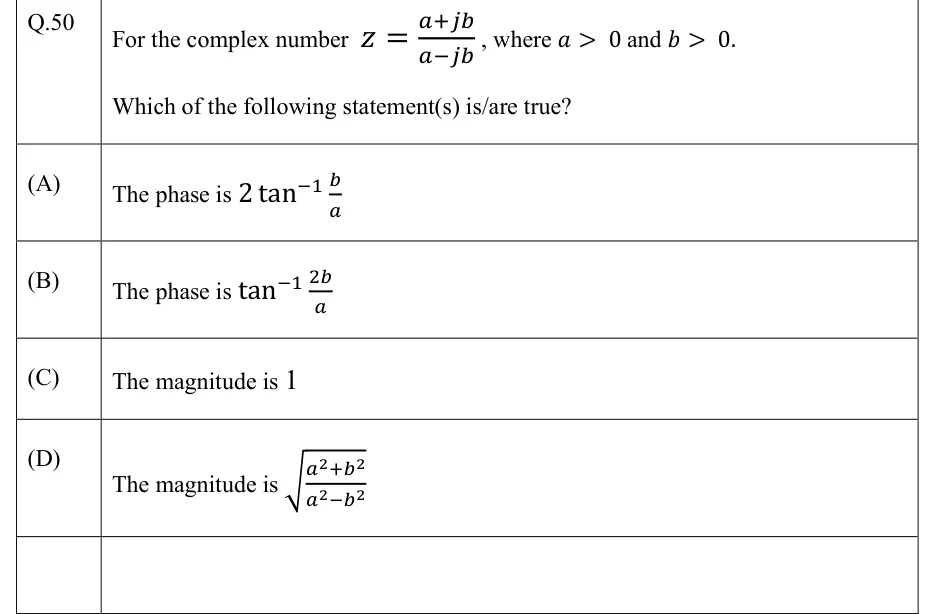
For the complex number , where and .
Which of the following statement(s) is/are true?
- (A)
The phase is
- (B)
The phase is
- (C)
The magnitude is
- (D)
The magnitude is

For the complex number , where and .
Which of the following statement(s) is/are true?
The phase is
The phase is
The magnitude is
The magnitude is
ANSWER
(A) and (C) are true. , so its magnitude is and its phase is .
Official answer: A, CSource: Official answer key, GATE 2022 IN (IIT Kharagpur)
Write the numerator in polar form: with and . Since and , the point lies in the first quadrant, so .
The denominator is the complex conjugate of the numerator: .
Divide in polar form (magnitudes divide, angles subtract):
Magnitude: . So (C) is true and (D) is false. (D) would need , but the modulus of is .
Phase: . Because , we get , which is already a principal argument, so no multiple of has to be added or removed. So (A) is true.
Check (B). For , the double-angle formula gives If (B) were true, we would have . Setting gives , so , which is excluded. For , , while . So (B) is false for every .
Correct options: (A) and (C).
KEY IDEA
is the conjugate of . The two have the same modulus and opposite angles. Dividing a complex number by its conjugate therefore gives a number of magnitude whose angle is twice the original angle: .
WATCH OUT FOR
Doubling inside the inverse tangent, writing instead of (option B). The inverse tangent is not linear, and , not . A second trap: rationalising to and then taking the phase as gives the wrong quadrant when , because the real part is then negative. A third: taking (option D). The minus sign is inside the complex number, and the modulus is still .
From the GATE 2022 IN paper. Every question of this paper · Download the full paper · All 24 Complex analysis questions, with notes