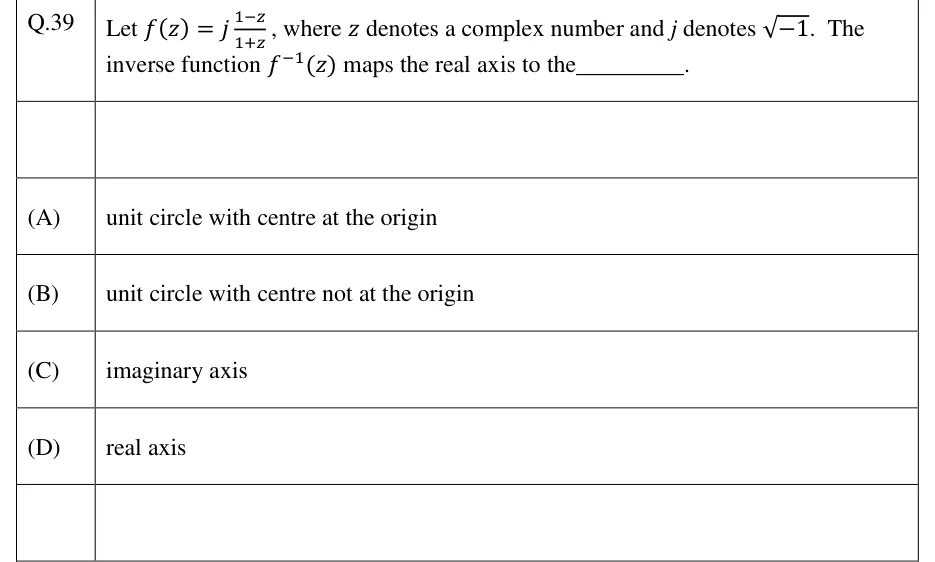
Let , where denotes a complex number and denotes . The inverse function maps the real axis to the ________.
- (A)
unit circle with centre at the origin
- (B)
unit circle with centre not at the origin
- (C)
imaginary axis
- (D)
real axis

Let , where denotes a complex number and denotes . The inverse function maps the real axis to the ________.
unit circle with centre at the origin
unit circle with centre not at the origin
imaginary axis
real axis
ANSWER
sends every real to a point with , so it maps the real axis onto the unit circle with centre at the origin. Answer: (A).
Official answer: ASource: Official answer key, GATE 2023 IN (IIT Kanpur)
Write . This is a bilinear (Mobius) map. Solve it for to get the inverse: .
So the inverse map is
Substitute a point of the real axis, with real: .
Take the modulus. The numerator is and the denominator is , and both have modulus :
So every image point lies on . Check a few points: ; ; . All three lie on the unit circle. A Mobius map is one-to-one, so as runs over the whole real axis (with the point at infinity) the image covers the whole circle.
A bilinear map sends a line to either a line or a circle. The inverse map's only pole is at , which is not on the real axis, so the image is bounded: it is a circle, not a line. That circle is , whose centre is the origin. Answer: (A).
KEY IDEA
Invert the bilinear map and substitute a real value. For real , the numbers and have the same modulus , so their ratio always has modulus 1. Put the other way round: is a Cayley-type transform that takes the unit circle onto the real axis, so takes the real axis back onto the unit circle.
WATCH OUT FOR
Using the forward map instead of . For real , is purely imaginary, so maps the real axis to the imaginary axis, which leads to the wrong option (C). A second slip is getting the image circle right but not checking its centre. The points , and are all at distance 1 from the origin, which fixes the centre at and rules out (B).
From the GATE 2023 IN paper. Every question of this paper · Download the full paper · All 24 Complex analysis questions, with notes