
IAE Academy

GATE 2025 EC GA Q.7: solution and answer

GATE 2025 · ECGA Q.7 · 2 marks · MCQ

A stick of length one meter is broken at two locations at distances of and from the origin (0), as shown in the figure. Note that . Which one of the following is NOT a necessary condition for forming a triangle using the three pieces?

Note: All lengths are in meter. The figure shown is representative.
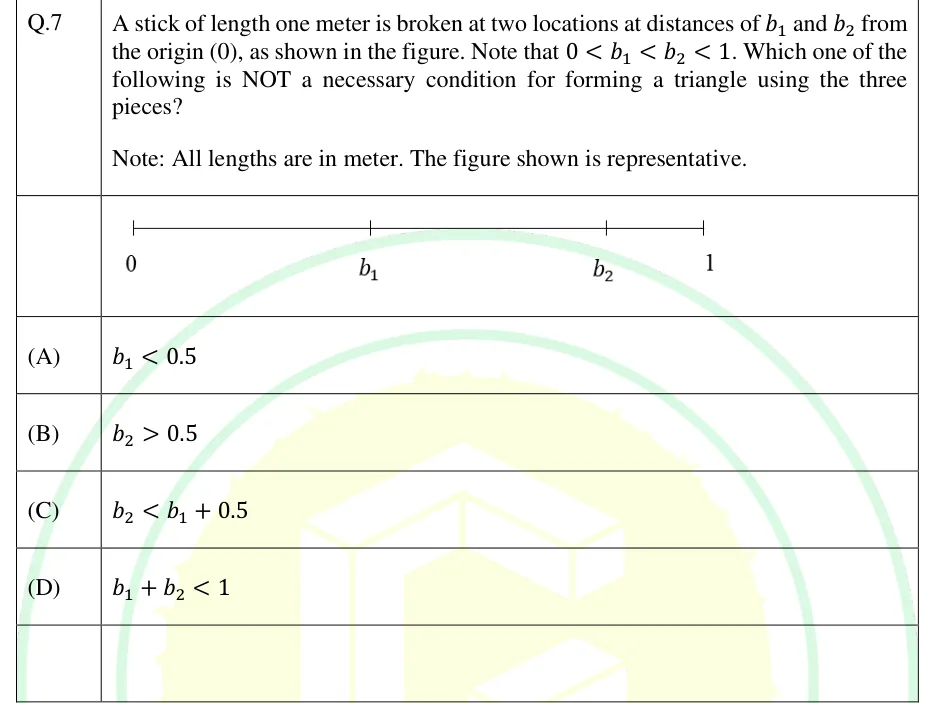
GATE 2025 EC GA question 7: A horizontal line segment representing the stick, with short vertical tick marks at its left end, at two interior points…Tap to open full size
Figure from the GATE 2025 EC paper. It is part of the question.
Figure description

A horizontal line segment representing the stick, with short vertical tick marks at its left end, at two interior points and at its right end. Below the ticks, from left to right, are the labels 0 (left end), b_1 (first interior tick, a little left of the middle), b_2 (second interior tick, about four-fifths of the way along) and 1 (right end). The figure is marked as representative, not to scale.

  1. (A)

  2. (B)

  3. (C)

  4. (D)

Answer and solution

ANSWER

(D) is NOT a necessary condition. The pieces form a triangle exactly when each is shorter than . Those three conditions are options (A), (B) and (C), and a triangle can form even when (for example , ).

Official answer: DSource: Official answer key, GATE 2025 EC (IIT Roorkee)

  1. The three pieces have lengths , and . All three are positive because , and they add up to .

  2. Triangle inequality: each side must be shorter than the sum of the other two. The three sides add up to 1, so the other two sides of any side add up to . The condition is then , which means . So a triangle can be formed exactly when every piece is shorter than . Each of these three conditions is necessary, and together they are sufficient.

  3. First piece: . This is option (A), so (A) is necessary.

  4. Second piece: . This is option (C), so (C) is necessary.

  5. Third piece: . This is option (B), so (B) is necessary.

  6. Option (D) is not one of these conditions, and one counter-example shows it is not necessary. Take , . The pieces are , and , all shorter than , so a triangle forms. Yet , so (D) fails even though the triangle exists.

  7. Therefore the condition that is NOT necessary is (D) .

KEY IDEA

When three lengths add up to , the triangle inequality reduces to one simple test: every side must be shorter than . Here , so each of , and must be less than . Write out these three inequalities and match them to the options. To show that a condition is not necessary, one counter-example is enough: a valid triangle that breaks that condition.

WATCH OUT FOR

Confusing 'necessary' with 'sufficient'. Each of (A), (B) and (C) alone is not enough to guarantee a triangle, so students sometimes wrongly mark one of them as the answer. The question asks which condition a triangle does not REQUIRE. Another trap is assuming from the figure, or from a symmetry argument that puts both cuts near the middle. The figure is only representative. Cuts at and give a valid triangle with .

From the GATE 2025 EC paper. Every question of this paper · Download the full paper · All 22 Geometry questions, with notes

More Geometry questions