
IAE Academy

GATE 2023 BT Q.12: solution and answer

GATE 2023 · BTQ.12 · 1 mark · MCQ

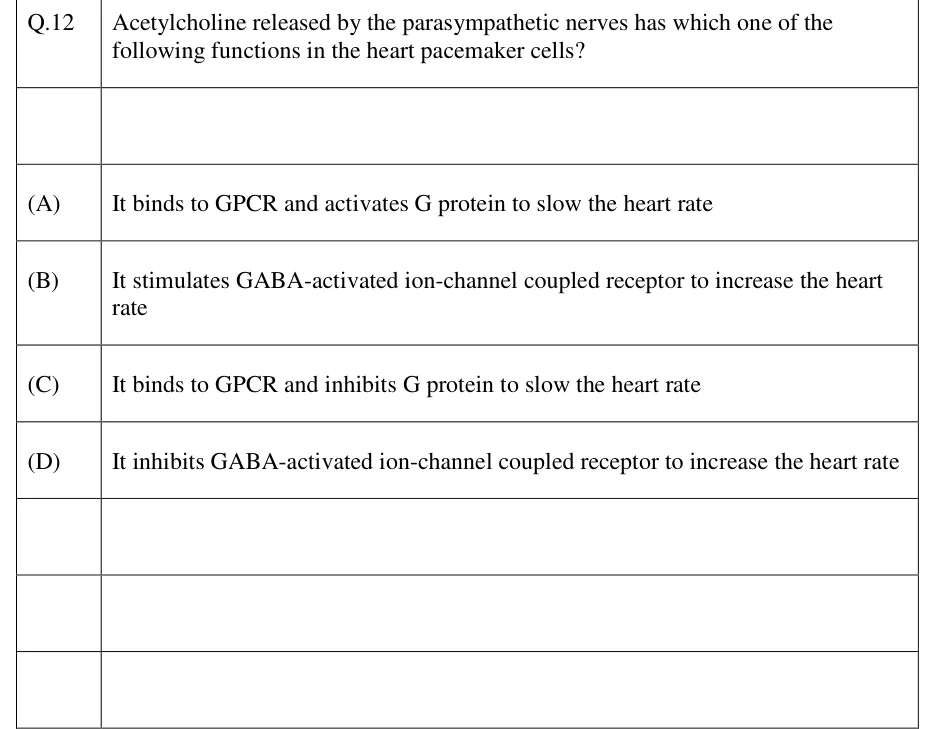
Acetylcholine released by the parasympathetic nerves has which one of the following functions in the heart pacemaker cells?

  1. (A)

    It binds to GPCR and activates G protein to slow the heart rate

  2. (B)

    It stimulates GABA-activated ion-channel coupled receptor to increase the heart rate
  3. (C)

    It binds to GPCR and inhibits G protein to slow the heart rate

  4. (D)

    It inhibits GABA-activated ion-channel coupled receptor to increase the heart rate

See the question in the paper

Answer and solution

ANSWER

The correct answer is (A): Acetylcholine binds to the M2 muscarinic GPCR on SA-node pacemaker cells and activates the associated inhibitory G protein (Gi/Go), which slows the heart rate.

Official answer: ASource: Official answer key, GATE 2023 BT (IIT Kanpur)

  1. Parasympathetic (vagal) acetylcholine acts on the M2 muscarinic acetylcholine receptor on SA-node pacemaker cells — a GPCR, not a ligand-gated ion channel.

  2. Options B and D invoke a 'GABA-activated ion-channel coupled receptor', which is unrelated to cardiac pacemaker physiology (GABA-A receptors are neuronal ligand-gated Cl– channels) and both also wrongly claim an increase in heart rate; both are eliminated.

  3. At the M2 receptor, ACh binding activates the coupled inhibitory G protein (Gi/Go) — the G protein itself is turned ON, not inhibited.

  4. The activated Gi/Go then inhibits adenylyl cyclase (lowering cAMP) and its Gβγ subunits open GIRK K+ channels, hyperpolarizing the SA node and slowing the pacemaker firing rate (negative chronotropy).

  5. Option A ('binds to GPCR and activates G protein to slow the heart rate') matches this mechanism exactly.

  6. Option C ('binds to GPCR and inhibits G protein to slow the heart rate') is wrong: ACh does not inhibit the G protein — it activates the inhibitory G protein; the inhibition occurs downstream, at adenylyl cyclase.

  7. Correct answer: A.

KEY IDEA

In SA-node pacemaker cells, parasympathetic acetylcholine acts on M2 muscarinic receptors — GPCRs coupled to an inhibitory G protein (Gi/Go), not on any GABA-gated channel. Binding activates this Gi/Go protein, which then inhibits adenylyl cyclase (lowering cAMP) and opens GIRK K+ channels, hyperpolarizing the cell and slowing the pacemaker rate (negative chronotropy).

WATCH OUT FOR

Confusing "activates the inhibitory G protein" with "inhibits the G protein" — the inhibition in this pathway happens downstream (Gi inhibits adenylyl cyclase), not at the G protein itself, which is what makes distractor (C) attractive but wrong.

From the GATE 2023 BT paper. Every question of this paper · Download the full paper · All 7 Cell signalling questions, with notes

More Cell signalling questions