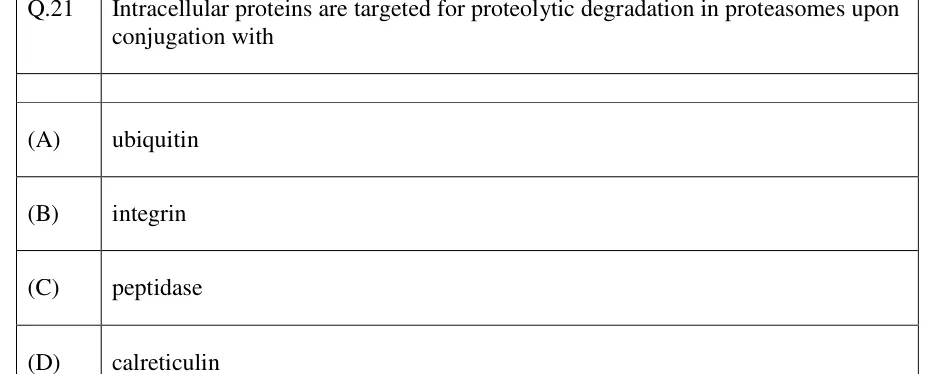
Intracellular proteins are targeted for proteolytic degradation in proteasomes upon conjugation with
- (A)
ubiquitin
- (B)
integrin
- (C)
peptidase
- (D)
calreticulin

Intracellular proteins are targeted for proteolytic degradation in proteasomes upon conjugation with
ubiquitin
integrin
peptidase
calreticulin
ANSWER
The correct answer is (A) ubiquitin.
Official answer: ASource: Official answer key, GATE 2023 BT (IIT Kanpur)
Recall that intracellular protein turnover in eukaryotes proceeds mainly via the ubiquitin-proteasome system.
Option (A) ubiquitin: a 76-residue protein covalently conjugated to lysine residues of a target protein via the E1-E2-E3 enzyme cascade; polyubiquitination is the signal recognized by the 26S proteasome for degradation. Correct.
Option (B) integrin: a transmembrane cell-adhesion receptor linking the cytoskeleton to the extracellular matrix; not a degradation-targeting tag. Incorrect.
Option (C) peptidase: an enzyme class that hydrolyzes peptide bonds; a protein is not "conjugated with" a peptidase as a targeting signal (proteasome subunits themselves act as peptidases, but that is not the tagging event). Incorrect.
Option (D) calreticulin: an ER-lumen calcium-binding chaperone in the calnexin/calreticulin protein-folding quality-control cycle, not a proteasomal degradation tag. Incorrect.
Therefore the molecule whose conjugation targets proteins for proteasomal degradation is ubiquitin, giving answer (A).
KEY IDEA
Covalent tagging of a target protein with (poly)ubiquitin chains is the signal recognized by the 26S proteasome for ATP-dependent proteolytic degradation.
WATCH OUT FOR
Confusing peptidase (an enzyme that carries out proteolysis, including proteasomal subunits) with the actual conjugated targeting tag; peptidase is never itself covalently attached to a substrate as a degradation signal.
From the GATE 2023 BT paper. Every question of this paper · Download the full paper · All 7 Cell signalling questions, with notes