IAE Academy

GATE 2020 BT Q.29: solution and answer

GATE 2020 · BTQ.29 · 2 marks · MCQ

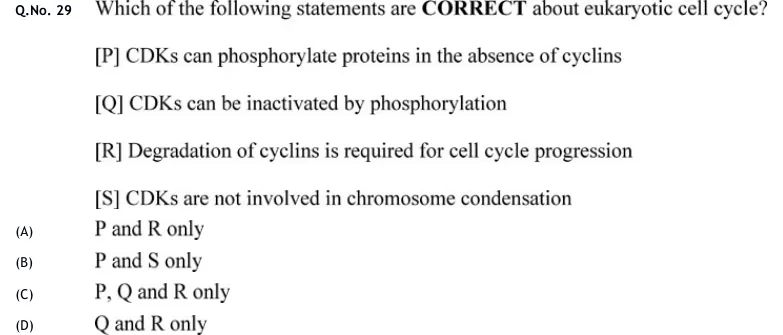
Which of the following statements are CORRECT about eukaryotic cell cycle? P CDKs can phosphorylate proteins in the absence of cyclins. Q CDKs can be inactivated by phosphorylation. R Degradation of cyclins is required for cell cycle progression. S CDKs are not involved in chromosome condensation.

  1. (A)

    P and R only

  2. (B)

    P and S only

  3. (C)

    P, Q and R only

  4. (D)

    Q and R only

See the question in the paper

Answer and solution

ANSWER

Q and R only — CDKs can be inactivated by inhibitory phosphorylation, and cyclin degradation is required for cell cycle progression.

Official answer: DSource: Official answer key, GATE 2020 BT (IIT Delhi)

  1. Statement P: A CDK monomer lacks the active conformation needed for catalysis; only cyclin binding repositions the T-loop and activates the kinase. So a CDK cannot phosphorylate substrates without a bound cyclin, and P is FALSE.

  2. Statement Q: CDK activity is turned off by inhibitory phosphorylation — Wee1 kinase phosphorylates CDK1 at Thr14 and Tyr15, and this phosphorylation is only removed by Cdc25 phosphatase to allow mitotic entry. So CDKs can indeed be inactivated by phosphorylation, and Q is TRUE.

  3. Statement R: Progression through the cell cycle (e.g., mitotic exit, the metaphase-to-anaphase transition) requires the APC/C to ubiquitinate cyclins such as cyclin B, targeting them for proteasomal degradation; without this degradation CDK activity stays high and the cycle cannot proceed. So R is TRUE.

  4. Statement S: The CDK1-cyclin B complex (MPF) phosphorylates condensin subunits and histone H3, directly driving mitotic chromosome condensation. So CDKs ARE involved in condensation, and S is FALSE.

  5. Only Q and R are correct statements, which corresponds to option (D).

KEY IDEA

CDK activity is controlled both positively (cyclin binding) and negatively (inhibitory phosphorylation, e.g. Wee1-mediated Tyr15/Thr14 phosphorylation of CDK1), and progression past checkpoints (such as the metaphase-to-anaphase transition and mitotic exit) requires the APC/C-mediated ubiquitination and proteasomal degradation of cyclins.

WATCH OUT FOR

Assuming CDKs act only through activation (cyclin binding, activating dephosphorylation by Cdc25) and forgetting that phosphorylation can also switch a CDK off (Wee1 pathway), which leads to wrongly rejecting statement Q; also assuming chromosome condensation is driven only by condensin loading and not recognizing that CDK1-cyclin B phosphorylates condensin subunits and histone H3, which would wrongly validate statement S.

From the GATE 2020 BT paper. Every question of this paper · Download the full paper · All 15 Cell biology questions, with notes

More Cell biology questions