IAE Academy

GATE 2026 BT Q.42: solution and answer

GATE 2026 · BTQ.42 · 2 marks · MSQ

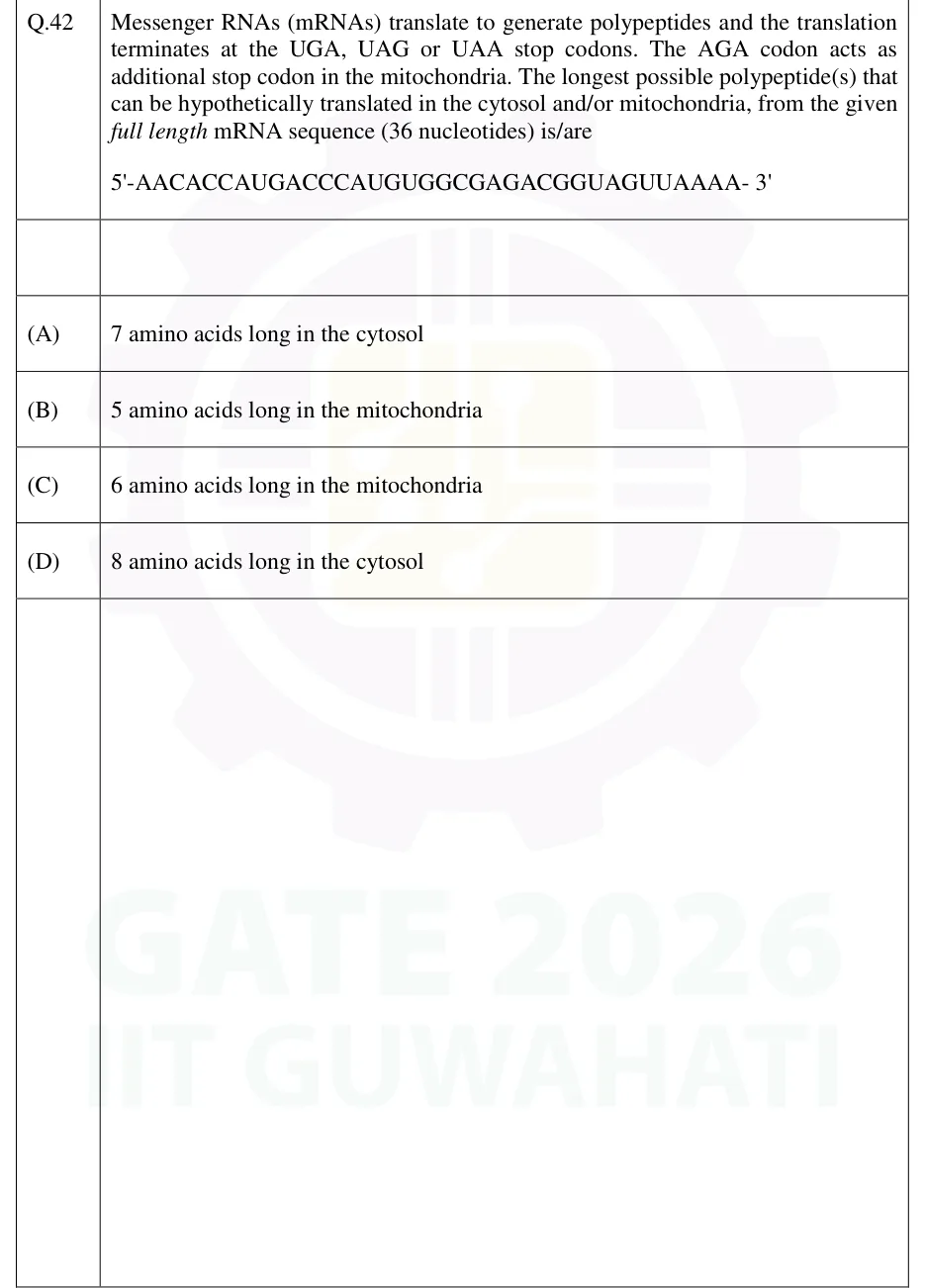
Messenger RNAs (mRNAs) translate to generate polypeptides and the translation terminates at the UGA, UAG or UAA stop codons. The AGA codon acts as additional stop codon in the mitochondria. The longest possible polypeptide(s) that can be hypothetically translated in the cytosol and/or mitochondria, from the given full length mRNA sequence (36 nucleotides) is/are

5'-AACACCAUGACCCAUGUGGCGAGACGGUAGUUAAAA-3'

  1. (A)

    7 amino acids long in the cytosol

  2. (B)

    5 amino acids long in the mitochondria

  3. (C)

    6 amino acids long in the mitochondria

  4. (D)

    8 amino acids long in the cytosol

See the question in the paper

Answer and solution

ANSWER

The longest polypeptide in the cytosol is 7 amino acids (option A) and the longest polypeptide in the mitochondria is 6 amino acids (option C); correct answer is A, C.

Official answer: A, CSource: Official answer key, GATE 2026 BT (IIT Guwahati)

  1. Index the 36-nt mRNA 1-36: positions 1-6 AACACC, 7-9 AUG, 10-12 ACC, 13-15 CAU, 16-18 GUG, 19-21 GCG, 22-24 AGA, 25-27 CGG, 28-30 UAG, 31-36 UUAAAA.

  2. Only two AUG start codons exist in the sequence: at 7-9 and at 14-16 (no other AUG triplet occurs anywhere else).

  3. ORF from AUG(7): AUG-ACC-CAU-GUG-GCG-AGA-CGG-UAG -> Met-Thr-His-Val-Ala-Arg(AGA)-Arg(CGG)-stop(UAG, a universal stop in both compartments).

  4. In the CYTOSOL, AGA is read as ordinary Arg (standard genetic code), so translation continues through it and stops only at the universal UAG codon: peptide = 7 amino acids (M,T,H,V,A,R,R) -> matches option A.

  5. In the MITOCHONDRIA, AGA is reassigned as an additional stop codon, so this same ORF halts right there, before AGA is incorporated: peptide = 5 amino acids (M,T,H,V,A) -> this is option B, a genuine but shorter mitochondrial product.

  6. ORF from AUG(14): re-reading the frame from position 14 gives AUG-UGG-CGA-GAC-GGU-AGU-UAA -> Met-Trp-Arg(CGA)-Asp-Gly-Ser-stop(UAA, universal). This frame contains no AGA codon at all (the shifted frame reads CGA, a distinct codon, at that position), so this 6-amino-acid product is the same, full-length product in both the cytosol and the mitochondria.

  7. Longest polypeptide per compartment: cytosol = max(7 aa from AUG-7, 6 aa from AUG-14) = 7 aa (option A). Mitochondria = max(5 aa from AUG-7, truncated by AGA; 6 aa from AUG-14) = 6 aa (option C).

  8. Option D (8 aa, cytosol) matches no valid ORF and is wrong. Option B is a real mitochondrial product but is not the longest one (6 aa beats it), so it is not selected. Correct options: A and C.

KEY IDEA

Mitochondrial translation reuses the universal genetic code except that AGA (and AGG) are reassigned from Arg codons to stop codons; so the same mRNA can yield different-length products in the two compartments depending on whether an in-frame AGA is read through (cytosol) or halts translation (mitochondria).

WATCH OUT FOR

Assuming there is only one reading frame (only the first AUG) to consider, and thus missing that a second, shorter-cytosolic-product ORF (from the internal AUG) becomes the LONGEST mitochondrial product once the first ORF is truncated by the AGA-as-stop rule; also assuming AGA truncation only removes the AGA and downstream residues without checking whether AGA itself even occurs in the alternate frame (it doesn't — that frame reads CGA instead).

From the GATE 2026 BT paper. Every question of this paper · Download the full paper · All 21 Gene expression questions, with notes

More Gene expression questions