GATE 2026 BT Q.20
Which one of the following antibiotics blocks protein chain elongation by preventing the action of peptidyl transferase ?
- (A)
Bleomycin
- (B)
Rifampicin
- (C)
Chloramphenicol
- (D)
Tetracycline

GATE BT
Replication, transcription, translation and regulation of gene expression
GATE Biotechnology study notes on DNA replication (prokaryotic and eukaryotic, telomeres), transcription, RNA processing, translation, prokaryotic operons (lac genetics, trp attenuation) and eukaryotic regulation including miRNA, siRNA, RNAi and other non-coding RNAs, with comparative tables, worked numerical examples and 7 original GATE-style practice questions.
21 previous-year questions · 20 solved · 7 practice questions
DNA replication is semi-conservative: each daughter duplex keeps one parental strand and one new strand. The classic density-shift experiment showed this: cells were grown in heavy nitrogen (15N) and then moved to 14N. After one generation all DNA was of hybrid density, and after two generations it was half hybrid and half light. New DNA is always made 5'→3', reading the template 3'→5'. The two template strands are antiparallel, so at each fork one new strand (the leading strand) is made continuously. The other (the lagging strand) is made discontinuously, as Okazaki fragments. Replication starts at defined origins: a single origin, oriC, in E. coli and most bacteria, and many origins on each eukaryotic chromosome. It is usually bidirectional, so two forks move away from each origin.
Proteins at a bacterial (E. coli) replication fork and what each does
DnaA binds the DnaA boxes in oriC and melts the neighbouring AT-rich region, opening a replication bubble.
DnaB helicase is loaded by DnaC. It encircles the lagging-strand template, moves 5'→3' along it and unwinds the duplex at each fork.
SSB (single-strand binding protein) coats the exposed single strands. This stops them re-annealing and forming secondary structure.
DNA gyrase (a type II topoisomerase) acts ahead of the fork and relieves the positive supercoils that unwinding creates. Topoisomerase IV separates (decatenates) the linked daughter circles at the end of replication.
Primase (DnaG) makes a short RNA primer of about 10–12 nt: once at the start of each leading strand, and once for every Okazaki fragment.
DNA polymerase III holoenzyme extends each primer. Its core has the α subunit (polymerase) and the ε subunit (3'→5' proofreading exonuclease). The β sliding clamp, loaded by the γ/τ clamp loader, makes it highly processive. The lagging-strand template loops out, so one holoenzyme can make both strands at a fork (the 'trombone' model).
DNA polymerase I removes each RNA primer with its 5'→3' exonuclease and fills the gap with DNA at the same time (nick translation).
DNA ligase seals the remaining nick with a phosphodiester bond, joining adjacent fragments. It uses NAD+ in E. coli and ATP in eukaryotes.
Termination: the two forks meet in a terminus region opposite oriC. There, Tus protein bound to ter sites stops fork movement in one direction only.
Replicative and associated DNA polymerases compared
Enzyme | Role | 3'→5' proofreading exonuclease | 5'→3' exonuclease |
|---|---|---|---|
DNA Pol III (bacteria) | Main replicative polymerase; extends primers on both strands | Yes | No |
DNA Pol I (bacteria) | Removes RNA primers and fills the gaps (nick translation); repair | Yes | Yes |
DNA Pol II (bacteria) | DNA repair and restart of stalled replication | Yes | No |
Pol α–primase (eukaryotes) | Starts every strand and every Okazaki fragment. Primase subunits make ~10 nt of RNA; Pol α adds a short stretch of DNA | No | No |
DNA Pol δ (eukaryotes) | Main lagging-strand polymerase; works with the PCNA clamp | Yes | No |
DNA Pol ε (eukaryotes) | Main leading-strand polymerase | Yes | No |
Eukaryotic replication: what differs from bacteria
Many origins per chromosome. In G1, each origin is 'licensed': the origin recognition complex (ORC), Cdc6 and Cdt1 load the MCM helicase. Each origin then fires only once per S phase.
The active helicase is the CMG complex (Cdc45–MCM–GINS).
PCNA is the sliding clamp, the counterpart of the bacterial β clamp. It is loaded by RFC (replication factor C).
Eukaryotic polymerases have no 5'→3' exonuclease. Instead, Pol δ displaces the primer into a flap, which FEN1 (flap endonuclease) cuts off, and RNase H2 can degrade RNA in RNA–DNA hybrids. DNA ligase I then seals the nick.
Okazaki fragments are about 100–200 nt long, compared with about 1000–2000 nt in bacteria.
OKAZAKI FRAGMENTS PER COMPLETE ROUND OF REPLICATION
= genome (or region) length in bp and = average Okazaki fragment length in nt. Every base pair is copied by exactly one fork, and each fork makes one strand continuously and the other discontinuously. So the total lagging-strand DNA equals nt, whatever the number of origins. Primer lengths and end effects at origins and termini are ignored.
WORKED EXAMPLE
A 60,000 bp region of a eukaryotic chromosome is replicated bidirectionally from a single origin at its centre. The average Okazaki fragment length is 200 nt. How many Okazaki fragments are made? Ignore primer lengths and end effects.
Each fork copies 30,000 bp. At each fork one strand is lagging, so each fork makes 30,000 nt of lagging-strand DNA.
Total lagging-strand DNA = 2 × 30,000 = 60,000 nt, which equals the region length , as the formula says.
Number of fragments = 60,000 / 200 = 300.
Answer: 300 Okazaki fragments
End-replication problem and telomerase. On a linear chromosome, the RNA primer at the very 5' end of each lagging strand is removed, and no polymerase can fill the gap it leaves, because polymerases only extend a 3'-OH. Each round of replication therefore leaves a 3' single-stranded overhang, and without compensation the chromosome ends shorten. Telomerase is a ribonucleoprotein reverse transcriptase. Its RNA component is the template, and its catalytic protein (TERT) uses it to add repeats to the 3' end of the G-rich strand (TTAGGG in vertebrates). The complementary strand is then filled in by Pol α–primase. Telomerase is active in germ cells, stem cells and most cancer cells, and low or absent in most somatic cells.
EXAM TIP
Primer handling differs between the two domains. In bacteria, Pol I removes primers with its 5'→3' exonuclease. In eukaryotes, the replicative polymerases lack that activity: primers are removed by strand displacement plus FEN1 and RNase H2.
Transcription makes RNA 5'→3' from ribonucleoside triphosphates, reading the template (antisense) strand 3'→5'. It needs no primer, unlike DNA polymerase. The RNA has the same sequence as the coding (sense) strand (with U in place of T), so gene sequences are written as the coding strand, 5'→3'. RNA polymerase proofreads only a little, by backtracking and cleaving the transcript, so its error rate is much higher than that of DNA replication. Bacteria have a single RNA polymerase: a core enzyme (α2ββ'ω) plus a σ factor that recognises promoters. Eukaryotes have three main nuclear RNA polymerases, each making a different class of RNA. Plants also have Pol IV and Pol V, which make small RNAs for silencing.
Eukaryotic nuclear RNA polymerases (α-amanitin sensitivity as in mammalian cells)
Polymerase | Product(s) | α-amanitin sensitivity |
|---|---|---|
RNA Pol I (nucleolus) | 45S pre-rRNA, processed into 28S, 18S and 5.8S rRNA | Insensitive |
RNA Pol II | pre-mRNA (hnRNA), U1/U2/U4/U5 snRNAs, most miRNA precursors, lncRNAs | Highly sensitive (inhibited at low concentrations) |
RNA Pol III | tRNA, 5S rRNA, U6 snRNA, 7SL RNA and other small RNAs | Inhibited only at high concentrations |
Stages of bacterial transcription
Initiation. The σ factor (σ70 for most genes) guides the core enzyme to the promoter by recognising the -35 element (consensus TTGACA) and the -10 element (consensus TATAAT). The polymerase melts about 12–14 bp around the start site (+1), forming an open complex.
Abortive initiation and promoter escape. The enzyme often makes and releases several short transcripts before it escapes the promoter. σ is usually released after about 10 nt, and the core enzyme then continues.
Elongation. The polymerase unwinds DNA ahead of it and rewinds it behind, extending the RNA 5'→3'. The RNA–DNA hybrid in the transcription bubble is about 8–9 bp long.
Rho-independent (intrinsic) termination. A GC-rich inverted repeat forms a stable hairpin in the RNA, followed by a run of U's. The weak rU:dA hybrid then lets the transcript and polymerase dissociate.
Rho-dependent termination. Rho, a hexameric ATP-dependent helicase, binds a C-rich rut site on the nascent RNA, moves 5'→3' along it and unwinds the RNA–DNA hybrid at a paused polymerase.
Many, but not all, eukaryotic Pol II core promoters carry a TATA box (consensus TATAAA) about 25–30 bp upstream of the start site. It is recognised by the TATA-binding protein (TBP) subunit of TFIID. TBP is also recruited to promoters that lack a TATA box. The general transcription factors (TFIIA, B, D, E, F and H) assemble with Pol II into the pre-initiation complex. TFIIH has helicase activity, which melts the promoter. It also has kinase activity: it phosphorylates Ser5 of the repeated heptad (YSPTSPS) in the C-terminal domain (CTD) of Pol II's largest subunit, which triggers promoter clearance. The phosphorylated CTD then recruits the capping, splicing and polyadenylation machinery.
EXAM TIP
Do not confuse the bacterial -10 element (TATAAT) with the eukaryotic TATA box (TATAAA). Both are AT-rich and both help position the start site, but different machinery reads them (σ factor vs TBP/TFIID) and they lie at different distances from +1.
In eukaryotes, the primary Pol II transcript (pre-mRNA) is processed in the nucleus before export:
Bacterial mRNA has no 5' cap and no stabilising eukaryote-type poly(A) tail; where bacteria do polyadenylate RNA, the tail promotes its decay. Bacterial genes also almost never contain spliceosomal introns. Bacteria have no nucleus, so their transcription and translation are coupled.
Splicing mechanism (two sequential transesterifications)
U1 snRNP base-pairs with the 5' splice site (GU). U2 snRNP base-pairs around the branch point, leaving the branch-point adenosine bulged out.
The U4/U6·U5 tri-snRNP joins. After rearrangements, U1 and U4 are released, and U2 and U6 snRNAs form the catalytic core. The spliceosome is therefore a ribozyme.
First transesterification. The 2'-OH of the branch-point adenosine attacks the phosphate at the 5' splice site. This forms a 2'–5' phosphodiester (the lariat intermediate) and releases the 5' exon with a free 3'-OH.
Second transesterification. The 3'-OH of the 5' exon attacks the phosphate at the 3' splice site (the AG at the end of the intron). This joins the two exons and releases the intron as a lariat, which is then debranched and degraded.
No phosphodiester bonds are gained or lost overall. The ATP used by splicing drives the spliceosome's assembly and rearrangements, not the chemical steps.
Processing events compared
Event | Location on transcript | Key factor(s) | Purpose |
|---|---|---|---|
5' capping | 5' end | RNA triphosphatase, guanylyltransferase and guanine-N7 methyltransferase | Protects against 5'→3' exonucleases; needed for export, splicing of the first intron and cap-dependent translation initiation |
3' cleavage and polyadenylation | 3' end: CPSF binds AAUAAA, CstF binds a downstream GU/U-rich element | CPSF, CstF, cleavage factors, poly(A) polymerase, poly(A)-binding protein | mRNA stability, nuclear export, translation efficiency |
Splicing | Exon–intron junctions (GU…AG) and branch point | Major spliceosome (U1, U2, U4, U5, U6 snRNPs) | Removes introns; alternative splicing yields several mRNAs from one gene |
EXAM TIP
GU–AG is the dominant splice-site rule for nuclear pre-mRNA introns (GT–AG in the DNA), but not the only mechanism. A minor spliceosome (U11, U12, U4atac, U6atac and U5) removes rare U12-type introns, some of which have AU–AC ends. Group I and group II introns splice themselves without any spliceosome.
The genetic code maps 64 triplet codons to 20 amino acids plus stop signals. Its properties:
CODON COMBINATORICS
4 bases in 3 positions give 64 codons: 61 sense codons (including AUG) and 3 stop codons (UAA, UAG, UGA).
ORF LENGTH FROM POLYPEPTIDE LENGTH
= nucleotides from the first base of the start codon to the last base of the stop codon, inclusive. = number of amino acids in the primary translation product, including the initiator Met. The +1 is the stop codon, which is not translated. If the initiator Met is removed after translation, add it back: a mature chain of residues gives . Any signal peptide or propeptide that is cleaved off must be added back in the same way.
WORKED EXAMPLE
An mRNA has an ORF of 1,203 nt, counted from the A of AUG to the last base of the stop codon. How many amino acids are in the primary translation product, and how many remain if only the initiator Met is removed?
Number of codons = 1,203 / 3 = 401.
One of these is the stop codon, which encodes no amino acid, so = 401 − 1 = 400.
Check with the formula: 3(400 + 1) = 1,203.
If only the initiator Met is removed, the mature protein has 399 residues.
Answer: 400 amino acids as synthesised; 399 after removal of the initiator Met
Charging tRNAs and the energy cost
Each of the 20 aminoacyl-tRNA synthetases attaches one amino acid to its tRNAs in two steps. First, amino acid + ATP → aminoacyl-AMP + PPi. Second, the aminoacyl group is transferred to the 3'-terminal A of the tRNA. Many synthetases proofread (edit) wrongly activated amino acids.
Charging uses ATP → AMP, which costs 2 high-energy phosphate bonds. Elongation uses 1 GTP to deliver the aminoacyl-tRNA (EF-Tu) and 1 GTP to translocate (EF-G). So each peptide bond costs 4 high-energy phosphate bonds, not counting initiation, termination or proofreading.
Stages of translation
Initiation (bacteria). The 30S subunit, with IF1, IF2·GTP and IF3, binds the mRNA. The Shine–Dalgarno sequence, a purine-rich element a few nucleotides upstream of the start codon, base-pairs with the 3' end of 16S rRNA. IF2 places fMet-tRNA(fMet) on the AUG in the P site. The 50S subunit then joins to form the 70S initiation complex.
Initiation (eukaryotes). eIF4F binds the 5' cap and recruits the 43S complex: the 40S subunit with eIF1, eIF1A, eIF3 and eIF2·GTP·Met-tRNAi. The complex scans 5'→3' to the first AUG in a good Kozak context (a purine at −3 and G at +4). The 60S subunit then joins to form the 80S ribosome.
Elongation. EF-Tu·GTP (bacteria) or eEF1A·GTP (eukaryotes) delivers each aminoacyl-tRNA to the A site. The peptidyl transferase centre, formed by rRNA (23S in bacteria, 28S in eukaryotes), catalyses peptide-bond formation, so the ribosome is a ribozyme. EF-G·GTP (bacteria) or eEF2·GTP (eukaryotes) then translocates the ribosome by one codon. The chain grows from its N terminus to its C terminus.
Termination. A release factor enters the A site at a stop codon: in bacteria, RF1 (UAA, UAG) or RF2 (UAA, UGA); in eukaryotes, eRF1 (all three). It triggers hydrolysis of the peptidyl-tRNA bond, which releases the polypeptide. RF3 (bacteria) and eRF3 (eukaryotes) are GTPases that assist, and the ribosome is then recycled.
Common inhibitors of transcription and translation
Inhibitor | Target | Effect |
|---|---|---|
Rifampicin | β subunit of bacterial RNA polymerase | Blocks transcription initiation (extension of the first few nucleotides) |
Actinomycin D | DNA (intercalates at GC pairs) | Blocks transcription elongation in both bacteria and eukaryotes |
α-amanitin | Eukaryotic RNA Pol II (Pol III at high concentrations, mammals) | Blocks elongation |
Streptomycin | Bacterial 30S subunit | Interferes with initiation; causes misreading |
Tetracycline | Bacterial 30S subunit (A site) | Blocks binding of aminoacyl-tRNA |
Chloramphenicol | Bacterial 50S subunit | Inhibits peptidyl transferase |
Erythromycin | Bacterial 50S subunit (exit tunnel) | Blocks elongation of the growing chain |
Puromycin | A site of both 70S and 80S ribosomes (aminoacyl-tRNA analogue) | Accepted as an amino acid, then releases the chain early |
Cycloheximide | Eukaryotic 60S subunit | Blocks translocation (80S ribosomes only) |
Diphtheria toxin | eEF2 | ADP-ribosylates eEF2 and stops translocation |
EXAM TIP
Wobble. The first (5') base of the anticodon pairs with the third (3') base of the codon, and this pairing is less strict than Watson–Crick pairing. Anticodon G pairs with C or U; anticodon U pairs with A or G; anticodon I (inosine) pairs with U, C or A. So one tRNA can read several codons for the same amino acid, which is why degeneracy is concentrated at the third position.
In bacteria, genes for related functions are often transcribed together, from one promoter, as a single polycistronic mRNA. This unit is an operon. Regulation acts mainly on transcription initiation: repressors and activators bind sites at or near the promoter. In some biosynthetic operons there is also attenuation, which works only because transcription and translation are coupled in bacteria.
lac operon genes and classic mutants (gene symbols written plainly)
Structural genes: lacZ (β-galactosidase), lacY (lactose permease), lacA (thiogalactoside transacetylase). They are transcribed together from the lac promoter; the operator overlaps the promoter.
lacI encodes the repressor. It has its own promoter and is expressed constitutively.
The natural inducer is allolactose, a lactose isomer made by β-galactosidase. IPTG is a gratuitous inducer: it induces the operon but is not metabolised.
lacI⁻ (no functional repressor): expression is constitutive. It is recessive, because a lacI⁺ copy anywhere in the cell supplies repressor in trans and restores inducibility.
lacOᶜ (operator-constitutive, cannot bind repressor): the genes on the same DNA molecule are expressed constitutively. It is cis-dominant: it has no effect on a second copy of the operon.
lacIˢ (super-repressor, cannot bind inducer): the operon cannot be induced. It is trans-dominant over lacI⁺.
lac operon vs trp operon
Feature | lac operon | trp operon |
|---|---|---|
Type of control | Inducible (catabolic genes, switched on when the substrate is present) | Repressible (biosynthetic genes, switched off when the product is abundant) |
Repressor without effector | Active; binds the operator and blocks transcription | Inactive (aporepressor); cannot bind the operator |
Effector and its action | Allolactose (inducer) binds the repressor and inactivates it | Tryptophan (corepressor) binds the aporepressor and activates it to bind the operator |
Positive control | The CAP–cAMP complex binds upstream of the promoter and activates transcription when glucose is low | Not a major feature |
Additional fine control | No attenuation; glucose also acts through inducer exclusion (glucose uptake inhibits lactose permease) | Attenuation: early termination in the leader region, set by how fast the ribosome moves over the leader's Trp codons |
trp operon attenuation, step by step
The leader (trpL) encodes a 14-amino-acid leader peptide with two adjacent Trp codons in region 1. The leader RNA has four regions that can pair in alternative ways: 1:2, 2:3 or 3:4. The 3:4 hairpin, followed by a run of U's, is a rho-independent terminator. The 2:3 hairpin is the antiterminator.
Trp plentiful (charged tRNA-Trp available): the ribosome translates through region 1 and stops at the leader's stop codon, where it covers region 2. Region 3 then pairs with region 4, the terminator forms, and transcription stops before the structural genes.
Trp scarce (charged tRNA-Trp limiting): the ribosome stalls at the Trp codons and so covers region 1. Region 2 is free and pairs with region 3 (the antiterminator), so the 3:4 terminator cannot form and RNA polymerase continues into the structural genes.
No translation of the leader: regions 1:2 and 3:4 pair, the terminator forms, and transcription stops.
Repression by the Trp–repressor complex and attenuation act together, giving a wide range of control.
EXAM TIP
The lac operon is expressed strongly only when both of two conditions hold: the repressor is inactivated (inducer present) and CAP–cAMP is bound (glucose low). These two controls act independently. Together with inducer exclusion, they explain why E. coli uses glucose before lactose (diauxic growth).
Eukaryotic gene expression is controlled at many levels beyond the bacterial operon.
Levels at which eukaryotic expression is controlled
Chromatin: histone modifications, DNA methylation and nucleosome remodelling.
Transcription initiation: activators, repressors, enhancers, silencers and Mediator.
RNA processing: alternative splicing and alternative polyadenylation.
Export and mRNA stability: for example, nonsense-mediated decay of mRNAs that carry a premature stop codon.
Translation: for example, phosphorylation of eIF2α reduces translation initiation overall; small RNAs repress translation of specific mRNAs.
After translation: protein modification, targeting and degradation.
RNA interference (RNAi) pathway
Long double-stranded RNA, from a virus, a transposon or an experimental source, is cut by the endonuclease Dicer into siRNA duplexes. Each strand is about 21–23 nt long, with about 19 bp paired, 2-nt 3' overhangs and 5' phosphates.
One strand, the guide strand, is loaded into the RNA-induced silencing complex (RISC), whose core is an Argonaute protein. The other strand, the passenger strand, is cleaved and discarded.
The guide strand pairs with a complementary mRNA. With extensive complementarity, including the central region, the Argonaute 'slicer' cuts the mRNA, and the pieces are degraded.
RNAi knocks down expression: it reduces the mRNA while the gene itself stays intact, unlike a knockout. In mammalian cells, long dsRNA triggers an interferon response, so experiments use synthetic ~21-nt siRNAs or short hairpin RNAs (shRNAs) expressed from vectors.
siRNA vs miRNA
Feature | siRNA | miRNA |
|---|---|---|
Origin | Long exogenous or endogenous dsRNA, fully paired | Genome-encoded hairpin transcript (pri-miRNA), usually made by Pol II |
Processing | Dicer cuts long dsRNA directly into siRNA duplexes | In the nucleus, Drosha–DGCR8 (the Microprocessor) crops the pri-miRNA to a ~60–70 nt pre-miRNA hairpin. Exportin-5 (with Ran-GTP) exports it, and Dicer in the cytoplasm cuts it to a ~22-nt duplex |
Target complementarity | Usually full complementarity to a specific target | In animals, usually partial: the seed region (nt 2–8 of the miRNA) pairs with sites often in the 3' UTR, so one miRNA can regulate many mRNAs. Plant miRNAs usually pair almost fully |
Typical outcome | mRNA cleavage by Argonaute | In animals, translational repression and mRNA decay (deadenylation); in plants, mostly cleavage |
Major classes of non-coding RNA
rRNA and tRNA: the core of the translation machinery.
snRNA: splicing (the RNA components of the spliceosome).
snoRNA: guide chemical modification of rRNA (2'-O-methylation and pseudouridylation).
miRNA (~22 nt) and siRNA (~21–23 nt): post-transcriptional silencing through Argonaute.
piRNA (~24–31 nt): made without Dicer and bound by Piwi-clade Argonautes. They silence transposons in the germline.
lncRNA (longer than 200 nt, not translated into protein): regulate chromatin and transcription. For example, Xist RNA coats one X chromosome in female mammalian cells and silences it.
EXAM TIP
Keep the regulatory non-coding RNAs (miRNA, siRNA, piRNA, lncRNA) separate in your recall from the 'housekeeping' ones (rRNA, tRNA, snRNA, snoRNA). The key contrasts between siRNA and miRNA are where they come from (long dsRNA vs a genome-encoded hairpin), how fully they pair with their target, and whether the result is cleavage or repression.
PREVIOUS-YEAR QUESTIONS
Try each question first, then open the answer. One shows the official answer only. We placed each question under a topic ourselves; the exam paper does not label topics.
See these papers in full: GATE BT 2026 · GATE BT 2025 · GATE BT 2024 · GATE BT 2023 · GATE BT 2022 · GATE BT 2020 · GATE BT 2019
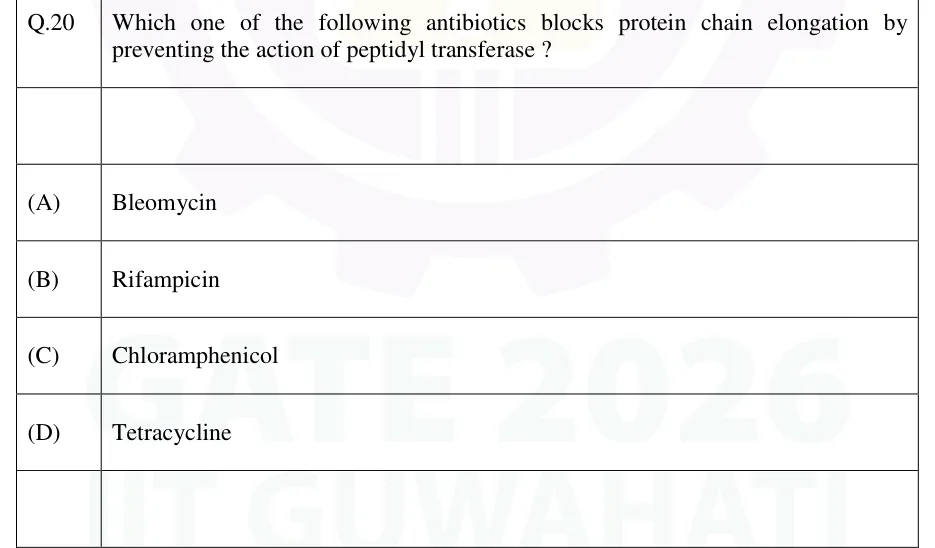
Which one of the following antibiotics blocks protein chain elongation by preventing the action of peptidyl transferase ?
Bleomycin
Rifampicin
Chloramphenicol
Tetracycline
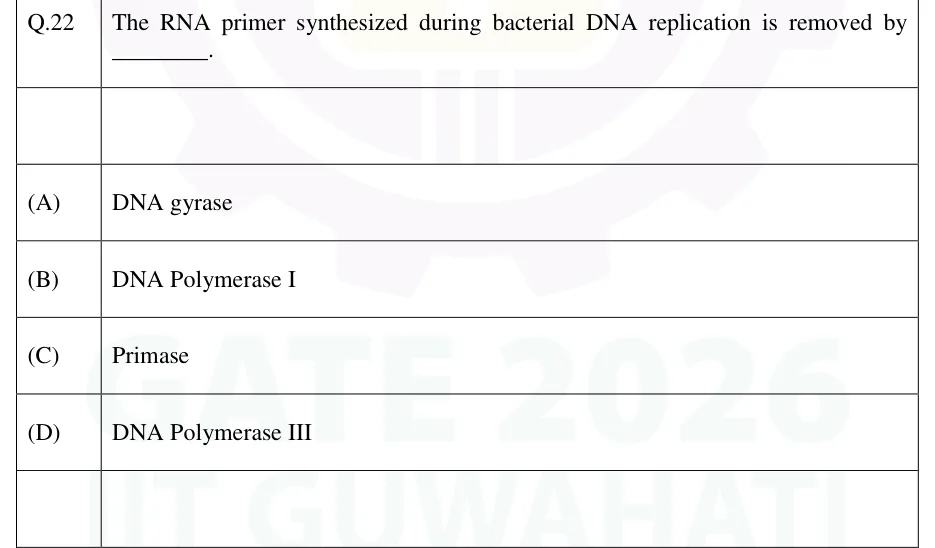
The RNA primer synthesized during bacterial DNA replication is removed by ________.
DNA gyrase
DNA Polymerase I
Primase
DNA Polymerase III
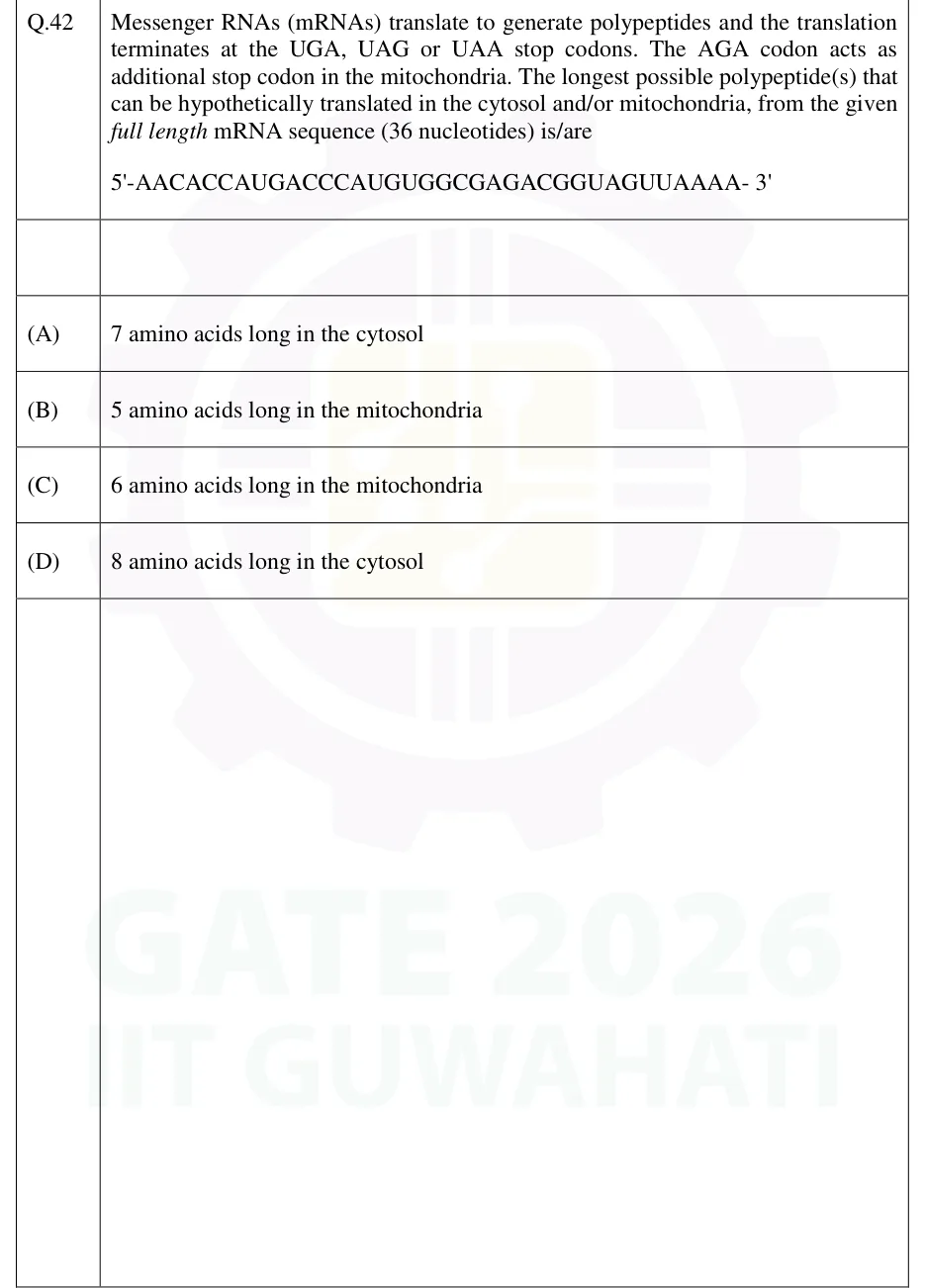
Messenger RNAs (mRNAs) translate to generate polypeptides and the translation terminates at the UGA, UAG or UAA stop codons. The AGA codon acts as additional stop codon in the mitochondria. The longest possible polypeptide(s) that can be hypothetically translated in the cytosol and/or mitochondria, from the given full length mRNA sequence (36 nucleotides) is/are
5'-AACACCAUGACCCAUGUGGCGAGACGGUAGUUAAAA-3'
7 amino acids long in the cytosol
5 amino acids long in the mitochondria
6 amino acids long in the mitochondria
8 amino acids long in the cytosol
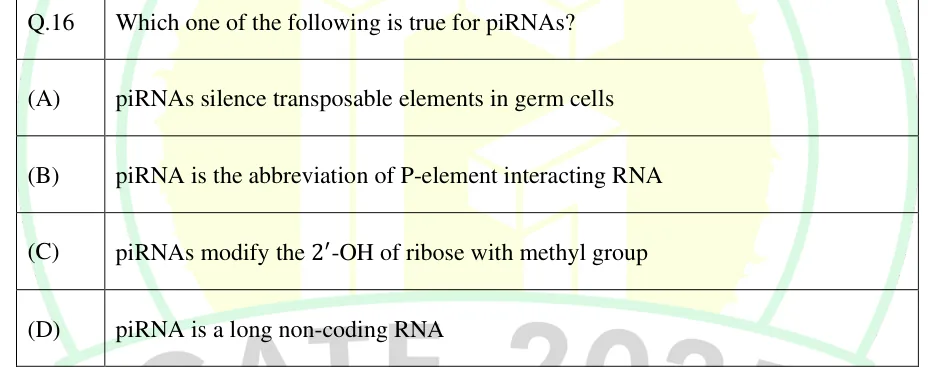
Which one of the following is true for piRNAs?
piRNAs silence transposable elements in germ cells
piRNA is the abbreviation of P-element interacting RNA
piRNAs modify the 2'-OH of ribose with methyl group
piRNA is a long non-coding RNA
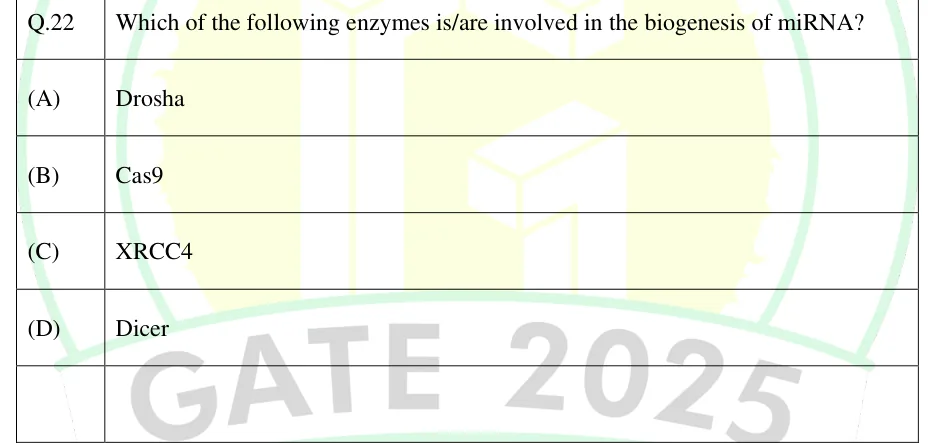
Which of the following enzymes is/are involved in the biogenesis of miRNA?
Drosha
Cas9
XRCC4
Dicer
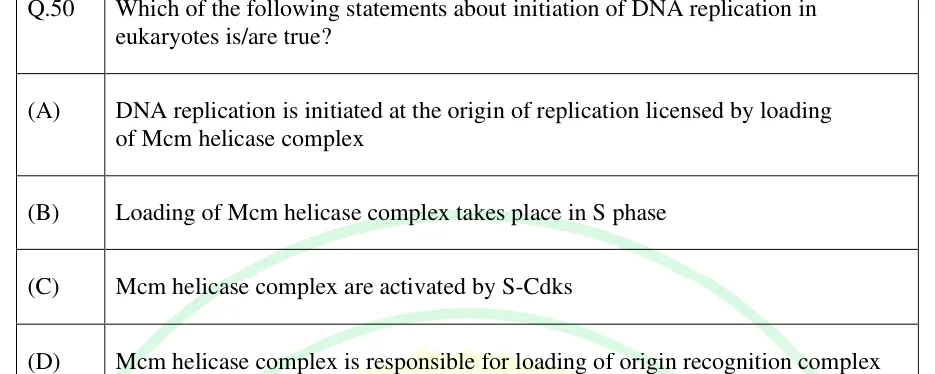
Which of the following statements about initiation of DNA replication in eukaryotes is/are true?
DNA replication is initiated at the origin of replication licensed by loading of Mcm helicase complex
Loading of Mcm helicase complex takes place in S phase
Mcm helicase complex are activated by S-Cdks
Mcm helicase complex is responsible for loading of origin recognition complex
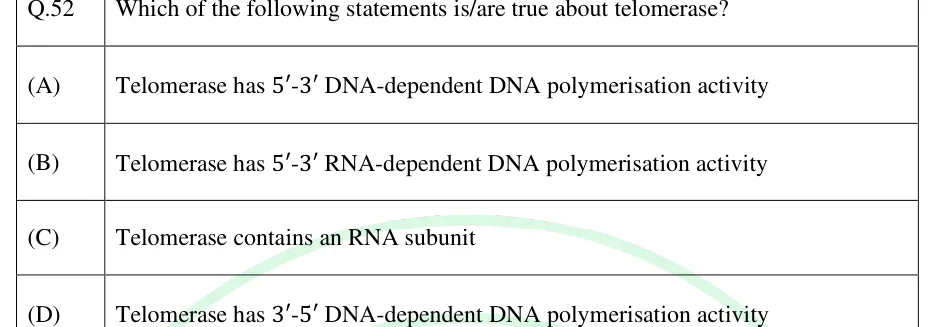
Which of the following statements is/are true about telomerase?
Telomerase has 5'-3' DNA-dependent DNA polymerisation activity
Telomerase has 5'-3' RNA-dependent DNA polymerisation activity
Telomerase contains an RNA subunit
Telomerase has 3'-5' DNA-dependent DNA polymerisation activity
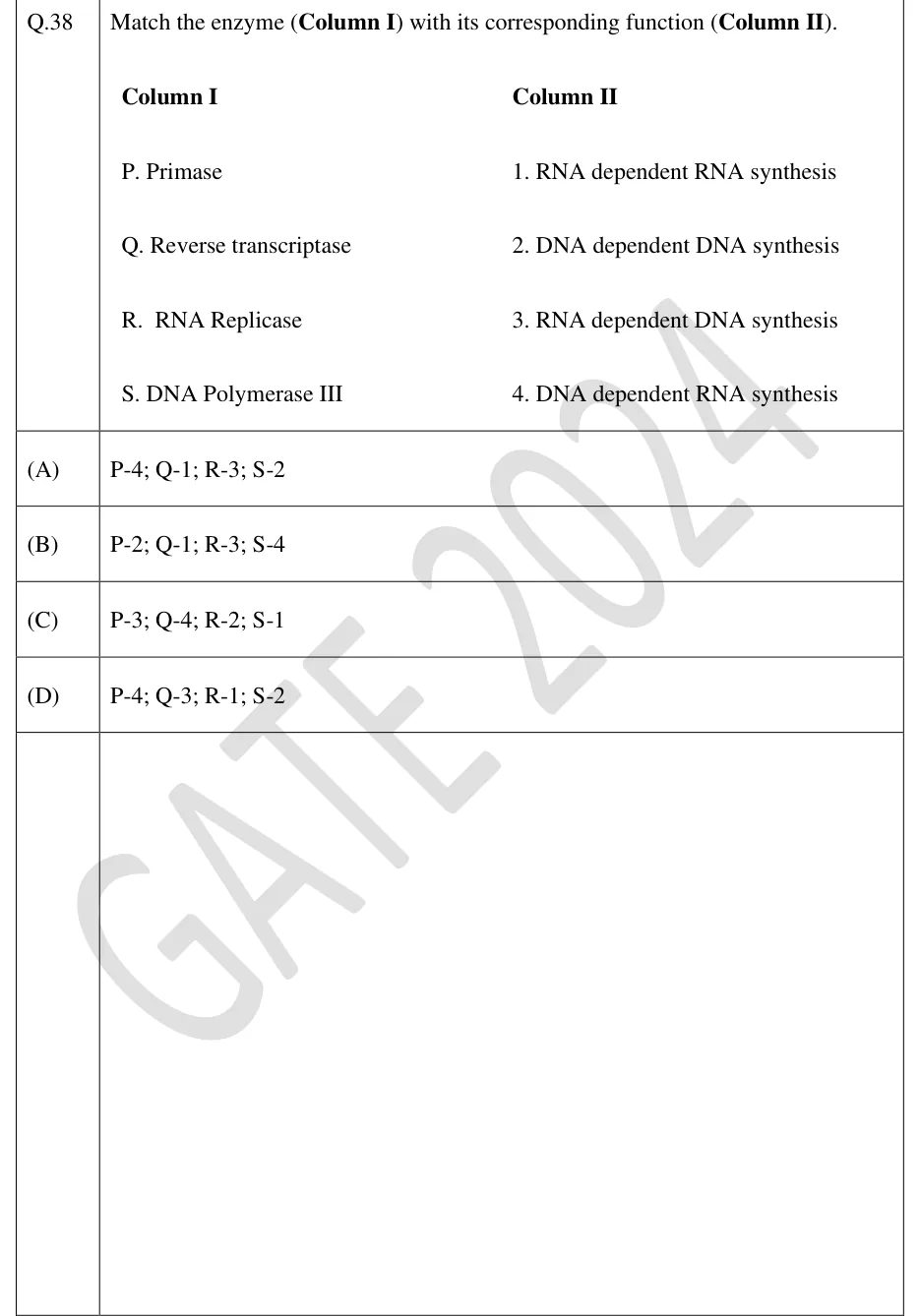
Match the enzyme (Column I) with its corresponding function (Column II).
Column I:
P. Primase
Q. Reverse transcriptase
R. RNA Replicase
S. DNA Polymerase III
Column II:
1. RNA dependent RNA synthesis
2. DNA dependent DNA synthesis
3. RNA dependent DNA synthesis
4. DNA dependent RNA synthesis
P-4; Q-1; R-3; S-2
P-2; Q-1; R-3; S-4
P-3; Q-4; R-2; S-1
P-4; Q-3; R-1; S-2
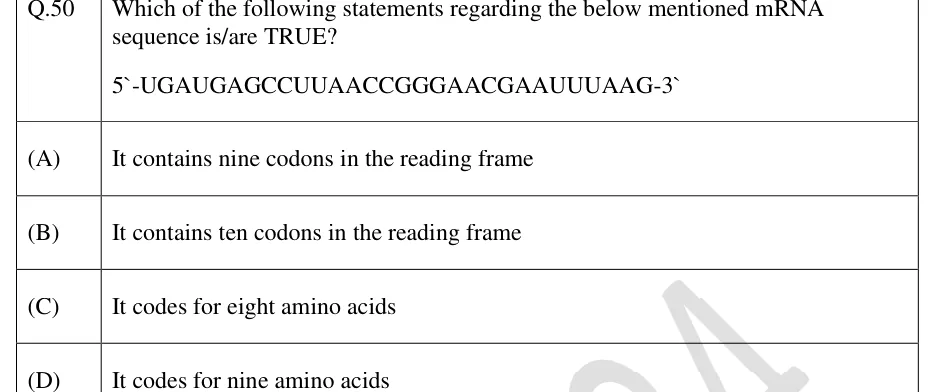
Which of the following statements regarding the below mentioned mRNA sequence is/are TRUE?
5-UGAUGAGCCUUAACCGGGAACGAAUUUAAG-3
It contains nine codons in the reading frame
It contains ten codons in the reading frame
It codes for eight amino acids
It codes for nine amino acids
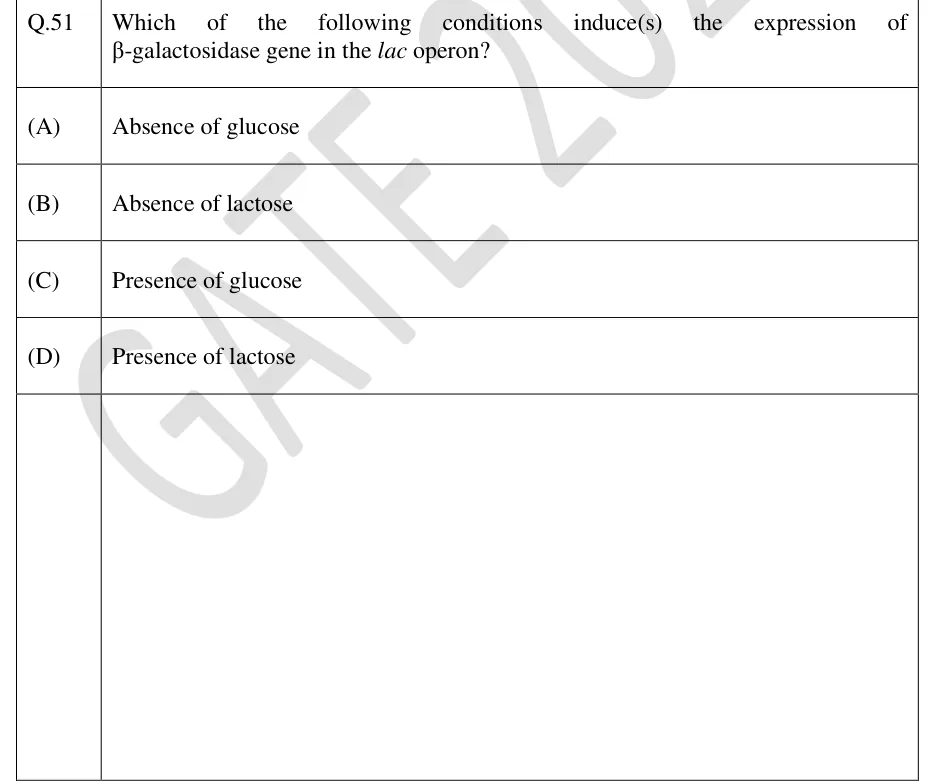
Which of the following conditions induce(s) the expression of β-galactosidase gene in the lac operon?
Absence of glucose
Absence of lactose
Presence of glucose
Presence of lactose
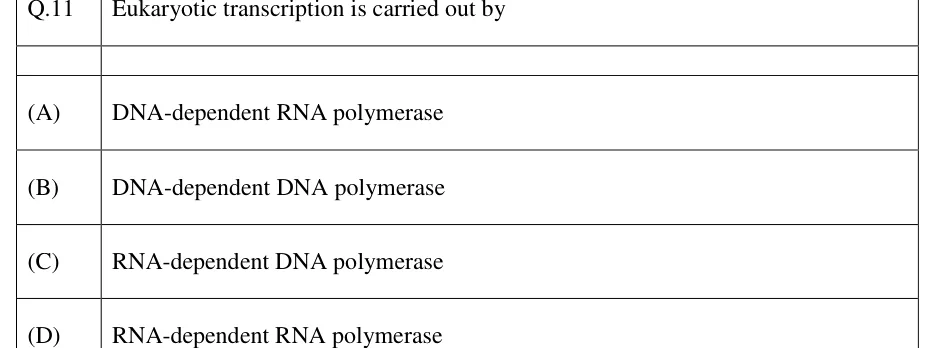
Eukaryotic transcription is carried out by
DNA-dependent RNA polymerase
DNA-dependent DNA polymerase
RNA-dependent DNA polymerase
RNA-dependent RNA polymerase
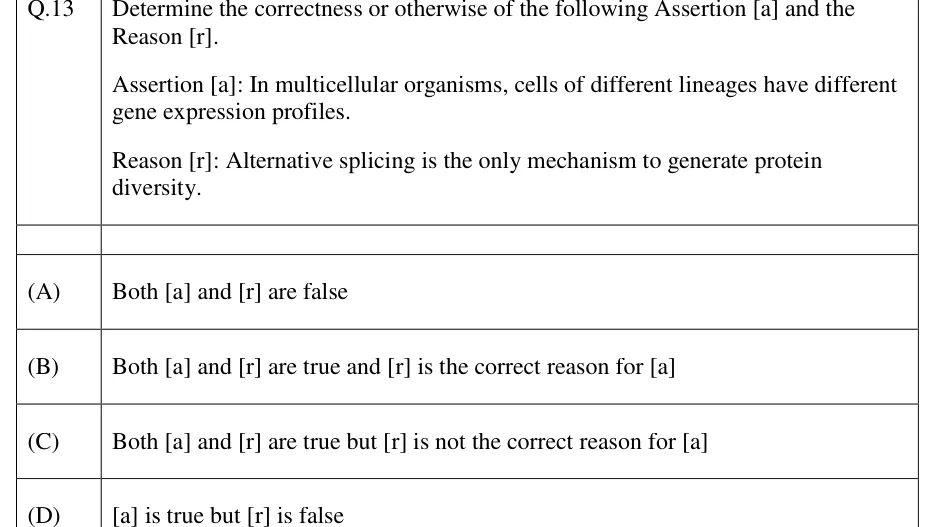
Determine the correctness or otherwise of the following Assertion [a] and the Reason [r].
Assertion [a]: In multicellular organisms, cells of different lineages have different gene expression profiles.
Reason [r]: Alternative splicing is the only mechanism to generate protein diversity.
Both [a] and [r] are false
Both [a] and [r] are true and [r] is the correct reason for [a]
Both [a] and [r] are true but [r] is not the correct reason for [a]
[a] is true but [r] is false
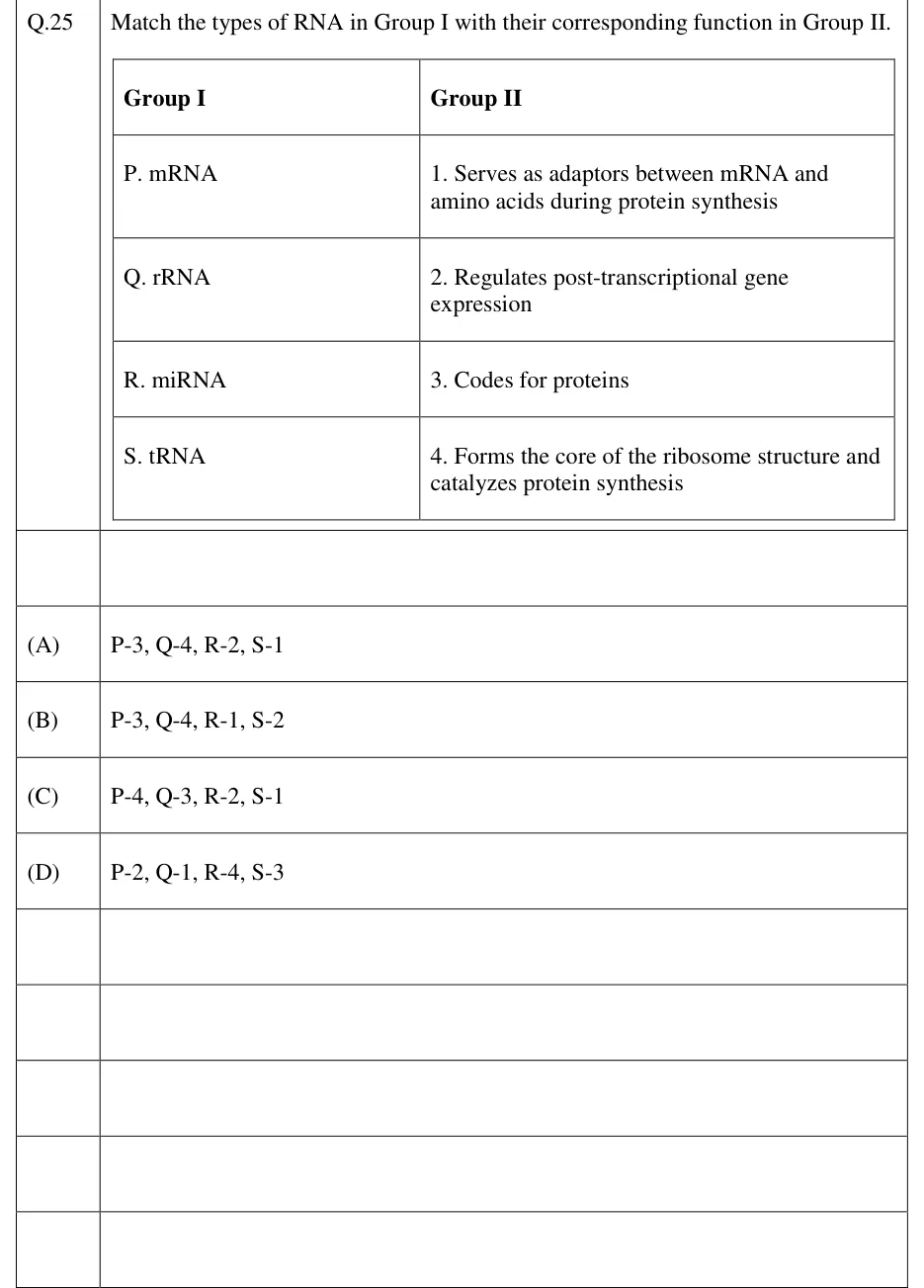
Match the types of RNA in Group I with their corresponding function in Group II.
Group I:
P. mRNA
Q. rRNA
R. miRNA
S. tRNA
Group II:
1. Serves as adaptors between mRNA and amino acids during protein synthesis
2. Regulates post-transcriptional gene expression
3. Codes for proteins
4. Forms the core of the ribosome structure and catalyzes protein synthesis
 Tap to open full size
A two-column matching table. Left column header 'Group I' lists four labeled RNA types: P. mRNA, Q. rRNA, R. miRNA, S. tRNA (each in its own row). Right column header 'Group II' lists four numbered functional descriptions in corresponding rows: 1. Serves as adaptors between mRNA and amino acids during protein synthesis; 2. Regulates post-transcriptional gene expression; 3. Codes for proteins; 4. Forms the core of the ribosome structure and catalyzes protein synthesis. The rows in Group I and Group II are not pre-aligned to each other — the candidate must determine the correct pairing.
P-3, Q-4, R-2, S-1
P-3, Q-4, R-1, S-2
P-4, Q-3, R-2, S-1
P-2, Q-1, R-4, S-3
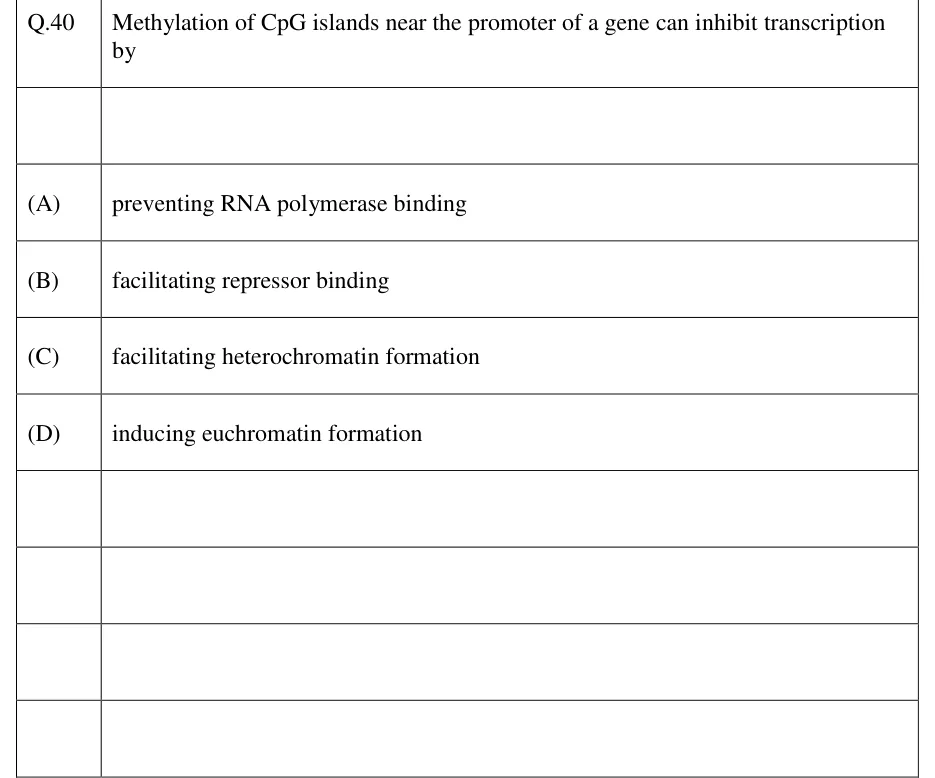
Methylation of CpG islands near the promoter of a gene can inhibit transcription by
preventing RNA polymerase binding
facilitating repressor binding
facilitating heterochromatin formation
inducing euchromatin formation
Official answer: A, B, CSource: Official answer key, GATE 2023 BT (IIT Kanpur)
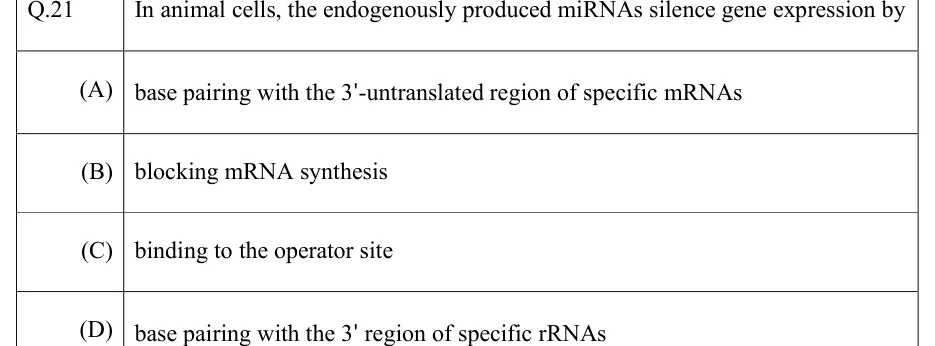
In animal cells, the endogenously produced miRNAs silence gene expression by
base pairing with the 3'-untranslated region of specific mRNAs
blocking mRNA synthesis
binding to the operator site
base pairing with the 3' region of specific rRNAs
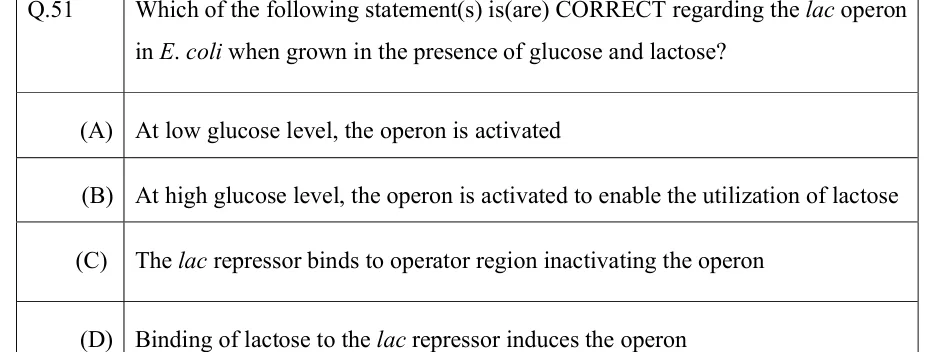
Which of the following statement(s) is(are) CORRECT regarding the lac operon in E. coli when grown in the presence of glucose and lactose?
At low glucose level, the operon is activated
At high glucose level, the operon is activated to enable the utilization of lactose
The lac repressor binds to operator region inactivating the operon
Binding of lactose to the lac repressor induces the operon
E. coli was grown in ¹⁵N medium for several generations. Cells were then transferred to ¹⁴N medium, allowed to grow for 4 generations and DNA was isolated immediately. The proportion of total DNA with intermediate density is ____ (round off to 2 decimal places).
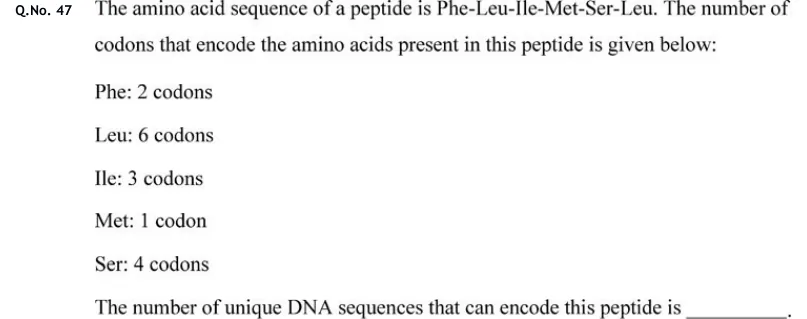
The amino acid sequence of a peptide is Phe-Leu-Ile-Met-Ser-Leu. The number of codons that encode the amino acids present in this peptide is given below:
Phe: 2 codons
Leu: 6 codons
Ile: 3 codons
Met: 1 codon
Ser: 4 codons
The number of unique DNA sequences that can encode this peptide is ____.
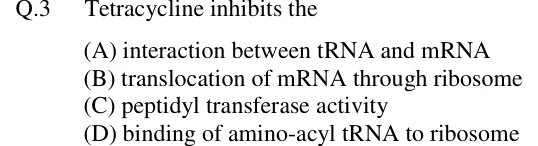
Tetracycline inhibits the
interaction between tRNA and mRNA
translocation of mRNA through ribosome
peptidyl transferase activity
binding of amino-acyl tRNA to ribosome
Which one of the following covalent linkages exists between 7-Methyl guanosine (m^7G) and mRNAs?
2'–3' triphosphate
3'–5' triphosphate
5'–5' triphosphate
2'–5' triphosphate
The molecular mass of a protein is 22 kDa. The size of the cDNA (excluding the untranslated regions) that codes for this protein is _______ kb (rounded off to 1 decimal place).
PRACTICE
In E. coli, which enzyme mainly removes the RNA primers laid down by primase and fills the resulting gaps with DNA during lagging-strand synthesis?
DNA polymerase I (5'→3' exonuclease + polymerase activity)
DNA polymerase III (core replicase)
DNA ligase
DnaB helicase
Answer: (A)
DNA polymerase III extends each RNA primer to make an Okazaki fragment, but it has no 5'→3' exonuclease, so it cannot remove primers.
DNA polymerase I removes the RNA primer ahead of it with its 5'→3' exonuclease and fills the gap with DNA at the same time (nick translation).
DNA ligase then seals the remaining nick. It does not remove primers.
DnaB is the replicative helicase and unwinds the duplex.
So the answer is DNA polymerase I.
A cytoplasmic protein has 150 amino acids in its mature form. Its only post-translational processing is removal of the initiator methionine. How many nucleotides long is the open reading frame (ORF) of its mRNA, counting from the first base of the start codon to the last base of the stop codon?
Answer:
The polypeptide as made on the ribosome has 150 + 1 = 151 amino acids, because the initiator Met is removed only after translation.
151 amino acids need 151 codons = 151 × 3 = 453 nucleotides.
Add one stop codon (3 nucleotides), which is not translated.
ORF length = 453 + 3 = 456 nucleotides. Check with the formula: 3(151 + 1) = 456.
An E. coli partial diploid has the genotype F′ lacI⁺ lacOᶜ lacZ⁻ / lacI⁻ lacO⁺ lacZ⁺. (lacOᶜ is an operator that cannot bind repressor; lacZ⁻ makes no functional β-galactosidase.) How is β-galactosidase activity expressed in this strain?
Constitutively (with or without inducer)
Inducibly (only when inducer is present)
Never, with or without inducer
Only when inducer is absent
Answer: (B)
Functional β-galactosidase can come only from the lacZ⁺ gene, which sits on the chromosome next to a wild-type operator (lacO⁺).
The lacI⁺ gene on the F′ makes a diffusible repressor, which acts in trans and binds the wild-type operator on the chromosome. The lacI⁻ mutation is recessive.
So the chromosomal lacZ⁺ gene is repressed without inducer and expressed when inducer is present.
The operator-constitutive mutation (lacOᶜ) acts only in cis, on the F′ copy, and that copy carries lacZ⁻, so its constitutive transcript makes no functional enzyme.
Answer: B, inducible.
A circular bacterial chromosome of 4,000,000 bp is replicated bidirectionally from a single origin, and the two forks together copy the genome exactly once. Every Okazaki fragment is exactly 1000 nucleotides long (primer included); ignore end effects at the origin and terminus. How many Okazaki fragments are made in one round of replication?
Answer:
Each fork makes one leading strand and one lagging strand, and every base pair of the genome is copied by exactly one fork.
So for every base pair, exactly one of the two new strands is made discontinuously. Total lagging-strand DNA = 4,000,000 nt, which is half of the 8,000,000 nt of new DNA.
Number of Okazaki fragments = 4,000,000 / 1000 = 4000.
In mammalian cells, which RNA polymerase makes the 45S pre-rRNA precursor, which is processed into 28S, 18S and 5.8S rRNAs?
RNA polymerase I
RNA polymerase II
RNA polymerase III
Mitochondrial RNA polymerase
Answer: (A)
RNA polymerase I works in the nucleolus and transcribes the 45S pre-rRNA genes.
RNA polymerase II makes pre-mRNA and the U1, U2, U4 and U5 snRNAs; it is inhibited by low concentrations of α-amanitin.
RNA polymerase III makes tRNA, 5S rRNA, U6 snRNA and 7SL RNA.
So the 45S precursor is made by RNA polymerase I.
Which of the following statements about intron splicing are TRUE?
Most nuclear pre-mRNA introns begin with GU at the 5' splice site and end with AG at the 3' splice site
The major spliceosome contains five snRNPs (U1, U2, U4, U5 and U6) together with many proteins
The 2'-OH of a branch-point adenosine within the intron attacks the 5' splice site, forming a lariat intermediate
Every intron in every organism needs a spliceosome; no intron splices itself
Answer: (A), (B), (C)
A is true: the GU–AG rule defines the canonical splice sites of nuclear pre-mRNA introns.
B is true: U1 recognises the 5' splice site and U2 the branch point, and the U4/U6·U5 tri-snRNP completes the spliceosome.
C is true: in the first transesterification, the 2'-OH of the branch-point adenosine attacks the 5' splice site. This forms a 2'–5' linkage (the lariat) and frees the 5' exon.
D is false: group I and group II introns splice themselves without a spliceosome.
Correct options: A, B, C.
In the trp operon leader of E. coli, charged tRNA-Trp is scarce and the ribosome stalls at the two Trp codons of the leader peptide. Which pairing forms in the leader RNA, and what happens to transcription of the structural genes?
Regions 1:2 and 3:4 pair; transcription terminates in the leader
Regions 2:3 pair (antiterminator); transcription continues into the structural genes
Regions 3:4 pair; transcription terminates in the leader
Regions 1:4 pair; transcription continues into the structural genes
Answer: (B)
The two Trp codons lie in region 1, so a ribosome stalled there covers region 1.
Region 2 is then free and pairs with region 3, forming the antiterminator hairpin.
Region 3 is now taken up, so the 3:4 terminator hairpin cannot form, and RNA polymerase continues into trpE and the other structural genes.
Option A describes the case with no translation of the leader. Option C describes Trp being plentiful (ribosome covering region 2). A 1:4 pairing is not part of the model.
Answer: B.
OFFICIAL GATE 2027 SYLLABUS WORDING
Copied from the GATE 2027 syllabus; see all 2027 syllabi.
GATE BT
Regulation of gene expression; Nucleic acid - replication, transcription, splicing, translation and their regulatory mechanisms; Non-coding and micro RNA; RNA interference
Preparing in Kolkata? IAE Academy's course for GATE BT.